

How Does a Standard ISO Terminal High Current Automotive Relay Differ from a Mini ISO Relay
2026-08-11
When designing or repairing vehicle electrical systems, selecting the right switching component is critical. The Standard ISO Terminal High Current Automotive Relay and the Mini ISO relay are two of the most common form factors, yet they serve distinctly different applications. At Huaguan, we frequently encounter engineers and technicians who confuse these two types, leading to performance issues or premature failures. Understanding their mechanical, electrical, and thermal differences is not just a matter of size—it directly impacts current capacity, coil power consumption, and long-term reliability in harsh automotive environments.
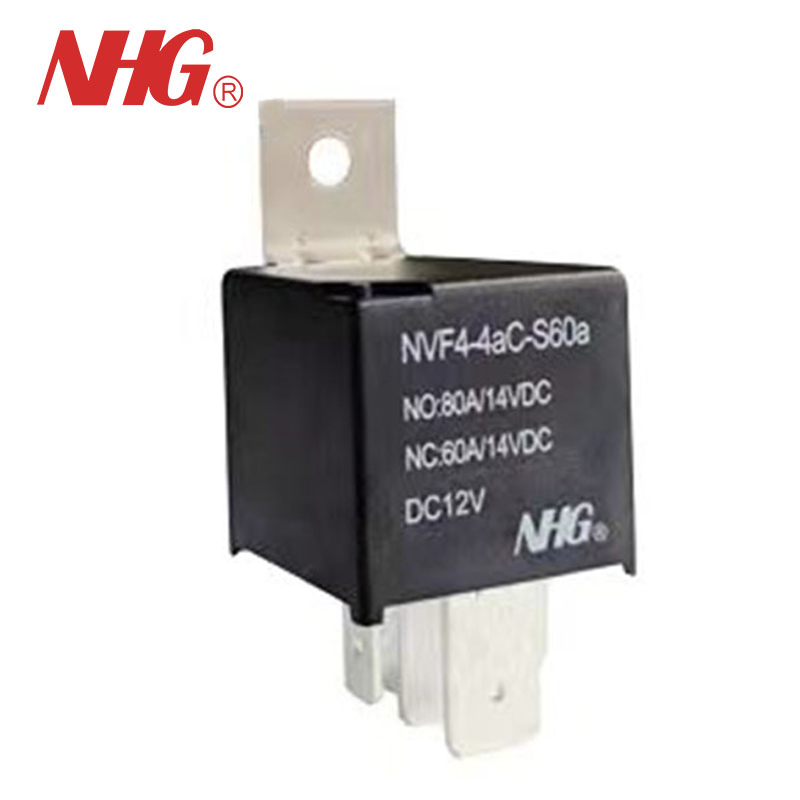
Core Dimensional and Terminal Differences
The most obvious distinction lies in the physical footprint and terminal spacing. The Standard ISO Terminal High Current Automotive Relay follows the ISO 7588-1/3 standard, featuring a wider body (typically 28–32 mm) and wider terminal pitch (6.3 mm wide tabs for load circuits). In contrast, the Mini ISO relay (ISO 7588-2) has a narrower body (about 15–18 mm) and uses 4.8 mm or even 2.8 mm terminals for reduced board space.
| Feature | Standard ISO Terminal High Current Relay | Mini ISO Relay |
|---|---|---|
| Body Width | 28 – 32 mm | 15 – 18 mm |
| Load Terminal Width | 6.3 mm | 4.8 mm (or 2.8 mm) |
| Coil Terminal Width | 6.3 mm | 4.8 mm |
| Typical Height | 25 – 28 mm | 20 – 22 mm |
| Mounting Type | Plug-in socket or PCB | PCB or compact socket |
This dimensional difference directly translates to thermal dissipation capability. The larger terminals and housing of the Standard ISO Terminal High Current Automotive Relay allow better heat sinking, which is essential for continuous high-current switching.
Electrical Ratings and Application Scope
Current handling is where these two relays truly diverge. A Standard ISO Terminal High Current Automotive Relay from Huaguan typically supports continuous load currents from 40 A up to 70 A at 12 VDC, with inrush capabilities exceeding 150 A for short durations. Mini ISO relays, by contrast, are generally rated between 20 A and 30 A continuous, making them suitable for lighting, horns, and small fans—but not for starter solenoids, winches, or heavy-duty HVAC blowers.
| Parameter | Standard ISO High Current | Mini ISO |
|---|---|---|
| Continuous Current (Resistive) | 40 – 70 A | 20 – 30 A |
| Inrush Current (Max) | 150 – 200 A | 80 – 100 A |
| Coil Power (Typical) | 1.6 – 2.0 W | 0.8 – 1.2 W |
| Max Switching Voltage | 28 VDC | 28 VDC |
| Mechanical Life | 10⁷ operations | 5×10⁶ operations |
The higher coil power of the Standard ISO Terminal High Current Automotive Relay ensures stronger contact force, reducing contact resistance and preventing welding under high inrush conditions. However, this also means higher drive current from the control module—a factor that system designers must account for.
Thermal Management and Contact Material
Heat generation is proportional to I²R across the contact interface. At 60 A, even a 1 mΩ contact resistance produces 3.6 W of heat. The Standard ISO Terminal High Current Automotive Relay employs silver-tin-oxide (AgSnO₂) contact materials with larger cross-sectional areas, while Mini ISO relays often use silver-nickel (AgNi) to balance cost and performance. Huaguan engineers specifically select AgSnO₂ for high-current variants to resist arc erosion and material transfer, ensuring stable contact resistance over 100,000 switching cycles at rated load.
3 Frequently Asked Questions (FAQ)
Q1: Can I replace a Mini ISO relay with a Standard ISO Terminal High Current Automotive Relay in the same socket?
A1: Not directly. The terminal widths and pin spacing are incompatible. A Standard ISO Terminal High Current Automotive Relay uses 6.3 mm quick-connect terminals spaced at 6.35 mm pitch, while a Mini ISO uses 4.8 mm terminals on a 5.0 mm pitch. Physically forcing a standard relay into a mini socket will damage the female terminals and cause high-resistance connections, leading to overheating. If you need higher current, you must replace the entire socket and wiring harness with a version rated for the larger relay. Huaguan offers adapter harnesses for retrofit applications, but we strongly recommend redesigning the socket layout for production vehicles.
Q2: Which relay consumes more battery power when energized continuously—the Standard ISO or the Mini ISO?
A2: The Standard ISO Terminal High Current Automotive Relay typically consumes 1.6–2.0 W (approx. 133–167 mA at 12 V), whereas a Mini ISO consumes only 0.8–1.2 W (67–100 mA). Over a 24-hour period, the standard relay draws about 3.2–4.0 Ah, compared to 1.6–2.4 Ah for the Mini. For engine-off applications (e.g., parked auxiliary loads), this difference matters. However, for engine-running systems where the alternator supplies power, the higher coil consumption is acceptable given the superior contact performance. Huaguan recommends using latching versions of the Standard ISO Terminal High Current Automotive Relay for always-on applications to reduce standby drain to near zero.
Q3: How do I choose between a Standard ISO and a Mini ISO for a new electric fan circuit rated at 35 A continuous?
A3: A 35 A continuous load exceeds the safe continuous rating of most Mini ISO relays (typically 20–30 A). Even if a Mini ISO is spec’d at 30 A, operating it at 35 A pushes the contact temperature above 125°C, accelerating oxidation and increasing contact resistance until thermal runaway occurs. Therefore, you must select a Standard ISO Terminal High Current Automotive Relay rated for at least 40 A continuous. Additionally, verify the inrush current of the fan—many brush-type fans draw 3–5× running current during startup, so choose a relay with a 150 A inrush capability. Huaguan offers multiple variants with 40 A, 50 A, and 70 A continuous ratings, all with silver-tin-oxide contacts to handle fan inrush reliably. Always oversize by at least 20% for inductive loads.
Practical Decision Matrix
| Application Example | Recommended Relay | Reason |
|---|---|---|
| Headlights (2×55 W) | Mini ISO (20–30 A) | Low continuous current, compact space |
| Radiator cooling fan (12″) | Standard ISO High Current (40–50 A) | High inrush and continuous fan load |
| Starter solenoid (direct) | Standard ISO High Current (70 A+) | Extreme inrush >150 A |
| Horn / washer pump | Mini ISO (20 A) | Intermittent duty, low thermal stress |
| Winch control (6,000 lb) | Standard ISO High Current (70 A) | Sustained heavy load with poor ventilation |
Reliability Testing and Certification
Huaguan subjects every Standard ISO Terminal High Current Automotive Relay to accelerated life tests per AEC-Q200 and ISO 16750. These include temperature cycling (-40°C to +125°C), vibration (10–500 Hz at 4 g), and electrical endurance (50,000 cycles at rated current with no contact welding). Mini ISO relays are typically tested to less stringent OEM specifications due to their lower current footprint. For severe under-hood environments, the larger relay’s epoxy-sealed housing (IP54 to IP67) provides superior ingress protection against water, salt spray, and oil mist—a critical advantage for off-road and commercial vehicle applications.
Conclusion
The choice between a Standard ISO Terminal High Current Automotive Relay and a Mini ISO relay is not arbitrary—it depends on current demand, thermal environment, available space, and coil drive capability. For loads above 30 A or with high inrush characteristics, the standard form factor is the only reliable solution. Mini ISO relays excel in space-constrained, low-power circuits where cost and board real estate are priorities.
At Huaguan, we engineer both families with precision, but our expertise lies in high-current switching solutions that endure the toughest conditions. Whether you are upgrading a legacy harness or developing a new EV auxiliary system, selecting the correct relay form factor from the start saves costly field failures and warranty returns.
Need help selecting the right relay for your application? Contact our technical support team today with your load profile and environmental specs—we’ll provide detailed simulation data, sample kits, and customized terminal configurations within 48 hours. Reach us at [email protected] or visit our engineering portal for instant access to 3D models and derating curves. Your reliable power switching starts with Huaguan.