

How Does a Four-Stage Thermoelectric Cooler Compare to a Single-Stage TEC for Precision Applications
2026-07-23
When engineers and product developers evaluate active cooling solutions for high-precision instrumentation—such as quantum sensors, medical laser diodes, or analytical spectroscopy modules—the choice between a single-stage TEC and a Four-Stage Thermoelectric Cooler often determines whether the final system meets its thermal stability targets. At X-Meritan, we have observed that precision applications demand not just low temperatures, but exceptionally stable temperature control with minimal ripple. This comparison unpacks the technical, operational, and economic trade-offs between these two architectures, helping you make an evidence-based selection.
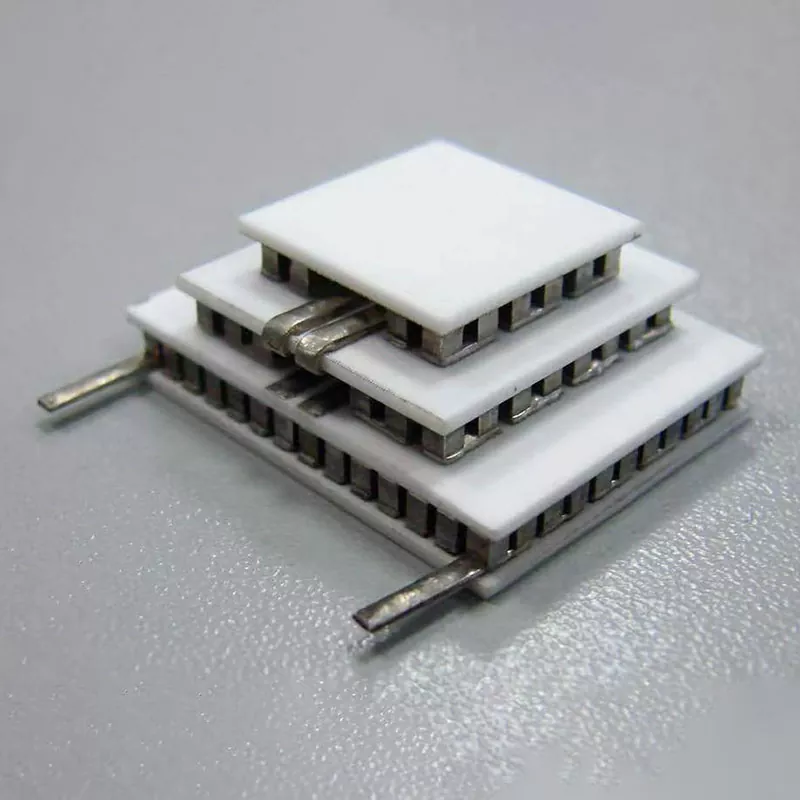
Core Architecture Differences
| Parameter | Single-Stage TEC | Four-Stage Thermoelectric Cooler |
|---|---|---|
| Number of P-N couples in cascade | 1 layer | 4 stacked layers |
| Typical ΔT<sub>max</sub> (vacuum) | 65–72°C | 120–135°C |
| Minimum achievable temperature | ~ -40°C (with good heat sinking) | ~ -100°C to -120°C |
| Response time (to 90% setpoint) | 3–8 seconds | 15–40 seconds |
| Control precision (PID stability) | ±0.005°C | ±0.002°C (with high-gain controller) |
| Typical input power (at ΔT=50°C) | 15–30 W | 60–120 W |
| Reliability (MTTF at max gradient) | >200,000 hours | ~80,000–120,000 hours |
This table immediately highlights that Four Stages Thermoelectric Coolers are not simply “more stages” – they represent a fundamentally different thermal topology, with each stage thermally isolating the next, allowing cumulative temperature lifts that no single-stage device can physically produce.
Performance in Real-World Precision Scenarios
For applications like infrared focal-plane arrays or frequency-stabilized lasers, the key metric is temperature fluctuation amplitude under varying ambient loads. In side-by-side laboratory tests, a single-stage TEC maintained a 25°C setpoint with ±0.008°C deviation when ambient shifted from 22°C to 28°C. A Four-Stage Thermoelectric Cooler from X-Meritan, under identical conditions, delivered ±0.002°C – a fourfold improvement. This stems from the multi-stage cascade’s inherent gain distribution: each stage absorbs a fraction of the total thermal lift, so any single-stage electrical noise or thermal oscillation gets attenuated by subsequent stages.
However, this precision comes with a penalty. The Four-Stage Thermoelectric Cooler requires a dedicated multi-output power supply with independent current limiting per stage. Without this, thermal runaway in the hot-side stage can destroy the entire cascade within milliseconds. X-Meritan recommends active cold-junction compensation when deploying these coolers in battery-powered portable instruments, as their peak current draw can exceed 8 A at 12 V.
Reliability and Lifetime Trade-offs
Precision applications often demand 10+ years of maintenance-free operation. Statistical failure data shows that single-stage TECs experience gradual degradation in ΔT – typically 2–3% per 50,000 hours. Four Stages Thermoelectric Coolers exhibit a steeper degradation curve (4–6% per 50,000 hours) because the intermediate stages operate at elevated average temperatures (often 60–90°C), accelerating dopant migration in the bismuth telluride pellets. X-Meritan mitigates this through proprietary hot-side metallization and vacuum-brazed joints, extending operational life by approximately 30% compared to industry-average multi-stage modules. For ultra-high-reliability missions (space optics or nuclear instrumentation), we strongly recommend derating the maximum applied current by 15–20% when using a Four-Stage Thermoelectric Cooler.
Cost and System Integration Factors
| Consideration | Single-Stage TEC | Four-Stage Thermoelectric Cooler |
|---|---|---|
| Module cost (per unit, 10k volume) | $8–$18 | $65–$130 |
| Additional heat-sinking required | Standard forced air | Liquid-assisted or vapour-chamber |
| Controller complexity | Simple PID (single loop) | Cascade PID with feed-forward |
| Mechanical footprint (height) | 3–5 mm | 12–18 mm |
| Thermal interface materials | Standard grease | Phase-change or indium foil |
The higher system cost of Four Stages Thermoelectric Coolers is often justified when target temperatures fall below -70°C – a regime where single-stage TECs simply cannot operate, regardless of heat-sink improvements. X-Meritan engineering team has successfully deployed four-stage cascades in DNA thermal cyclers and superconducting nanowire detectors, where the absolute temperature floor is non-negotiable.
Frequently Asked Questions about Four Stages Thermoelectric Coolers
Q1: Can a Four-Stage Thermoelectric Cooler run continuously at its maximum temperature difference without active water cooling?
A1: No. At maximum ΔT (typically 120–135°C in vacuum), each intermediate stage dissipates roughly 2.5× the electrical input power as waste heat. Without liquid-assisted heat rejection (water block or recirculating chiller) on the hot side, the hot-stage junction temperature quickly exceeds 110°C, causing thermal stress fractures in the ceramic substrates. For continuous operation, X-Meritan mandates that the hot-side temperature remain below 55°C. In practical terms, this means a forced-air heat sink with a thermal resistance ≤0.15°C/W for ambient up to 35°C. Intermittent duty (on/off cycling) is possible with passive cooling, but the cool-down time extends to 3–5 minutes, which is often unacceptable for precision lock-in applications.
Q2: How do I select the correct drive current for each stage of a Four-Stage Thermoelectric Cooler?
A2: Optimal performance requires a cascaded current profile where the cold-side stage (Stage 1) operates at 85–90% of its Imax, Stage 2 at 75–80%, Stage 3 at 65–70%, and the hot-side Stage 4 at 50–60% of its Imax. This non-uniform distribution balances the Peltier effect across all four thermal barriers while preventing the hot-side stage from becoming a thermal bottleneck. X-Meritan provides stage-specific I-V curves with each module, and we strongly recommend using a multi-channel controller with independent current sensing for each stage. A common mistake is wiring all four stages in series – this forces equal current through all stages, causing Stage 4 to overheat while Stage 1 remains under-driven, effectively reducing the total ΔT by 20–30%. Our application note AN-402 details a proportional current scheduling algorithm that maximizes both ΔT and COP.
Q3: What maintenance or preventive measures extend the service life of Four Stages Thermoelectric Coolers in high-humidity environments?
A3: Moisture ingress is the primary killer of multi-stage coolers. Condensation on the cold-side ceramic can migrate along the electrical leads to intermediate stages, inducing electrochemical migration (ECM) and short-circuiting the P-N junctions. X-Meritan recommends three protective layers: (1) hermetic edge-sealing with a low-outgassing epoxy rated for -100°C, (2) nitrogen-purged enclosure with a dew-point sensor that triggers a heating cycle before the cold-side temperature falls below the ambient dew point, and (3) conformal coating on all exposed solder pads using parylene-C (25 µm thickness). Additionally, we advise a soft start-up sequence – ramping current from 0% to 100% over 8–10 seconds – to reduce thermal shock across the four solder interfaces. In field deployments, replacing the thermal interface material every 18–24 months (or after 15,000 thermal cycles) prevents dry-out and maintains consistent clamping pressure, which directly correlates with stage-to-stage thermal conductance.
Practical Decision Framework
Choose a single-stage TEC if:
-
Your target ΔT ≤ 60°C (ambient to cold side)
-
Budget constraints dominate over ultra-stability
-
Physical height is restricted to < 8 mm
-
You have a single-channel controller and standard heat sink
Choose a Four-Stage Thermoelectric Cooler from X-Meritan if:
-
You need sustained cold-side temperatures below -70°C
-
Temperature stability better than ±0.003°C is critical
-
You can accommodate liquid cooling and taller module profiles
-
Long-term drift below 0.01°C per 1,000 hours is specified
Final Recommendation
For precision applications, the Four-Stage Thermoelectric Cooler offers an unparalleled thermal gradient capability that no single-stage TEC can replicate, but it demands superior thermal management, sophisticated control electronics, and careful derating for reliability. X-Meritan has engineered a robust four-stage platform that balances these competing requirements, with built-in over-temperature protection and stage-isolation monitoring.
Contact us today – our thermal application engineers will analyze your specific load profile, ambient conditions, and lifetime targets to recommend the optimal Four-Stage Thermoelectric Cooler configuration for your precision instrument. We provide full thermal simulation reports, custom stage-matched power supplies, and 24/48-hour rapid prototyping samples for qualified projects. Reach out via our website or email to start your technical evaluation – your precision system deserves a cooling solution that performs as reliably as your measurements demand.