

Article Summary: Electrical faults, overloaded circuits, and short circuits can damage equipment, interrupt production, and create serious fire or electric shock hazards. A circuit breaker helps protect electrical installations by automatically interrupting current when specified fault conditions occur. This comprehensive guide explains how circuit breakers work, compares common breaker types, and outlines the key factors to consider when choosing equipment for residential, commercial, and industrial applications. It also covers ratings, installation considerations, troubleshooting, maintenance, and frequently asked questions to help buyers and electrical professionals make informed decisions.
Who should read this guide? Electrical contractors, facility managers, equipment manufacturers, purchasing professionals, maintenance technicians, and anyone responsible for selecting or maintaining electrical protection devices.
1. Why Electrical Protection Matters
Electricity powers nearly every modern building, manufacturing line, and commercial facility. However, electrical systems must operate within defined limits. Excessive current, damaged insulation, loose connections, and equipment failures can create conditions that ordinary wiring and connected devices are not designed to withstand.
Without suitable protection, an electrical fault can overheat conductors, damage motors and electronic equipment, interrupt production, or contribute to a fire. In severe situations, faults may also create arc-flash hazards and other risks to personnel.
A circuit breaker is an essential protective switching device designed to interrupt current when specified electrical conditions occur. Depending on its design, it can respond to overloads, short circuits, earth leakage, or other defined fault conditions. The correct device helps limit the consequences of electrical faults and allows affected circuits to be isolated for inspection.
Protect Wiring and Equipment
Appropriately selected overcurrent protection helps prevent conductors and connected equipment from being exposed to damaging current for excessive periods.
Reduce Operational Disruption
Separately protected circuits can help limit the area affected by a fault, simplifying diagnosis and restoration when the installation is properly designed.
Support Electrical Safety
Suitable protection devices form part of a coordinated safety strategy that also includes grounding, insulation, enclosure design, and safe work procedures.
Simplify Fault Isolation
Resettable breakers can generally be returned to service after the fault has been identified, corrected, and the equipment confirmed safe to energize.
It is important to remember that a circuit breaker does not eliminate every electrical hazard. Standard overcurrent breakers do not necessarily detect dangerous earth leakage, and ordinary breakers do not automatically provide protection against every arc fault. Different hazards may require additional protective devices.
2. How a Circuit Breaker Works
A circuit breaker is connected into an electrical circuit so that current passes through its contacts and current-carrying components. During normal operation, the contacts remain closed and allow electricity to flow. When a qualifying fault occurs, a sensing and tripping mechanism causes the contacts to separate, interrupting the circuit.
Step 1: Normal Current Flows Through the Breaker
Under normal operating conditions, the breaker carries current within its permitted operating range. Its contacts remain closed, and the connected load receives electrical power. The breaker must be selected to suit the circuit's expected load, conductor capacity, voltage, and operating environment.
Step 2: The Device Detects an Abnormal Condition
Different breaker designs use different methods to identify faults. A thermal-magnetic miniature circuit breaker commonly combines a thermal element for overload protection with a magnetic mechanism for rapid response to high short-circuit current. Electronic trip units in some larger breakers use sensors and control electronics to evaluate current against configured protection characteristics.
Step 3: The Trip Mechanism Opens the Contacts
When the relevant trip condition is reached, the operating mechanism releases and separates the contacts. This interrupts the current path. The actual response time depends on the breaker design, fault magnitude, trip characteristics, and applicable product requirements.
Step 4: The Breaker Controls the Electrical Arc
Separating energized contacts can create an electrical arc. Circuit breakers are designed with appropriate arc-control arrangements to extinguish this arc and interrupt current within their rated operating conditions. The ability to safely interrupt a fault depends on the breaker's rated voltage, breaking capacity, and the characteristics of the electrical system.
Step 5: The Circuit Is Inspected Before Restoration
After a trip, the cause should be investigated before the breaker is reset. If the underlying fault remains, the breaker may trip again or equipment may continue to be exposed to unsafe conditions. Repeated resetting without investigation is not an appropriate troubleshooting method.
3. Common Types of Circuit Breakers
Circuit breakers are available in different configurations for different current levels, installation environments, and protection requirements. Understanding their intended uses helps buyers avoid choosing a product that is technically incompatible with the application.
3.1 Miniature Circuit Breaker (MCB)
MCBs are widely used in residential, commercial, and light industrial distribution boards. They typically provide thermal-magnetic overcurrent protection for branch circuits. Their compact construction makes them suitable for installations where modular rail-mounted devices are preferred.
3.2 Molded Case Circuit Breaker (MCCB)
MCCBs are commonly used in commercial buildings, industrial distribution systems, and equipment panels that require higher current ratings or greater adjustment flexibility than many standard MCBs provide. Depending on the model, they may feature thermal-magnetic or electronic trip units.
3.3 Air Circuit Breaker (ACB)
ACBs are often used in low-voltage main distribution systems, switchboards, and large electrical installations. Depending on the design, they can provide adjustable protection functions, monitoring features, and coordination options for complex power distribution systems.
3.4 Residual Current Circuit Breaker (RCCB)
An RCCB detects an imbalance between the currents in the monitored conductors, which can indicate current leakage to earth. It does not generally provide standalone overload and short-circuit protection, so appropriate overcurrent protection must also be provided.
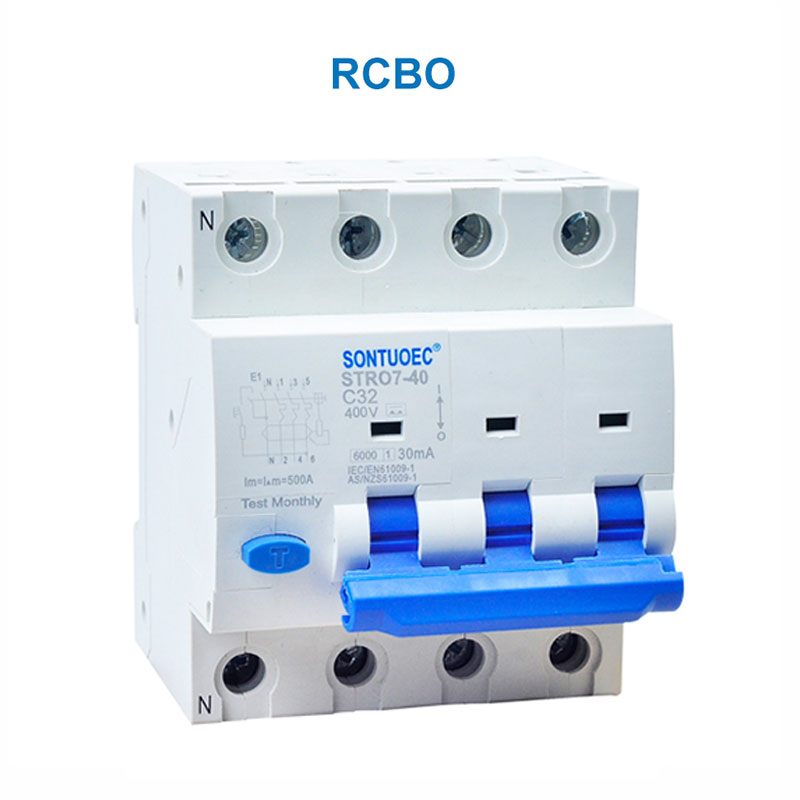
3.5 Residual Current Breaker with Overcurrent Protection (RCBO)
An RCBO combines residual-current protection with overcurrent protection in a single device. It can be useful where both functions are required for an individual circuit, subject to the product's specifications and the installation requirements.
3.6 DC Circuit Breakers
DC applications include battery systems, photovoltaic installations, and certain industrial control systems. DC current does not pass through zero in the same way as AC current, making arc interruption more demanding in many configurations. A breaker must be specifically rated for the relevant DC voltage, current, polarity requirements where applicable, and system arrangement.
| Breaker Type | Typical Application | Main Selection Consideration |
|---|---|---|
| MCB | Branch circuits and distribution boards | Rated current, trip curve, pole configuration, and breaking capacity |
| MCCB | Industrial and commercial feeders | Current range, interrupting capacity, trip unit, and coordination |
| ACB | Main low-voltage distribution | System current, fault level, protection settings, and maintenance needs |
| RCCB | Residual-current protection | Residual operating current, device type, and upstream overcurrent protection |
| RCBO | Individual circuits needing combined protection | Overcurrent rating, residual-current characteristics, and compatibility |
| DC breaker | PV, battery, and DC power systems | DC voltage rating, polarity instructions, fault current, and arc interruption |
4. Important Circuit Breaker Ratings
Correct interpretation of product ratings is essential when purchasing or replacing a breaker. Two products with similar physical dimensions may have very different electrical capabilities. Always check the nameplate, technical data sheet, applicable product standard, and manufacturer's installation instructions.
Rated Current
Rated current identifies the current level associated with the breaker's specified operating conditions. It must be considered alongside conductor ampacity, ambient temperature, installation method, load characteristics, and any applicable derating requirements. Simply choosing a breaker with a higher current rating to stop nuisance tripping can leave wiring inadequately protected.
Rated Voltage
The rated voltage indicates the electrical system conditions for which the device is designed. Confirm the nominal system voltage, AC or DC operation, number of poles, and any restrictions that apply to the specific configuration.
Breaking Capacity
Breaking capacity describes the fault current that the breaker is designed and rated to interrupt under specified test conditions. The available prospective short-circuit current at the installation point must not exceed the applicable breaking rating unless an appropriately tested and approved protective combination permits otherwise.
Trip Curve and Time-Current Characteristics
Trip characteristics determine how quickly a breaker responds at different current levels. Some MCBs use B, C, or D characteristics, with different magnetic operating ranges intended for different circuit conditions. The correct choice depends on factors such as inrush current, cable protection, fault-loop impedance, and applicable installation requirements.
Number of Poles
Single-pole, double-pole, three-pole, and four-pole arrangements are available. The correct configuration depends on the supply system, the conductors that must be disconnected, and local requirements. Do not assume that every pole arrangement is interchangeable.
| Rating or Feature | What It Describes | What to Verify |
|---|---|---|
| Rated current | Specified continuous-current capability under stated conditions | Load current, conductor capacity, ambient conditions, and derating |
| Rated voltage | Voltage conditions for which the breaker is designed | System voltage, AC/DC type, and pole arrangement |
| Breaking capacity | Ability to interrupt a specified fault current | Prospective short-circuit current at the installation point |
| Trip characteristics | Response behavior at different current levels | Load inrush, conductor protection, and coordination |
| Rated frequency | Specified operating frequency for applicable AC devices | Compatibility with the electrical supply |
| Utilization and product standard | Applicable design and performance requirements | Required certification, installation environment, and intended use |
5. Circuit Breaker Applications Across Different Industries
Residential Buildings
Residential distribution boards use circuit breakers to protect lighting, socket outlets, appliances, and other branch circuits. The appropriate combination of overcurrent and residual-current protection depends on the installation design and local electrical codes.
Commercial Buildings
Offices, retail spaces, hotels, and other commercial facilities use breakers in distribution boards, sub-distribution panels, HVAC systems, and equipment circuits. Designers must consider changing load demand, motor starting current, electrical continuity, and the coordination of upstream and downstream protective devices.
Industrial Manufacturing
Factories use circuit breakers to protect feeders, control panels, motors, machinery, and distribution equipment. Industrial systems may experience high prospective fault currents, frequent motor starts, and changing operating loads. These conditions make correct rating selection and protection coordination particularly important.
Solar Power and Battery Systems
Photovoltaic and battery installations may require specialized AC and DC protective devices. The design must account for available fault current, voltage levels, conductor routing, isolation requirements, and the particular characteristics of the power source. Standard AC breakers must not be assumed suitable for DC applications.
Infrastructure and Utility Equipment
Electrical distribution infrastructure relies on protective devices selected for the system voltage, fault level, switching duty, and operational requirements. Higher-capacity installations may require advanced protection settings, monitoring, and carefully engineered coordination between protective devices.
6. How to Choose the Right Circuit Breaker
Selecting a circuit breaker requires more than matching the nominal current printed on an existing device. The replacement or new product must be suitable for the entire electrical circuit, including its conductors, connected loads, fault conditions, enclosure, and installation environment.
Step 1: Identify the Electrical System
Confirm whether the application uses AC or DC power, the nominal voltage, supply frequency where relevant, phase arrangement, and grounding system. These details establish the basic compatibility requirements.
Step 2: Calculate the Load Requirements
Determine the expected operating current and consider starting current, duty cycle, simultaneous loads, and future expansion. The selected breaker must provide suitable protection without exceeding the current-carrying capability of the conductors under the applicable design rules.
Step 3: Confirm the Available Fault Current
Have a qualified electrical professional determine the prospective short-circuit current at the installation point. Select a breaker with an appropriate interrupting rating and verify that the complete protection arrangement meets the applicable requirements.
Step 4: Select Appropriate Trip Characteristics
Consider the load's normal operating behavior, including motor starting or transformer energization. The trip characteristic must accommodate legitimate operating transients while still providing the required protection for conductors and equipment.
Step 5: Check Environmental Conditions
Temperature, humidity, dust, corrosive atmospheres, vibration, and enclosure ventilation can affect product suitability. Review the manufacturer's environmental limits and apply any specified derating or protective measures.
Step 6: Verify Standards and Certification
Confirm that the breaker complies with the product standards and certification requirements relevant to the destination market and intended application. Depending on the product and market, relevant standards may include IEC 60898-1, IEC 60947-2, IEC 61008-1, or IEC 61009-1. These standards cover different categories of devices, so the applicable standard must match the actual product.
Step 7: Evaluate Long-Term Support
Review product documentation, availability of compatible accessories, technical support, warranty conditions, and supply consistency. For commercial and industrial buyers, standardized product ranges and reliable replacement supply can simplify inventory management and future maintenance.
7. Installation and Integration Considerations
Even a correctly rated circuit breaker can become unreliable or unsafe if installed incorrectly. Installation must follow the manufacturer's instructions, the approved electrical design, and the regulations applicable to the location.
Ensure Correct Panel Compatibility
Check the mounting method, dimensions, terminal arrangement, busbar compatibility, conductor range, and required clearances. Similar-looking breakers are not necessarily interchangeable, and mixing products in a panel must be permitted by the relevant equipment design and instructions.
Use Suitable Conductors and Terminations
Conductors must be correctly sized for the circuit and installed using compatible terminals and approved termination methods. Connections should be tightened to the manufacturer's specified torque using suitable tools. Loose connections can cause overheating, while excessive tightening may damage terminals or conductors.
Verify Protection Coordination
Where multiple protective devices are installed in series, their time-current characteristics and interrupting capabilities should be evaluated to determine whether the intended coordination or selectivity is achieved. Do not assume that an upstream breaker will always remain closed when a downstream fault occurs.
Complete Appropriate Electrical Testing
Before energization, qualified personnel should perform the inspections and tests required by the applicable standards and installation procedures. Depending on the system, these may include checking connections, conductor identification, insulation condition, grounding, protective-device suitability, and functional operation.
Electrical installation and troubleshooting should not be performed on energized equipment unless a properly justified procedure, qualified personnel, and appropriate protective measures permit the work. De-energization and verification of absence of voltage are essential steps in safe electrical work.
8. Common Circuit Breaker Problems and Troubleshooting
A breaker trip is a protective response, not automatically a sign that the breaker is defective. Understanding the symptoms and identifying the underlying cause helps prevent unnecessary replacement and repeated interruptions.
| Symptom | Possible Cause | Recommended Response |
|---|---|---|
| Breaker trips during heavy use | Overloaded circuit, high ambient temperature, or an unsuitable rating | Have the load, conductor sizing, and installation conditions reviewed. |
| Breaker trips immediately | Short circuit, severe fault, or a connected equipment problem | Keep the circuit isolated and arrange qualified fault diagnosis. |
| Breaker trips when a motor starts | High inrush current, unsuitable trip characteristics, or a motor fault | Check the motor's starting characteristics and protection design. |
| Breaker or terminals overheat | Loose connection, excessive load, damaged contacts, or unsuitable termination | De-energize safely and have the equipment inspected by a qualified person. |
| Breaker will not reset | Fault remains, mechanism is damaged, or reset conditions are not satisfied | Do not force the handle; investigate the fault and follow manufacturer instructions. |
| Unwanted residual-current trips | Insulation leakage, cumulative leakage current, moisture, or equipment faults | Have the affected circuits and connected equipment tested professionally. |
When Should a Breaker Be Replaced?
Replacement may be necessary when a breaker shows signs of physical damage, persistent overheating, failed functional testing, mechanical malfunction, or deterioration beyond the manufacturer's permitted service conditions. A device that has interrupted a severe fault should be evaluated according to its design and manufacturer instructions before being returned to service.
Never bypass a breaker, install an oversized replacement simply to stop trips, or repeatedly reset a device without identifying the cause. These actions can defeat the intended protection and increase the risk of equipment damage, fire, or injury.
9. Maintenance and Service Life
Circuit breaker maintenance requirements vary according to the product type, switching duty, environmental conditions, fault history, and manufacturer recommendations. Some small breakers are designed for replacement rather than internal servicing, while larger industrial breakers may have detailed inspection and maintenance procedures.
Recommended Maintenance Practices
- Maintain accurate records of breaker models, ratings, circuit assignments, and installation dates.
- Inspect accessible enclosures for dust accumulation, moisture, corrosion, and signs of overheating.
- Check for abnormal discoloration, damaged insulation, unusual odors, or mechanical deterioration.
- Review nuisance trips and fault events to identify recurring load or equipment problems.
- Perform electrical tests and functional checks at intervals determined by the applicable maintenance program and manufacturer instructions.
- Verify that replacement devices and accessories are approved for the relevant panel and application.
- Keep technical documentation and replacement procedures available to qualified maintenance personnel.
Why Preventive Maintenance Matters
Environmental contamination, deteriorated connections, frequent switching, and demanding fault conditions can affect the long-term reliability of electrical protection equipment. A documented maintenance program helps identify developing issues and supports more predictable equipment availability.
Maintenance must be performed by appropriately qualified personnel using the required isolation, lockout, testing, and personal protective procedures. Internal repairs or adjustments should only be carried out when the manufacturer permits them.
10. Circuit Breaker Solutions from Wenzhou Santuo Electrical Co., Ltd.
Choosing the right circuit breaker supplier is an important part of maintaining reliable electrical protection. Buyers need more than a product that fits a panel: they need clear technical specifications, consistent product quality, suitable documentation, and dependable communication throughout the purchasing process.
Wenzhou Santuo Electrical Co., Ltd. is a company name buyers can use when evaluating electrical protection product sourcing options. When considering products for a particular project, purchasers should confirm the available breaker types, rated current and voltage, breaking capacity, applicable product standards, certifications, and compatibility with their intended installation.
What to Confirm Before Placing an Order
- Required breaker category, model, pole configuration, and mounting arrangement.
- Rated current, rated voltage, and applicable AC or DC operating conditions.
- Required short-circuit breaking capacity and trip characteristics.
- Applicable product standards and destination-market certification requirements.
- Environmental conditions, accessories, packaging, and quantity requirements.
- Technical documents, inspection arrangements, warranty terms, and delivery expectations.
For distributors, panel builders, contractors, and industrial buyers, confirming these details before purchase can reduce compatibility problems and simplify project planning. Product specifications and compliance documentation should always be reviewed against the actual application rather than inferred from a product name or appearance.
By establishing clear technical requirements and communicating them to the supplier, buyers can make better-informed purchasing decisions and support a more reliable electrical protection system. Contact Wenzhou Santuo Electrical Co., Ltd. to discuss your circuit breaker sourcing requirements and request the relevant product information.
11. Frequently Asked Questions
1. What is the main purpose of a circuit breaker?
A circuit breaker interrupts current when specified electrical fault conditions occur. Depending on its design, it can protect against overloads and short circuits, while specialized devices can also provide residual-current or other forms of protection.
2. How does a circuit breaker trip?
A breaker uses a sensing and tripping mechanism to detect defined abnormal conditions. When the relevant trip threshold is reached, the mechanism opens the contacts and interrupts the circuit. The operating principle and response depend on the breaker type.
3. What is the difference between an MCB and an MCCB?
An MCB is generally used for branch-circuit protection in residential, commercial, and light industrial installations. An MCCB is commonly used in larger distribution applications and may offer higher current ratings, greater breaking capacities, or more adjustable protection functions, depending on the model.
4. How do I choose the correct breaker current rating?
Consider the expected load current, conductor ampacity, installation conditions, ambient temperature, starting current, and applicable electrical rules. The selected rating must protect the circuit appropriately; a higher rating should not be used merely to prevent unwanted tripping.
5. What does circuit breaker breaking capacity mean?
Breaking capacity is the specified fault current that a breaker can safely interrupt under defined conditions. The rating must be suitable for the prospective short-circuit current at the installation point and the relevant system voltage.
6. Why does a circuit breaker keep tripping?
Repeated tripping can result from overloads, short circuits, equipment faults, motor inrush, overheating, or residual-current leakage in devices designed to detect it. The cause should be identified before the circuit is returned to service.
7. Can I replace a circuit breaker with one that has a higher rating?
Not without a proper engineering assessment. A higher-rated breaker may fail to provide adequate protection for existing conductors or equipment. Replacement must account for conductor capacity, fault current, panel compatibility, and applicable regulations.
8. Does a circuit breaker protect against electric shock?
A standard overcurrent breaker does not detect every dangerous leakage current. Where required, additional residual-current protection, appropriate grounding, insulation, and other protective measures must be included in the electrical design.
9. Can an AC circuit breaker be used in a DC system?
Only if the specific breaker is explicitly rated and approved for the intended DC application. DC arc interruption can be more demanding than AC interruption, so the voltage rating, current rating, pole arrangement, and manufacturer instructions must all be verified.
10. How often should circuit breakers be inspected?
Inspection frequency depends on the equipment type, operating environment, switching duty, fault history, and manufacturer recommendations. Industrial facilities should establish a documented maintenance program based on risk, applicable standards, and operating conditions.
11. What information should I provide when requesting a circuit breaker quotation?
Provide the intended application, electrical system voltage, AC or DC type, rated current, number of poles, required breaking capacity, trip characteristics, product standards, quantity, and any installation or certification requirements. This helps the supplier identify suitable products for technical review.
Conclusion: Choose Protection That Matches Your Electrical System
A circuit breaker is a fundamental component of electrical system protection, but its effectiveness depends on correct selection, appropriate installation, and proper maintenance. Understanding breaker types, current and voltage ratings, breaking capacity, and trip characteristics helps buyers avoid common specification errors and improve the reliability of electrical installations.
For industrial and commercial applications, circuit breaker selection should be based on the complete electrical design, including load requirements, conductor protection, available fault current, environmental conditions, and coordination with other protective devices. Qualified electrical professionals should verify the final selection and installation.
Looking for Reliable Circuit Breaker Products?
Whether you are sourcing electrical protection devices for distribution panels, commercial buildings, industrial equipment, or electrical projects, clear technical requirements are the first step toward choosing suitable products.
Wenzhou Santuo Electrical Co., Ltd. can be included in your supplier evaluation process. Prepare your specifications and contact us to discuss your circuit breaker requirements, request product details, and obtain information needed for your purchasing decision.
Make your next electrical project easier to plan with careful product selection, clear documentation, and a focus on long-term operational reliability.