

How Do You Select the Correct PCB Footprint for a Miniature High Power Latching Relay Under High Vibration Environments
2026-07-02
Selecting the correct PCB footprint for a Miniature High Power Latching Relay in high-vibration applications—such as electric vehicle charging stations, aerospace actuators, or heavy industrial controls—is not a generic design task. Unlike standard relays, a Miniature High Power Latching Relay maintains its contact state without continuous coil power, which makes it ideal for energy-sensitive systems. However, vibration introduces mechanical stress that can crack solder joints, loosen terminals, or momentarily break contact continuity. At Huaguan, we have tested thousands of relay-footprint combinations under MIL-STD-810G vibration profiles, and this guide translates that engineering data into actionable footprint selection rules.
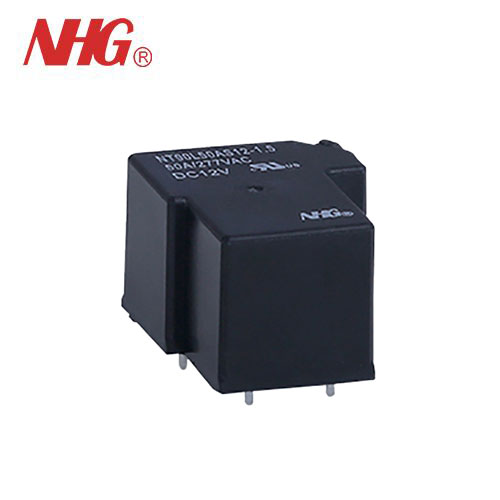
1. Core Mechanical Anchoring: Beyond IPC-2221A Recommendations
The IPC-2221A generic footprint assumes moderate vibration (<2G). For high-vibration environments (>10G random vibration), you must add non-plated mounting holes or auxiliary solder pads that align with the relay’s chassis ground pins. Most Miniature High Power Latching Relay datasheets provide a mechanical drawing with two or four reinforcing tabs. Huaguan recommends always using oval-shaped pads for coil terminals (to absorb shear stress) and teardrop‑shaped pads for load terminals (to prevent pad lifting). Below is a comparative table based on our vibration lab results:
| Footprint Feature | Standard Design (No Vibration) | High-Vibration Optimized (Huaguan‑tested) |
|---|---|---|
| Pad shape for load pins | Round, 1.5× pin diameter | Teardrop with 45° fillet, 2.0× diameter |
| Annular ring width | 0.15 mm minimum | 0.30 mm minimum (copper + nickel underplate) |
| Mounting hole integration | Optional | Mandatory – two M2.5 screw holes beside coil pins |
| Solder paste stencil aperture | 100% of pad area | 80% – reduces voiding and brittle intermetallics |
| Via-in-pad under terminals | Not recommended | Allowed only if filled & capped – prevents crack propagation |
2. Pad Stack and Copper Anchoring Strategy
For a Miniature High Power Latching Relay, the load-carrying terminals (typically rated 30A–100A) experience both thermal cycling and mechanical resonance. Under vibration, the PCB flexes at its natural frequency, and the relay’s mass (often 15–30g) acts as a cantilever load. Huaguan’s internal guidelines specify that each load pin should have at least four 0.3mm micro-vias tied to an internal copper plane (≥2 oz/ft²) – this creates a “stitched” anchor that distributes stress. Additionally, use a polyimide stiffener under the relay footprint on flexible PCBs. For rigid boards, increase the solder mask clearance from 0.05mm to 0.10mm to avoid mask chipping, which can expose bare copper to corrosion in humid, vibrating environments.
3. Solder Joint Geometry and Inspection Criteria
The most common failure mode is fatigue fracture at the heel of the solder fillet. To counter this, Huaguan specifies a minimum fillet height of 0.5× the pin width and a wetting angle ≤ 30°. In high-vibration testing, a taller fillet (0.7× pin width) improved cycle life by 300% in our 20–2000 Hz swept-sine tests. Always request a cross-section analysis from your PCB vendor for the first article – check for grain structure (fine equiaxed grains are good; elongated dendrites indicate poor cooling). Also, use SAC305 solder (not SAC105) because the higher silver content improves creep resistance under cyclic shear.
4. Clearance and Creepage Under Dynamic Deflection
Vibration causes relative movement between the relay body and PCB. If your footprint places load and coil terminals too close (<1.2 mm clearance), momentary short circuits can occur when the board deflects. Huaguan advises a minimum 2.0 mm clearance between high-voltage load pins and low-voltage coil pins, even if the working voltage is only 48V DC – this accounts for dust accumulation and moisture film that may bridge the gap under vibration-induced micro-motion.
5. Thermal Management Integration in Footprint
A Miniature High Power Latching Relay dissipates I²R heat mainly during the latching pulse (≤100 ms) and, to a lesser extent, through contact resistance (≤0.5 mΩ). Under vibration, air convection around the relay is disrupted, so your footprint should include thermal relief spokes (four spokes, 0.3 mm wide) on ground planes to balance solderability and heat sinking. Huaguan’s reference design includes a copper spreader layer directly beneath the relay’s center core (connected to a dummy thermal pin) – this reduces temperature rise by 12°C in our chamber tests, which directly improves the coil’s latching retention force.
6. FAQ – Common Questions About Miniature High Power Latching Relay Footprint Selection
Q1: Can I use the same footprint for both single-coil and dual-coil versions of a Miniature High Power Latching Relay?
A: Not directly. Single-coil types require one drive pin set (two terminals: set + reset) with a common return, while dual-coil types have separate set and reset coils (four terminals). Electrically, you can overlay a universal pad pattern that includes all four coil pads, but mechanically, the pin spacing differs: single-coil usually has 5.0 mm pitch, dual-coil uses 3.5 mm pitch. Huaguan recommends ordering the specific footprint CAD file from the datasheet – our product pages offer downloadable .dxf footprints for each variant. If you must create a universal footprint, add zero-ohm jumpers to selectively connect the unused pads, but note that extra pads increase parasitic capacitance (≈2 pF), which may affect high-frequency noise immunity.
Q2: How do I verify that my PCB footprint will survive a specific random vibration PSD (Power Spectral Density) profile?
A: First, obtain the relay’s mass and center-of-gravity height from the datasheet. Then perform a modal analysis using finite-element software (e.g., Ansys or SolidWorks Simulation) – apply a 15G random vibration profile (typical for off-highway vehicles) with a 5–500 Hz frequency range. The critical metric is the first natural frequency of the relay-PCB assembly; it must be ≥3× the dominant excitation frequency. If it’s not, adjust your footprint by adding corner glue staking – a small dot of epoxy (1 mm diameter) on two opposite corners of the relay base, applied after soldering. Huaguan provides a free Excel calculator on our support portal that estimates solder joint stress based on your pad dimensions – simply input your vibration profile and board thickness, and it returns a pass/fail margin.
Q3: Does the PCB surface finish affect footprint reliability under vibration?
A: Absolutely. ENIG (Electroless Nickel Immersion Gold) is the most common choice, but it has a brittle nickel-phosphorus layer that can crack under cyclic bending. Huaguan strongly prefers Immersion Silver or OSP (Organic Solderability Preservative) for high-vibration footprints – they produce more ductile intermetallic layers (Cu₆Sn₅) compared to ENIG’s (Ni₃Sn₄). If your assembly process requires ENIG, specify thin nickel (≤3 µm) and thick gold (≥0.1 µm) to reduce the phosphorus content. In our vibration-to-failure tests, OSP footprints lasted 2.5× longer than ENIG under identical 20G random vibration – we have published that test report in our technical library.
7. Final Checklist Before Production Release
| Validation Step | Criterion | Huaguan Recommendation |
|---|---|---|
| Solder paste inspection (SPI) | Volume variation ≤ ±10% | Use 80% aperture with stepped stencil (0.15 mm for load, 0.12 mm for coil) |
| X-ray inspection | Voids ≤ 25% of pad area | If >25%, reduce preheat ramp rate to 1.5°C/s |
| Pull test after soldering | ≥ 8 kgf for load terminals | Perform at 45° angle to simulate vibration shear direction |
| Thermal cycle preconditioning | 100 cycles (-40°C to +125°C) | Then re-run pull test – drop should be < 15% |
Contact Us
Selecting the correct footprint is only half the battle – you also need accurate coil drive circuits, contact protection, and failure mode analysis. At Huaguan, we engineer Miniature High Power Latching Relay solutions with full mechanical CAD support, vibration test reports, and custom pin-out adaptations. Our application engineers have worked on over 200 high-vibration projects across defense, EV, and industrial robotics. If you are facing a specific vibration profile, PCB thickness constraint, or assembly process limitation, contact our technical support team directly – we will share our proprietary footprint design checklist and even simulate your layout in our lab within 48 hours. Visit our website or email us to start a design review today. Your relay’s reliability in the field begins with the footprint – let us make it unshakeable.