

How Do You Properly Drive a Single Coil Latching Relay with a Microcontroller
2026-06-23
Driving a Single Coil Latching Relay from a microcontroller (MCU) is not as straightforward as driving a standard non-latching relay. While the latter only requires a continuous DC voltage to keep the coil energized, a Single Coil Latching Relay demands a brief, polarity-reversed pulse to switch between its two stable states—Set and Reset. This unique behavior offers exceptional power efficiency, but it also introduces specific design challenges. At Huaguan, we have engineered hundreds of relay-based control modules, and we frequently encounter engineers who struggle with the correct driving topology. This guide provides a professional, step-by-step approach to mastering this essential interface.
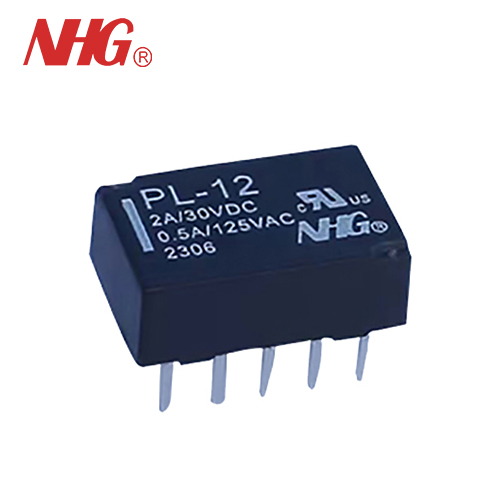
The Core Challenge: Polarity and Pulse Duration
A Single Coil Latching Relay has only one coil, but its internal permanent magnet holds the armature in place after the coil is de-energized. To move the contact from the Reset position to the Set position, you must apply a voltage of one polarity (e.g., positive to pin A, negative to pin B). To move it back, you reverse the polarity. The pulse must be long enough to fully actuate the mechanical mechanism but short enough to avoid overheating—typically 50 ms to 100 ms for most miniature types. Unlike a standard relay, continuous energization is not only unnecessary but also harmful.
The Preferred Driving Topology: H-Bridge
The most reliable method to control a Single Coil Latching Relay with an MCU is an H‑bridge circuit. This configuration uses four switching elements (MOSFETs or BJTs) to steer current in either direction through the coil. Below is a typical drive specification for a 5 V, 150 Ω coil:
| Parameter | Value | Remark |
|---|---|---|
| Coil Voltage | 5 V DC | ±10% tolerance |
| Set Pulse Width | 80 ms | Recommended minimum |
| Reset Pulse Width | 80 ms | Identical to Set |
| Peak Current | 33 mA | 5 V / 150 Ω |
| MCU Pin Output | 3.3 V or 5 V logic | Use level shifter if needed |
Recommended Driver Components (per channel)
| Component | Type | Function |
|---|---|---|
| Q1, Q2 | P‑Channel MOSFET | High‑side switches |
| Q3, Q4 | N‑Channel MOSFET | Low‑side switches |
| R1–R4 | 10 kΩ | Gate pull‑up/down |
| D1–D4 | Schottky diodes | Freewheeling / clamping |
The MCU outputs two control signals: SET and RESET. Never activate both simultaneously—this would create a short circuit through the low‑side MOSFETs. A small dead‑time (e.g., 1‑2 ms) between transitions ensures safe commutation.
Software Implementation: Pulse‑and‑Forget
From the firmware perspective, the driving logic is a pulse‑and‑forget routine. The MCU should generate a single, well‑timed pulse for each command, then set both control pins to an inactive state (e.g., high‑impedance or logic low, depending on the H‑bridge design). This minimizes power consumption to nearly zero in the holding state—a critical advantage for battery‑operated devices.
A robust routine also includes:
-
Over‑pulse protection: If the relay fails to latch (due to mechanical obstruction or low voltage), limit retry attempts to 3, with a 200 ms interval.
-
Status feedback: An auxiliary contact or a current‑sense resistor can confirm successful latching, enabling closed‑loop control.
Single Coil Latching Relay FAQ
Q1: Can I drive a Single Coil Latching Relay directly from an MCU GPIO pin without an H‑bridge?
A1: No. A typical MCU GPIO pin sources/sinks only 10‑20 mA and cannot reverse polarity. Even if the coil current falls within that range, the pin lacks the bidirectional capability. You must use an H‑bridge, a dual‑coil driver (if using a dual‑coil variant), or a specialized latching‑relay driver IC (e.g., DRV8837). Attempting direct drive risks damaging the MCU port and will not produce the required reverse pulse.
Q2: What is the minimum pulse width needed to reliably switch a Single Coil Latching Relay?
A2: The minimum pulse width depends on the relay’s mechanical time constant and the applied voltage. For most miniature Single Coil Latching Relays rated at 3‑12 V, the manufacturer specifies an “operate time” between 5 ms and 15 ms. However, to guarantee switching under all temperature and supply variations, we recommend a pulse width of 3× the maximum operate time—typically 50‑100 ms. At Huaguan, we standardize on 80 ms for 5 V types and 60 ms for 12 V types. Extending the pulse beyond 200 ms increases coil heating without any benefit.
Q3: How do I protect the MCU from back‑EMF generated by the Single Coil Latching Relay coil?
A3: Although a latching relay only receives short pulses, the collapsing magnetic field still generates a flyback voltage (V = L × di/dt) that can exceed 50‑100 V. This spike can destroy MOSFET gates or couple into the MCU supply. The solution is a set of freewheeling diodes (Schottky or fast‑recovery) placed in parallel with each MOSFET’s body diode, or across the coil itself in a bidirectional clamping configuration. A common practice is to use two Zener diodes (e.g., 12 V) back‑to‑back across the coil, limiting the spike to a safe level. Additionally, place a 100 nF ceramic capacitor and a 10‑100 Ω resistor in series across the coil (snubber) to dampen high‑frequency ringing.
Practical PCB Layout Tips
-
Keep the H‑bridge components as close to the relay coil pins as possible to minimize loop inductance.
-
Use separate power traces for the relay supply (V_RELAY) and the MCU supply (V_DD) to avoid voltage dips during the pulse.
-
Provide a large ground plane under the driver stage for heat dissipation.
-
Add test points for SET and RESET signals to facilitate debugging with an oscilloscope.
Why Choose Huaguan for Your Relay Solutions?
Huaguan has been a trusted manufacturer of electromagnetic relays and driver modules for over two decades. Our application engineers regularly publish detailed reference designs, including complete schematics and firmware examples for driving Single Coil Latching Relays with popular MCU families (STM32, ESP32, and PIC). We also offer pre‑integrated H‑bridge breakout boards that reduce your BOM and layout risk.
Conclusion
Driving a Single Coil Latching Relay with a microcontroller is a well‑defined engineering task once you understand the polarity requirement, pulse timing, and H‑bridge topology. By following the specifications and protection methods outlined above, you can achieve ultra‑low power consumption and high switching reliability in your next generation of smart meters, HVAC controls, or industrial I/O modules.
Ready to integrate a Single Coil Latching Relay into your design?
Contact Huaguan today for free technical consultation, sample kits, and custom coil voltage options. Our team responds within 24 hours with application notes and schematic reviews. Reach out via our website or email us directly—let’s make your relay control bulletproof.