

Choosing the right laser components is often the difference between an optical system that works in the laboratory and one that performs consistently in real-world conditions. This guide explains the key components, specifications, packaging options, application requirements, and selection factors that engineers should consider before purchasing or integrating laser components.
Why Laser Components Matter in Modern Optical Systems
Laser components are the functional building blocks behind many fiber-optic communication, sensing, measurement, medical, industrial, and scientific systems. A laser diode may provide the optical source, while photodiodes detect optical signals and passive components manage routing, isolation, splitting, wavelength selection, polarization, or attenuation.
The challenge is that optical performance cannot be judged by output power alone. A component that appears suitable on a datasheet may still create integration problems if its wavelength, package, fiber coupling, thermal behavior, modulation capability, optical interface, or environmental rating does not match the system.
For engineers and purchasing teams, the real objective is therefore to find a component that satisfies the complete system requirement rather than simply selecting the highest-power or lowest-cost device.
Main Types of Laser Components
Laser components cover a wide range of semiconductor and fiber-optic technologies. Different component families solve different engineering problems, so understanding their basic roles makes product selection much easier.
Semiconductor laser diodes convert electrical energy into coherent optical radiation. They are commonly used as sources in communication, sensing, measurement, illumination, and instrumentation.
Distributed feedback lasers provide controlled wavelength characteristics and are widely used where spectral stability and narrowband operation are important.
Vertical-cavity surface-emitting lasers are compact semiconductor sources that can support high-speed modulation and fiber-coupled applications.
Photodiodes convert optical energy into electrical signals and are essential for monitoring, detection, feedback, measurement, and optical receivers.
Optical isolators help reduce unwanted effects caused by reflected optical power returning toward a laser source.
These passive components distribute optical power between fiber paths and are useful in communication, sensing, monitoring, and test systems.
A professional laser component supplier may also provide wavelength division multiplexers, circulators, attenuators, polarization controllers, fiber Bragg gratings, pump combiners, and other specialty optical components. Each device should be evaluated according to the role it plays in the optical architecture.
Key Specifications to Evaluate Before Ordering
One of the most common mistakes in component selection is focusing on a single parameter. Optical components interact with one another, so several specifications must be considered together.
| Specification | Why It Matters | Typical Engineering Question |
|---|---|---|
| Wavelength | Determines compatibility with fibers, detectors, filters, amplifiers, and optical coatings. | Does the source wavelength match the complete optical path? |
| Output Power | Determines available optical signal level and can influence thermal requirements. | What optical power is actually required at the application point? |
| Spectral Characteristics | Important for communications, interferometry, spectroscopy, and precision sensing. | How narrow or stable does the optical spectrum need to be? |
| Fiber Coupling | Affects insertion loss, beam quality, alignment, and system efficiency. | Is the component designed for the required fiber type and coupling geometry? |
| Package | Determines mechanical integration, thermal management, and electrical connection. | Will the package fit the available space and mounting structure? |
| Temperature Range | Optical wavelength and output characteristics can change with temperature. | Can the device maintain the required performance across operating conditions? |
| Monitor Photodiode | Provides optical feedback for monitoring or stabilization in applicable designs. | Does the control system require real-time optical feedback? |
| TEC / Thermal Control | Temperature stabilization can improve wavelength and power consistency. | Is active temperature control necessary for the application? |
For example, a 1310 nm or 1550 nm laser source may be appropriate for one fiber-optic architecture but unsuitable for another application that requires a different wavelength or detector response. Similarly, increasing optical power does not automatically improve system performance if the detector becomes saturated or thermal loading becomes excessive.
Understanding Laser Diode Packaging
Packaging is more than a mechanical enclosure. It affects thermal dissipation, optical alignment, electrical access, fiber connection, environmental protection, and the way the component can be integrated into a larger system.
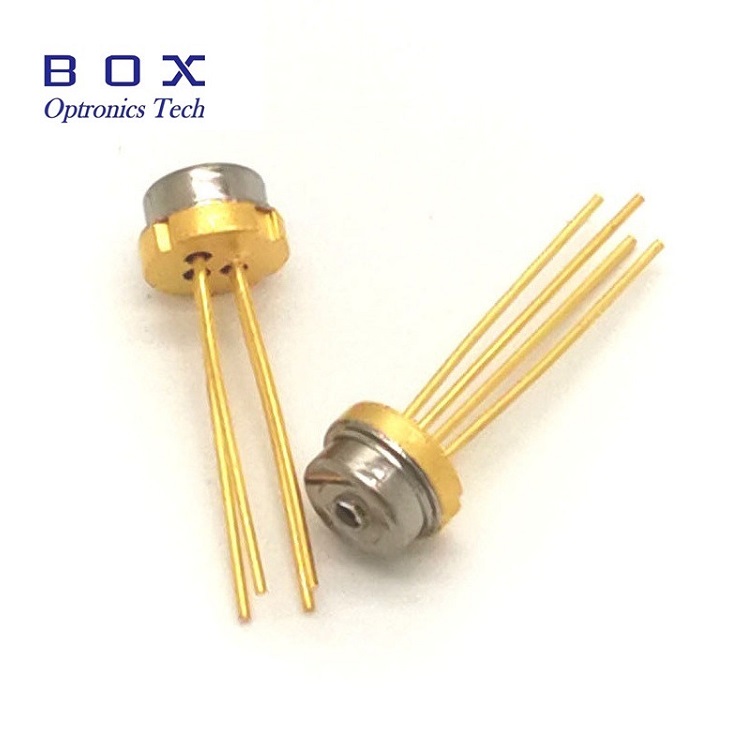
TO-CAN Packages
TO-CAN laser diodes are compact and practical for many OEM applications. They can be attractive when space, cost, and straightforward electrical integration are important. Box Optronics lists 5.6 mm and 9 mm TO-can laser diode options among its laser component packaging formats.
Butterfly Packages
Butterfly packages are commonly selected for applications requiring more integrated thermal and optical management. Depending on the device design, the package can incorporate features such as a thermoelectric cooler, thermistor, monitor photodiode, optical isolator, and fiber pigtail.
Chip on Submount and C-Mount Designs
Chip-on-submount and C-mount configurations can provide flexibility for higher-power or application-specific integration. They are often considered by OEM engineers who have their own optical, thermal, or mechanical assembly architecture.
Applications and System Requirements
Different applications place very different demands on laser components. Understanding the end-use environment helps engineers avoid unnecessary specifications while protecting the requirements that directly influence system performance.
| Application | Important Component Characteristics | Typical Considerations |
|---|---|---|
| Fiber-Optic Communication | Wavelength accuracy, modulation, power stability, fiber coupling | Network wavelength plan, transmission distance, receiver sensitivity |
| Fiber-Optic Sensing | Wavelength stability, linewidth, low noise, environmental stability | Sensor architecture, measurement resolution, operating temperature |
| Interferometry | Coherence, wavelength stability, spectral characteristics | Phase stability, optical path length, measurement precision |
| OTDR and Reflectometry | Pulse behavior, wavelength, peak power, fiber coupling | Measurement distance, spatial resolution, detector compatibility |
| Medical Equipment | Wavelength, output stability, package reliability, thermal management | Instrument architecture, duty cycle, safety and qualification requirements |
| Industrial Measurement | Robustness, temperature performance, optical stability | Vibration, ambient temperature, operating lifetime |
| Optical Instrumentation | Beam quality, wavelength, power stability, mechanical compatibility | Optical alignment, space constraints, calibration requirements |
A component should therefore be selected from the application backward. Start with the measurement or communication requirement, determine the optical architecture, identify the required source and passive components, and then define the detailed component specifications.
A Practical Selection Process for Laser Components
A structured selection process can reduce prototype revisions, compatibility issues, and unnecessary purchasing costs.
Build a Complete Specification Sheet
Before contacting a supplier, prepare a concise technical specification. At minimum, it should include:
- Required center wavelength or wavelength range
- Minimum and target optical output power
- Continuous-wave or pulsed operating mode
- Required modulation speed, if applicable
- Fiber type, core size, numerical aperture, or coupling method
- Preferred package and mechanical dimensions
- Operating and storage temperature
- TEC, thermistor, or monitor photodiode requirements
- Connector, pigtail, or bare-fiber requirements
- Prototype quantity and expected annual production volume
Providing these details allows the supplier's technical team to determine whether a standard product is suitable or whether a customized configuration should be considered.
Common Purchasing Problems and How to Avoid Them
Problem 1: Choosing Only by Wavelength
Two components may operate at the same nominal wavelength while having substantially different power, package, linewidth, fiber coupling, thermal, or electrical characteristics. Wavelength should be treated as the starting point rather than the complete selection criterion.
Problem 2: Selecting Excessive Optical Power
More power is not always better. Excess power can increase thermal load, introduce detector saturation, complicate attenuation, and increase system design requirements. Define the required power at the actual optical interface instead of selecting the largest available rating.
Problem 3: Ignoring Fiber Compatibility
Efficient coupling depends on factors such as fiber type, mode field characteristics, numerical aperture, alignment, and optical design. A laser with excellent free-space output may not provide the desired performance after fiber coupling.
Problem 4: Treating the Package as an Afterthought
Package selection affects assembly, heat removal, electrical control, maintenance, and mechanical reliability. Confirm the complete package specification before approving the final component.
Problem 5: No Production Plan After Prototyping
A component may perform well during laboratory testing but create supply or consistency challenges during mass production. Discuss sample availability, production capacity, testing procedures, customization, packaging, and expected volumes early in the project.
Reliability and Quality Considerations
Optical components operate in environments where small variations can influence system-level performance. Reliability should therefore be evaluated from both the component and integration perspectives.
- Verify that key optical and electrical parameters are tested against defined specifications.
- Confirm the operating temperature range required by the final equipment.
- Review whether burn-in or screening is performed when appropriate for the product type.
- Check optical fiber alignment and coupling consistency between production units.
- Confirm package integrity and mechanical requirements for the intended environment.
- Request relevant test data when the application has demanding stability requirements.
- For OEM projects, clarify engineering change procedures and production consistency expectations.
For example, Box Optronics states on its product page that certain TO-CAN DFB laser products undergo testing and burn-in. The same product information also identifies applications such as communications research, interferometry, and optical reflectometry for distance measurement.
When Custom Laser Components Are Needed
Standard components are efficient when their specifications match the application. However, OEM projects frequently have requirements that do not fit a standard catalog configuration.
Customization may involve wavelength, optical output, fiber type, package configuration, pigtail length, connector, operating temperature, electrical interface, or mechanical dimensions. In some projects, the most effective approach is not to modify every parameter but to identify the few specifications that directly affect system performance and keep the remaining parameters as standard as possible.
Box Optronics lists customized laser components as part of its offering and indicates that customers can work with the company on product solutions and industry cost optimization. Its published laser component range includes products such as 850 nm and 940 nm VCSELs, 1270–1310 nm TO-CAN DFB laser diodes, and higher-power chip-on-carrier laser diodes.
What to Provide for a Custom Project
- Application description and expected operating environment.
- Required wavelength and allowable tolerance.
- Target optical power and operating mode.
- Fiber type and optical coupling requirements.
- Package drawings or available installation space.
- Electrical drive conditions and control requirements.
- Temperature range and thermal-management method.
- Sample quantity and expected production volume.
- Required testing, documentation, and acceptance criteria.
The more complete the initial technical information, the easier it becomes to identify an appropriate configuration and reduce unnecessary engineering iterations.
Frequently Asked Questions About Laser Components
Making Laser Component Selection More Predictable
Selecting laser components is fundamentally an engineering compatibility problem. Wavelength, output power, spectral characteristics, fiber coupling, package design, thermal control, electrical requirements, and environmental conditions all influence the final performance of an optical system.
A reliable selection process begins by defining the application, translating system requirements into measurable component specifications, evaluating package and integration constraints, and validating performance before moving into volume production.
For engineers developing fiber-optic communication equipment, sensing systems, measurement instruments, medical devices, or industrial optical equipment, working with a supplier that can discuss both standard products and application-specific configurations can simplify development and shorten the path from prototype to production.
Need the Right Laser Components for Your Project?
Box Optronics Tech provides laser components and related fiber-optic products for communication, sensing, measurement, industrial, and OEM applications. If you already have a target wavelength, optical power, package, fiber specification, or custom requirement, our technical team can help you define a suitable configuration.
Share your application requirements, expected quantity, and technical specifications with us so the product configuration can be evaluated according to your actual system needs.
Contact Us