

How Do High-Frequency Transformers Reduce Energy Loss in Power Adapters
2026-03-11
In the world of power electronics, efficiency is paramount. The Power Adapter EE Vertical High-Frequency Transformer plays a pivotal role in minimizing energy waste. At Haoer, we specialize in manufacturing these critical components to ensure your devices run cooler, last longer, and comply with global energy standards.
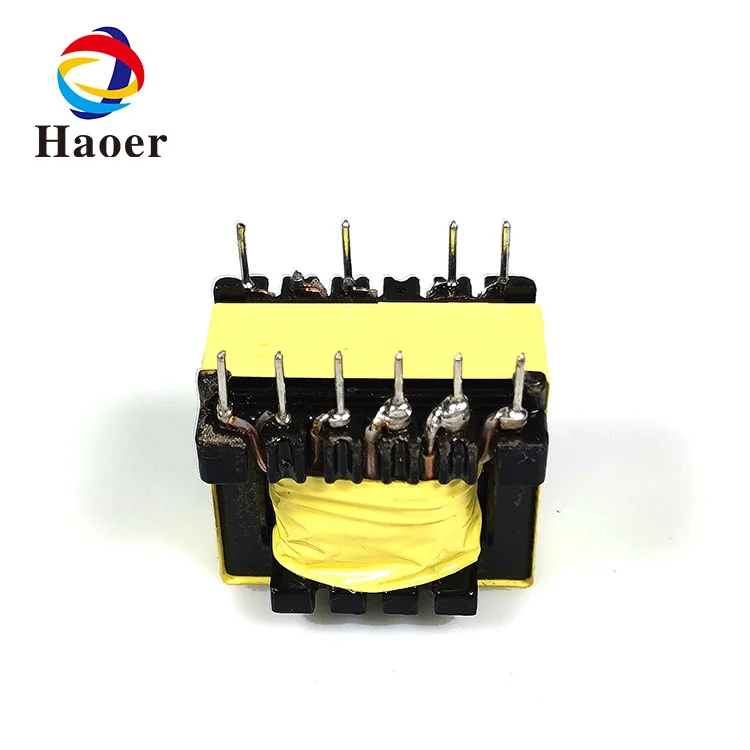
The Science of Energy Loss Reduction
Traditional transformers operate at lower frequencies, requiring larger cores and more copper windings. This leads to significant losses. High-frequency transformers solve this by operating at frequencies between 20 kHz and several MHz. This shift allows for a dramatic reduction in core volume and turns count, which directly curbs two primary types of energy loss.
1. Core Loss Reduction
Core losses, consisting of hysteresis and eddy current losses, are frequency-dependent. By utilizing advanced ferrite materials in our Haoer transformers, we achieve low coercivity and high resistivity. Operating at high frequencies with optimized flux density minimizes the area inside the hysteresis loop, thus reducing heat generation.
2. Copper Loss Reduction
Copper losses (I²R) are minimized due to the shorter wire lengths required in a smaller core structure. The EE Vertical configuration further enhances this by providing a compact winding window, which reduces the Mean Length per Turn (MLT).
Comparative Efficiency Analysis
To visualize the advantage, here is a comparison between a standard 60Hz transformer and a Haoer high-frequency transformer in a power adapter application:
| Parameter | Standard 60Hz Transformer | Haoer High-Frequency Transformer |
|---|---|---|
| Operating Frequency | 50/60 Hz | 50 kHz - 200 kHz |
| Core Material | Silicon Steel | Advanced Ferrite |
| Core Loss (Typical) | High (Significant heat) | Low (Minimal heat) |
| Copper Loss | High (Long windings) | Low (Compact windings) |
| Efficiency Range | 75% - 85% | 90% - 95%+ |
| Physical Size | Large and Heavy | Compact and Lightweight |
Key Design Factors Influencing Efficiency
Several engineering factors determine how effectively a Power Adapter EE Vertical High-Frequency Transformer reduces energy loss:
-
Core Geometry: The EE shape offers a balanced magnetic path, reducing leakage inductance.
-
Winding Technique: Techniques like interleaving and using Litz wire reduce skin and proximity effects.
-
Gap Control: Precision air gaps prevent core saturation, maintaining inductance under load.
At Haoer, we precisely control these variables to ensure that every transformer meets strict efficiency targets, such as the US Department of Energy Level VI standards.
Frequently Asked Questions
Here are some common inquiries regarding the Power Adapter EE Vertical High-Frequency Transformer:
What makes the EE vertical design more efficient than other shapes for reducing energy loss?
The EE vertical design is inherently efficient because it provides a large cross-sectional area relative to its window area. This geometry confines the magnetic flux effectively, resulting in lower leakage inductance compared to other shapes like toroidal or pot cores in certain mounting contexts. Lower leakage inductance means less energy is stored in the air gap as stray magnetic fields, which would otherwise dissipate as heat. The vertical orientation also allows for better PCB layout, shortening trace paths and reducing resistive losses in the adapter circuitry.
How does operating at a higher frequency actually reduce the physical size and core loss of a transformer?
The relationship is governed by the formula for voltage in a transformer (V = 4.44 * f * N * B * A). For a given voltage, if the frequency (f) increases, the product of the number of turns (N) and the core area (A) can decrease proportionally. A smaller core area (A) and fewer turns (N) mean less core material and shorter copper wires. Less core material directly reduces hysteresis and eddy current losses, while shorter wires reduce resistance and thus copper losses (I²R). This is the fundamental principle that allows Haoer to create compact yet highly efficient power solutions.
Can a high-frequency transformer still be efficient if the power adapter has a fluctuating load?
Yes, a well-designed Power Adapter EE Vertical High-Frequency Transformer maintains high efficiency across a wide load range. This is achieved through careful selection of ferrite materials with low core loss at various flux densities and by optimizing the winding design for both continuous and discontinuous conduction modes. Haoer designs transformers with specific inductance and leakage inductance values to ensure that the switching integrated circuit (IC) can maintain Zero Voltage Switching (ZVS) or Valley Switching even under light loads, thereby minimizing switching losses and preserving overall adapter efficiency.
Conclusion
The shift to high-frequency operation is the key to modern, efficient power adapters. By minimizing core and copper losses, the Power Adapter EE Vertical High-Frequency Transformer enables compact, cool, and energy-compliant designs.
Are you looking to improve the efficiency of your power adapters? Haoer provides cutting-edge transformer solutions tailored to your specifications.
Contact us today for a engineering consultation and request a quote.