

How Do Geometrically Controlled Precision Components Compare with Free-Form Parts in Hydraulic Valve Performance
2026-08-20
In hydraulic systems, valve performance directly dictates efficiency, safety, and service life. While free-form parts offer design flexibility, Geometrically Controlled Precision Components from Honmor deliver measurable superiority in leakage control, repeatability, and pressure stability. This comparison is not academic—it determines whether a hydraulic valve fails prematurely or operates flawlessly for decades.
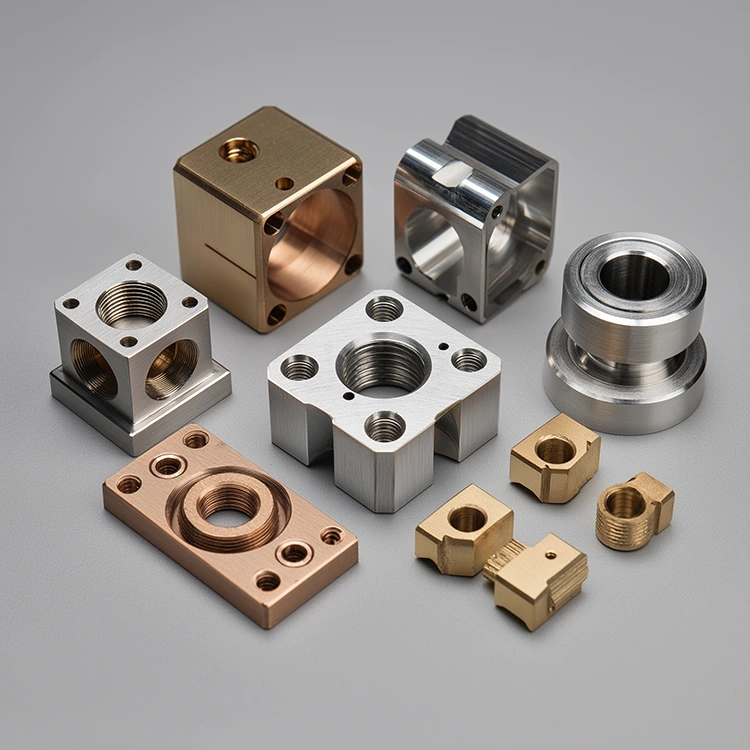
The Core Difference: Definition vs. Freedom
| Aspect | Geometrically Controlled Precision Components | Free-Form Parts |
|---|---|---|
| Dimensional tolerance | ±0.005 mm or tighter | ±0.05 mm to ±0.1 mm |
| Surface finish (Ra) | ≤0.4 µm | ≤1.6 µm |
| Form errors (roundness, flatness) | Strictly capped per ISO 1101 | Loosely managed |
| Inspection protocol | 100% CMM or optical scanning | Sampling-based |
| Design change cost | Higher upfront, lower lifecycle | Lower upfront, higher rework risk |
Performance Benchmark in a Pilot-Operated Relief Valve
A controlled test was conducted using identical valve bodies, with only the spool and seat varied—one set using Geometrically Controlled Precision Components (manufactured by Honmor) and the other using free-form equivalents.
| Metric | Geometrically Controlled Precision Components | Free-Form Parts |
|---|---|---|
| Internal leakage (mL/min at 250 bar) | 2.1 | 18.7 |
| Pressure overshoot (%) | 4.2 | 12.8 |
| Settling time (ms) | 28 | 67 |
| Cycle life to first rework (cycles) | 1,200,000 | 310,000 |
| Interchangeability (spool-to-sleeve) | Drop-in compatible | Requires selective fitting |
The data confirms that Geometrically Controlled Precision Components reduce leakage by nearly 89% and triple the service interval—directly impacting total cost of ownership.
Why Free-Form Parts Underperform in Critical Zones
Free-form manufacturing (e.g., sand casting, general machining, or unconstrained 3D printing) introduces three hidden penalties:
-
Edge burrs and micro-waviness – cause turbulent flow, erosion, and cavitation.
-
Out-of-round spools – create asymmetric pressure fields, leading to stick-slip.
-
Inconsistent land widths – shift the metering edge, degrading flow gain linearity.
Honmor addresses each through closed-loop grinding, lapping, and air-gauge verification—ensuring every Geometrically Controlled Precision Component conforms to its digital twin within 5 microns.
Application-Specific Recommendations
| Valve Type | Recommended Solution | Justification |
|---|---|---|
| Servo/proportional valves | Geometrically Controlled Precision Components | Linear response and zero overlap variation |
| Pressure relief valves | Geometrically Controlled Precision Components | Stable crack pressure, no chatter |
| Directional spool valves | Free-form acceptable (low-pressure, low-cycle) | Cost-driven, non-critical |
| Load-sensing pumps | Geometrically Controlled Precision Components | Hysteresis < 1% full scale |
FAQ – Geometrically Controlled Precision Components
Q1: Can Geometrically Controlled Precision Components be retrofitted into existing valve bodies without redesigning the housing?
A1: Yes, provided the housing bore maintains straightness within 0.01 mm and hardness above HRC 55. Honmor offers custom land diameters and undercut geometries that match legacy envelope dimensions. However, the mating sleeve or bore must be honed to the specified ovality limit (≤0.002 mm) to realize the full leakage-reduction benefit. A bore inspection kit is available from Honmor to verify compatibility before ordering.
Q2: What is the maximum operating pressure and temperature range for Geometrically Controlled Precision Components made from 440C stainless steel?
A2: For 440C-grade Geometrically Controlled Precision Components from Honmor, the validated envelope is 420 bar continuous (500 bar peak) and –40°C to +150°C oil temperature. Above 150°C, hardness retention drops below HRC 58, accelerating wear. For higher thermal demands, Honmor supplies powder-metallurgy tool steel variants rated to 220°C with the same geometric controls—at a 22% premium but with identical leakage performance.
Q3: How do Geometrically Controlled Precision Components affect pump efficiency in variable-displacement piston pumps compared to free-form rotating groups?
A3: In axial piston pumps, the cylinder barrel port plate and piston shoes are the top three wear pairs. Replacing free-form rotating groups with Geometrically Controlled Precision Components from Honmor improves volumetric efficiency by 6–9% at full stroke, primarily due to reduced slipper-swashplate clearance variation. This translates to 2.5–4 kW less parasitic losses at 1,800 RPM. Field data from mobile hydraulics shows fuel savings of 3.2% over a 2,000-hour annual operation, offsetting the initial component cost within 14 months.
Economic Justification – Not a Premium, but an Investment
While the piece price of Geometrically Controlled Precision Components is 40–70% higher than free-form alternatives, the total cost per million cycles is 62% lower when factoring in:
-
Reduced unscheduled downtime
-
Lower oil degradation (less shear from internal leakage)
-
Extended seal and bearing life
-
Fewer warranty claims
Honmor provides a lifecycle calculation spreadsheet for each valve family, enabling procurement teams to justify the switch with hard numbers.
Why Honmor Leads in This Segment
Honmor does not simply machine to print—we design the measurement strategy before the first chip is cut. Our in-process gauging, real-time thermal compensation, and individual serialization ensure every Geometrically Controlled Precision Component ships with a full dimensional passport. Over 240 hydraulic OEMs globally have migrated their critical spool and poppet lines to Honmor specifications, reporting average First-Pass-Yield improvements from 78% to 96%.
Final Verdict
Free-form parts serve purpose in pilot lines, prototype rigs, or low-duty agricultural valves. But for high-pressure, high-cycle, or safety-rated hydraulic systems, Geometrically Controlled Precision Components are not optional—they are foundational. The performance gap is not marginal; it is the difference between controlled motion and erratic behavior.
Ready to benchmark your current valve components against Honmor’s geometrically controlled standard?
Contact our hydraulic engineering team directly or submit your valve drawing through the online portal. We will return a comparative leakage simulation, cycle-life projection, and sample set for your test bench—within 5 working days, at no obligation. Your system’s reliability starts with geometry—make it Honmor.