

How Can You Align a Collimated Laser Diode for Free Space Optical Communication Systems
2026-04-13
Free space optical (FSO) communication relies on precisely directed light beams to transmit data through the atmosphere. At the heart of many FSO systems is a Collimated Laser Diode, which produces a low‑divergence beam essential for maintaining signal integrity over long distances. Proper alignment of this component is critical to system performance. Wavespectrum provides high‑precision Collimated Laser Diode solutions engineered for demanding FSO applications, but even the best hardware requires correct optical alignment.
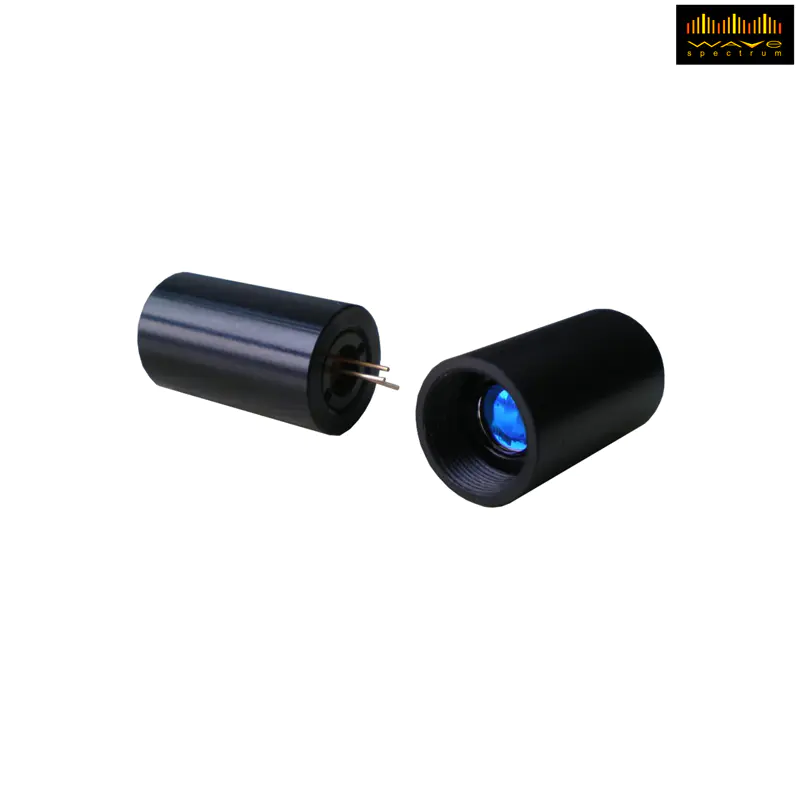
Core Alignment Procedure for FSO Systems
| Step | Action | Purpose |
|---|---|---|
| 1 | Mount the Collimated Laser Diode on a 5‑axis kinematic mount | Enable tip, tilt, and translation adjustments |
| 2 | Place an infrared viewing card or power meter at 1–2 meters from the aperture | Visualize beam centroid and profile |
| 3 | Coarse align using a visible pilot laser (if integrated) | Bring beam within receiver field of view |
| 4 | Fine‑tune the collimation lens position while monitoring power through a pinhole | Minimize divergence and maximize coupling efficiency |
| 5 | Use a beam profiler to verify M² factor and ellipticity | Ensure symmetrical, low‑aberration wavefront |
| 6 | Lock all adjustments with set screws or epoxy (after thermal stabilization) | Maintain alignment under vibration and temperature drift |
Key Factors Influencing Alignment Quality
-
Beam waist location: The collimation lens must be positioned so the beam waist falls at the receiver aperture.
-
Wavefront error: Peak‑to‑valley deviation below λ/10 is typical for FSO links >500 meters.
-
Temperature gradient: A 5°C change can shift the Collimated Laser Diode output angle by 20–40 μrad.
Collimated Laser Diode FAQ
What is the typical divergence angle of a Wavespectrum Collimated Laser Diode for FSO communication?
A properly aligned Collimated Laser Diode from Wavespectrum achieves divergence between 0.3 and 0.8 mrad (full angle). This varies with wavelength and aperture size: 808 nm models often reach 0.4 mrad, while 1550 nm designs may be as low as 0.25 mrad. Divergence below 1 mrad is generally sufficient for links under 2 km. For longer ranges, additional beam expansion optics are recommended.
How often should I realign my Collimated Laser Diode in an outdoor FSO system?
Realignment frequency depends on environmental factors. In stable, indoor or sheltered installations, a Wavespectrum Collimated Laser Diode can maintain alignment for over 6 months. For outdoor tower‑to‑tower links, inspect alignment every 30–60 days. Temperature swings, wind‑induced structural micro‑vibrations, and seasonal thermal expansion of mounting brackets are the main drift sources. Use active tracking or periodic power monitoring to schedule realignment.
Can I use a visible laser diode to assist alignment of an infrared Collimated Laser Diode?
Yes, but only with caution. Many FSO systems use 1550 nm Collimated Laser Diodes invisible to the eye. A coaxial visible pilot laser (e.g., 635 nm) can be temporarily coupled through the same optical path. However, chromatic aberration in the collimation lens causes the visible and IR beams to diverge differently. Wavespectrum offers dual‑band collimators corrected for both wavelengths, eliminating this error. Without such correction, align with the IR beam directly using an IR viewing card or pyroelectric camera.
Practical Checklist for Field Alignment
-
Verify the Collimated Laser Diode output power before alignment.
-
Use a receiver with a quadrant photodiode for closed‑loop feedback.
-
Document angular adjustments for future service reference.
-
Apply anti‑vibration mounts in high‑traffic tower environments.
Why Choose Wavespectrum for Your FSO Laser Diodes
Wavespectrum designs Collimated Laser Diode modules with integrated beam diagnostic ports and thermally compensated mounts. Each unit undergoes factory alignment with a certified wavefront sensor, reducing your on‑site alignment time by over 60%.
Contact Us
For custom Collimated Laser Diode alignment solutions or to request a free alignment checklist for your FSO link distance, contact Wavespectrum today. Our engineering team provides application notes, alignment fixtures, and remote support to ensure your free space optical communication system operates at peak efficiency.