

How Can a 2.8' Transmissive Smart HMI TFT LCD Display Module Enhance Compact Device Interfaces?
2026-11-20
Human-machine interfaces (HMI) play an essential role in modern electronic equipment, enabling users to monitor information, understand operating conditions, and interact with intelligent devices. For compact products, choosing a display that balances screen clarity, power consumption, mechanical dimensions, and system compatibility can be challenging. A 2.8' Transmissive Smart HMI TFT LCD Display Module provides a compact visual solution for industrial controllers, portable instruments, smart home appliances, and embedded electronic systems.
Featuring a 240 × RGB × 320 resolution, MCU 8/16-bit interface, 65K/262K color support, and a four-LED backlight, this module is designed for space-conscious applications. Its operating temperature range of -20°C to +70°C also makes it suitable for various industrial and commercial environments. This article explores its working principles, technical specifications, application scenarios, integration considerations, and purchasing factors to help engineers and buyers make informed decisions.
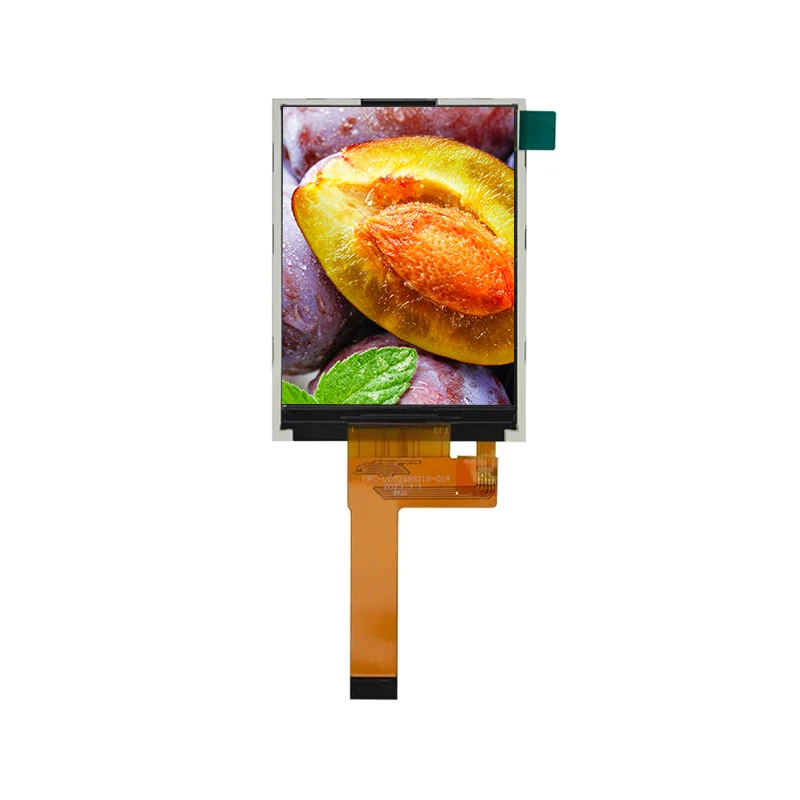
1. Understanding the 2.8' Transmissive Smart HMI TFT LCD Display Module
A 2.8' Transmissive Smart HMI TFT LCD Display Module is a compact color display designed to present operating information, graphical interfaces, and real-time data in electronic equipment. It combines thin-film transistor (TFT) display technology with a transmissive optical structure and an LED backlight, providing a practical visual interface for embedded systems.
The 2.8-inch screen format is particularly useful when equipment designers need to display multiple types of information without increasing the overall product size. It can accommodate numerical readings, operating menus, icons, simple diagrams, status indicators, and other graphical elements.
Unlike a monochrome character display, a color TFT LCD can present different colors and visual elements to help users distinguish operating states and understand information more quickly.
The Tianfu 2.8-inch module features a 240 × RGB × 320 pixel resolution and supports 65K/262K colors. It uses an MCU 8/16-bit interface and is driven by ILJ9341 or ST7789 controller IC options, depending on the configuration.
What Makes It Suitable for HMI Applications?
HMI applications require more than simply displaying an image. The screen must communicate operating information in a clear and organized way. A compact TFT display enables developers to build graphical interfaces that combine text, numbers, symbols, and visual indicators.
For example, a portable instrument can display measurement values alongside operating status, while a smart appliance can use color menus to guide users through different functions.
2. How Does Transmissive TFT LCD Technology Work?
Transmissive TFT LCD technology works by controlling how much light passes through liquid crystal pixels. Since liquid crystals do not produce their own light, the display relies on a backlight positioned behind the LCD panel.
The Basic Display Process
- Backlight generation: White LEDs generate light behind the LCD panel.
- Light transmission: The light passes through the optical layers and liquid crystal structure.
- Pixel control: Thin-film transistors control the electrical state of individual pixels.
- Color formation: RGB color filters combine red, green, and blue subpixels to create different colors.
- Image presentation: The controlled pixels form text, graphics, icons, and other visual content.
What Does Transmissive Display Mode Mean?
A transmissive display uses its backlight as the primary source of illumination. This allows the screen to maintain visible content in environments where ambient lighting is insufficient.
Unlike reflective displays that rely heavily on surrounding light, transmissive TFT LCD modules can operate consistently in indoor environments with varying lighting conditions, provided the backlight is properly powered.
However, transmissive technology does not automatically mean sunlight-readable performance. Direct sunlight may create reflections and reduce perceived contrast. Outdoor applications should evaluate brightness, optical bonding, anti-glare treatment, and other sunlight-visibility requirements.
Why Does TFT Technology Matter?
TFT technology uses active-matrix pixel control. Each pixel is controlled through its corresponding transistor structure, allowing the display to refresh graphical content efficiently.
This makes TFT LCD technology suitable for interfaces that need to show changing measurements, operating menus, status information, and graphical indicators.
3. Key Features and Technical Advantages
When choosing a small HMI display, buyers should consider more than screen size. Electrical compatibility, display resolution, power consumption, environmental resistance, and mechanical dimensions all affect the final application.
Provides a portrait-oriented display area for menus, measurements, icons, and compact graphical interfaces.
Supports colorful interface elements that help distinguish operating information and device status.
Provides an interface option for compatible embedded processors and controller platforms.
Measures approximately 50.0 × 69.2 × 2.45 mm, helping simplify integration into space-limited equipment.
Designed to operate from -20°C to +70°C under the specified conditions.
Uses four parallel LEDs with a maximum specified current of 80 mA.
Multiple Voltage Compatibility
The module specifies a logic supply voltage of 2.5–3.3V and an I/O voltage range of 1.65–3.3V. This provides flexibility for embedded platforms operating with different logic voltage levels.
Engineers should still confirm the exact electrical timing, voltage tolerances, and pin assignments before connecting the module to a host controller.
Low-Power Backlight Design
Power consumption is a major concern in portable instruments, battery-powered equipment, and compact smart devices. The four-LED backlight design has a specified maximum current of 80 mA.
Actual system power consumption also depends on backlight drive conditions, operating brightness, display logic, refresh behavior, and the surrounding power-management circuit.
4. Detailed Technical Specifications
Understanding the product specifications helps engineers determine whether the display matches their mechanical, optical, and electrical requirements. The following table summarizes the published parameters of the Tianfu 2.8-inch transmissive smart HMI TFT LCD module.
| Specification | Product Parameter |
|---|---|
| Product Name | 2.8' Transmissive Smart HMI TFT LCD Display Module |
| Display Type | 2.8-inch TFT, Normally White |
| Resolution | 240 × RGB × 320 |
| Color Support | 65K / 262K Colors |
| Interface | MCU 8/16-bit |
| Display Mode | Transmissive TFT |
| Driver IC | ILJ9341 / ST7789 |
| Backlight | 4 Parallel LEDs |
| Maximum Backlight Current | 80 mA |
| Overall Dimensions | 50.0 × 69.2 × 2.45 mm |
| Active Area | 43.20 × 63.35 mm |
| Pixel Pitch | 0.153 × 0.153 mm |
| Operating Temperature | -20°C to +70°C |
| Storage Temperature | -30°C to +80°C |
| Contrast Ratio | 300:1 Typical |
| Response Time | 30 ms Rise / 30 ms Fall |
| Viewing Angle | 65° Typical, 12 O'clock Direction |
| Logic Voltage (VDD) | 2.5–3.3V, Typical 2.8V |
| I/O Voltage (IOVCC) | 1.65–3.3V, Typical 1.8V |
| Touch Panel | None |
Understanding the Display Dimensions
The overall dimensions are 50.0 × 69.2 × 2.45 mm, while the active display area is 43.20 × 63.35 mm. These measurements serve different purposes in product development.
- Overall dimensions: Define the physical footprint of the display module.
- Active area: Defines the region where visual content is displayed.
- Pixel pitch: Represents the distance between adjacent pixels and helps determine pixel density.
When designing an enclosure, engineers should use the mechanical drawing and mounting details rather than relying only on the nominal 2.8-inch diagonal size.
Why Should Engineers Check the Driver IC?
The ILJ9341 and ST7789 are listed as driver IC options for this product. The exact controller configuration should be confirmed before firmware development.
Different driver ICs may require different initialization commands, memory addressing settings, and timing configurations. Using the correct driver documentation can reduce debugging time and improve display compatibility.
5. Why Is the 2.8-Inch Format Suitable for Compact HMI Devices?
Display size directly affects the physical design, user experience, and information architecture of an electronic product. A screen that is too small can make important information difficult to read, while an oversized display may increase enclosure dimensions and system costs.
The 2.8-inch format offers a practical middle ground for products that need more visual flexibility than a basic character LCD but cannot accommodate a large display.
Better Information Organization
A 240 × 320 resolution allows developers to organize numerical values, status indicators, menus, and graphical elements into a compact interface.
For example, a handheld measurement instrument can display a main measurement value at the top, operating status in the middle, and menu controls near the bottom.
More Flexible Industrial Interface Design
Color TFT displays allow software developers to use different colors to represent warning conditions, normal operation, and system notifications. This helps users identify important information without relying entirely on text.
Space-Efficient Equipment Design
The compact dimensions make the module suitable for handheld devices, embedded controllers, and front-panel applications where installation space is limited.
Practical Power Management
The specified backlight current and low-voltage logic requirements make the module worth considering for embedded systems with defined power budgets. Engineers should calculate the complete system power consumption before finalizing the power supply.
6. Industrial and Commercial Applications
A 2.8-inch smart HMI TFT LCD display module can be used in many applications where compact visual information and reliable operation are required.
6.1 Industrial Automation and Control Panels
Industrial equipment often needs local displays to show machine status, production data, operating parameters, and warning messages.
A compact TFT display can serve as the visual interface for smaller controllers, PLC-related terminals, and monitoring equipment. It helps operators access essential information without installing a large industrial monitor.
6.2 Portable Testing and Measurement Instruments
Handheld instruments need screens that balance readability with portability. A 2.8-inch TFT LCD can display measurement values, test results, signal indicators, and configuration menus.
Potential applications include portable meters, testing instruments, handheld oscilloscopes, and monitoring equipment, subject to the required electrical and environmental specifications.
6.3 Smart Home Appliances
Smart appliances increasingly use graphical displays to communicate operating status and guide users through different functions.
Examples include:
- Coffee machines and beverage equipment.
- Smart thermostats and climate controllers.
- Air purification and ventilation systems.
- Ovens and intelligent kitchen appliances.
- Washing machines and household control devices.
The color display format can make menus and operating information easier to organize.
6.4 Portable Medical and Laboratory Instruments
Portable medical and laboratory equipment often needs to display measurement values, operating conditions, and system notifications in a compact format.
A small TFT LCD can support the visual interface of compatible instruments. However, medical applications require additional verification of regulatory compliance, electrical safety, reliability, and environmental suitability.
6.5 Fitness and Personal Monitoring Equipment
Fitness devices and compact monitoring systems can use small TFT displays to show exercise parameters, operating modes, measurement results, and user settings.
The display size helps equipment designers maintain a compact product structure while offering more information than a basic segment display.
7. How to Integrate the Display into an Embedded System
Display integration involves more than connecting power and signal wires. Engineers must verify electrical compatibility, configure the display driver, develop the graphical interface, and ensure that the mechanical structure protects the module during operation.
Step 1: Verify the Power Supply
Check the module's VDD and IOVCC requirements before connecting it to the host controller.
The specified logic voltage is 2.5–3.3V, while the I/O voltage is 1.65–3.3V. The power circuit must provide stable voltage within the permitted ranges.
Step 2: Confirm the MCU Interface
The module uses an MCU 8/16-bit interface. Confirm the exact pin definitions, bus configuration, communication timing, and supported operating modes using the manufacturer's datasheet.
The host processor must provide compatible GPIO and bus functionality to communicate with the display driver.
Step 3: Configure the Display Driver
Confirm whether the actual module uses the ILJ9341 or ST7789 driver IC. The initialization sequence, display orientation, color format, and memory addressing configuration should match the installed controller.
Step 4: Develop the Graphical Interface
Design the screen layout according to the available resolution. Important operating values should be easy to identify, while menus and secondary information should be arranged to avoid overcrowding.
For embedded products, efficient graphics libraries and optimized image assets can help reduce memory usage and improve interface performance.
Step 5: Design the Backlight Circuit
The module uses four parallel LEDs with a maximum specified current of 80 mA. The backlight driver should be designed according to the LED electrical requirements and the manufacturer's recommended circuit.
Do not assume that the backlight can be connected directly to every host board's power output. Current regulation and thermal considerations must be evaluated.
Step 6: Complete Mechanical Installation
Use the product drawing to determine the enclosure opening, fixing points, FPC routing, and connector clearance.
Avoid excessive pressure on the glass panel and flexible circuit. Mechanical stress can damage the display or cause connection problems.
Step 7: Test the Finished Device
Before mass production, test the module under actual operating conditions. Check image stability, color consistency, backlight performance, power consumption, temperature behavior, and communication reliability.
| Integration Area | Key Verification Items |
|---|---|
| Electrical Design | VDD, IOVCC, signal levels, and power stability. |
| Interface | MCU bus width, pin definitions, and timing. |
| Driver Software | Controller IC, initialization commands, and image orientation. |
| Graphics Design | Resolution, color format, font size, and memory usage. |
| Backlight | LED current, power supply, and brightness control. |
| Mechanical Design | Dimensions, FPC position, mounting, and enclosure clearance. |
| Environmental Testing | Operating temperature, vibration, and electrical interference. |
8. Common Display Integration Challenges and Solutions
Even a technically suitable LCD module can experience problems when the electrical design, software configuration, or installation environment is not properly evaluated.
Problem 1: The Display Shows a White or Blank Screen
Possible causes: Incorrect initialization commands, unstable power supply, loose FPC connections, or an incompatible driver configuration.
Recommended solutions: Check the power rails, verify the pin connections, confirm the driver IC, and review the initialization sequence.
Problem 2: Display Colors Look Incorrect
Possible causes: Incorrect RGB/BGR configuration, color-depth mismatch, or unsuitable pixel-format settings.
Recommended solutions: Confirm the color format supported by the driver and host software. Test standard color patterns during development.
Problem 3: The Display Is Difficult to Read
Possible causes: Insufficient backlight output, strong ambient light, viewing-angle limitations, or unsuitable display orientation.
Recommended solutions: Evaluate the specified brightness and viewing direction. If the equipment will be used outdoors, discuss higher-brightness or optical customization options with the supplier.
Problem 4: The Display Does Not Work with the Main Controller
Possible causes: Incompatible MCU interface configuration, incorrect signal voltage, timing errors, or incorrect driver IC assumptions.
Recommended solutions: Review the electrical datasheet and verify the exact module configuration before firmware development. Test communication with a minimal driver program first.
Problem 5: The Display Performs Poorly at Low or High Temperatures
Possible causes: Operation outside the specified temperature range, unsuitable power conditions, or environmental stress.
Recommended solutions: Confirm the actual operating environment and keep the device within the specified -20°C to +70°C operating range. If the application requires more extreme temperatures, request a suitable alternative.
Problem 6: The Module Does Not Fit the Product Enclosure
Possible causes: Incorrect interpretation of the overall dimensions, insufficient FPC clearance, or unsuitable mounting tolerances.
Recommended solutions: Use the latest mechanical drawing, verify all mounting dimensions, and test a sample in the final enclosure before mass production.
9. How to Choose a Reliable HMI TFT LCD Display Supplier
Choosing an LCD supplier is an important decision for manufacturers developing electronic products. The right supplier should provide consistent product quality, accurate technical documentation, practical customization options, and dependable technical support.
Evaluate Technical Specifications
Ask for a complete datasheet and mechanical drawing. Verify the display resolution, driver IC, interface, logic voltage, backlight requirements, viewing angle, and operating temperature range.
Technical documentation should clearly identify the actual product configuration instead of relying on general specifications for an entire product family.
Check Quality Inspection Procedures
Display defects such as dead pixels, uneven backlighting, abnormal colors, and connection failures can affect the finished product.
Buyers should understand the supplier's incoming material inspection, functional testing, appearance inspection, and environmental verification procedures.
Consider Customization Capabilities
Different electronic products may require customized FPC dimensions, connector positions, backlight configurations, display brightness, or mechanical structures.
Discuss these requirements before production to determine technical feasibility, development time, tooling costs, and minimum order quantities.
Confirm Long-Term Supply Stability
For products intended for long-term manufacturing, display availability is an important consideration. Buyers should discuss component lifecycle management, production continuity, replacement options, and technical support arrangements.
Why Work with Shenzhen Tianfu Innovative Technology Co., Ltd.?
Shenzhen Tianfu Innovative Technology Co., Ltd. specializes in LCD display modules and customized display solutions for industrial and commercial electronic applications.
The company's 2.8' Transmissive Smart HMI TFT LCD Display Module is designed for compact equipment requiring color display functionality, practical electrical integration, and reliable operation across a range of environmental conditions.
Key product characteristics include:
- 240 × RGB × 320 resolution.
- 65K/262K color support.
- MCU 8/16-bit interface.
- ILJ9341 / ST7789 driver IC options.
- -20°C to +70°C operating temperature.
- Four-LED backlight with a maximum current of 80 mA.
- Compact 50.0 × 69.2 × 2.45 mm dimensions.
The product information also describes pixel inspection, environmental testing, and RoHS-related product compliance. Buyers should request the relevant documentation and confirm the applicable specifications for their order.
For developers and procurement teams, working directly with Tianfu provides an opportunity to discuss display compatibility, product customization, and project-specific technical requirements.
Buyer Checklist Before Ordering
- Confirm the required 2.8-inch screen format.
- Verify the 240 × RGB × 320 resolution.
- Check the driver IC and MCU interface configuration.
- Confirm VDD and IOVCC compatibility.
- Review the backlight electrical requirements.
- Verify overall dimensions and active area.
- Check operating and storage temperatures.
- Confirm whether touch functionality is required.
- Request a sample for prototype evaluation.
- Discuss customization, lead time, and long-term supply.
10. Frequently Asked Questions
Q1. What is a 2.8' Transmissive Smart HMI TFT LCD Display Module?
It is a compact color TFT LCD module designed for human-machine interface applications. It displays graphical information, operating data, menus, and status indicators in electronic equipment.
Q2. What is the resolution of the Tianfu 2.8-inch HMI TFT LCD module?
The module has a resolution of 240 × RGB × 320 pixels and supports 65K/262K colors, making it suitable for compact graphical interfaces and numerical information displays.
Q3. What does transmissive TFT LCD mean?
Transmissive TFT LCD technology uses a backlight behind the LCD panel to illuminate the displayed content. It is suitable for applications requiring consistent screen illumination in indoor environments and controlled lighting conditions.
Q4. Does this 2.8-inch HMI display support touch input?
The published specification lists the touch panel as none. It is a display module rather than an integrated touchscreen. If touch functionality is required, buyers should discuss a compatible touch-enabled configuration with the manufacturer.
Q5. Which driver IC does the display use?
The product lists ILJ9341 and ST7789 as driver IC options. The exact installed controller should be confirmed before selecting the firmware driver and preparing the initialization sequence.
Q6. What interface does the module support?
The published product specification identifies an MCU 8/16-bit interface. Engineers should request the detailed pinout and timing documentation to verify compatibility with the intended host controller.
Q7. What is the operating temperature range?
The specified operating temperature range is -20°C to +70°C, while the storage temperature range is -30°C to +80°C. Applications outside these limits require a different or customized display solution.
Q8. Is the module suitable for industrial control equipment?
Yes. Its compact size, color display, MCU interface, and operating temperature range make it suitable for evaluating in industrial controllers, monitoring instruments, and compact HMI equipment. Final suitability depends on the complete system requirements.
Q9. How much power does the backlight consume?
The module uses four parallel LEDs with a specified maximum current of 80 mA. Actual power consumption depends on the LED drive voltage and operating conditions. Refer to the manufacturer's backlight circuit specifications when designing the power supply.
Q10. Can the display be used in outdoor equipment?
It may be considered for outdoor equipment when the operating temperature and other environmental conditions are suitable. However, its transmissive display mode and published viewing characteristics do not establish direct-sunlight readability. Higher brightness and additional optical protection may be needed.
Q11. Can the 2.8-inch display module be customized?
Customization may be available depending on the project, including mechanical dimensions, FPC configuration, backlight requirements, and display specifications. Buyers should provide technical drawings and application details for evaluation.
Q12. What information is needed to request a quotation?
Provide the required display size, resolution, interface, controller compatibility, operating temperature, mechanical dimensions, application environment, and expected order quantity. A reference drawing or existing display model can also help the supplier assess the project.
Conclusion: Choosing a Compact HMI Display for Reliable Device Performance
A 2.8' Transmissive Smart HMI TFT LCD Display Module offers a practical visual solution for electronic devices that require compact dimensions, color information, and flexible embedded system integration.
With its 240 × RGB × 320 resolution, 65K/262K color support, MCU 8/16-bit interface, four-LED backlight, and -20°C to +70°C operating temperature range, the module can be considered for industrial controllers, portable instruments, smart appliances, and other compact HMI applications.
However, successful integration depends on more than choosing the correct screen size. Driver IC compatibility, electrical requirements, backlight design, mechanical dimensions, and environmental conditions must all be evaluated before production.
For equipment manufacturers, distributors, and electronic product developers, working with an experienced display supplier can help simplify component selection, reduce integration risks, and support long-term product development.
Looking for a Reliable 2.8-Inch Smart HMI TFT LCD Display Supplier?
Shenzhen Tianfu Innovative Technology Co., Ltd. provides TFT LCD display modules and customized display solutions for industrial equipment, smart home appliances, portable instruments, and embedded electronic systems.
Whether you are developing a compact HMI controller, upgrading an existing electronic device, or sourcing display modules for volume production, our team can help you evaluate suitable display configurations and technical requirements.
Have a new project or sourcing requirement? Contact us today to discuss your application, request detailed product specifications, and explore a suitable TFT LCD display solution for your business.
Contact Us for Product Details