

Does a DC1500V 400A Molded Case Circuit Breaker Require Arc-Flash Mitigation Accessories
2026-06-25
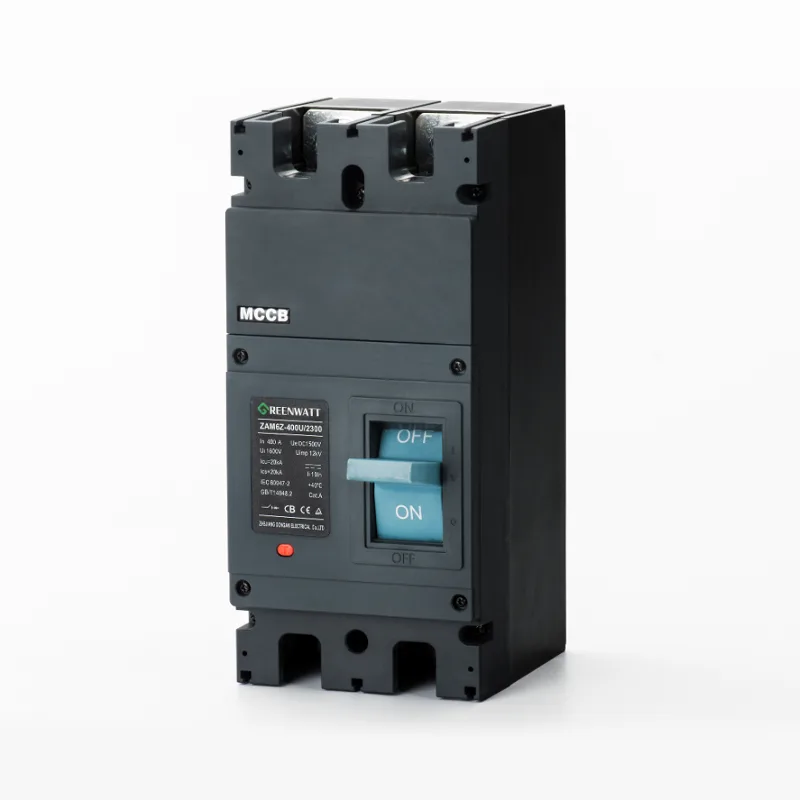
When specifying protective devices for large-scale photovoltaic plants or battery energy storage systems, the DC1500V 400A Molded Case Circuit Breaker has become a workhorse component. Yet one critical question persistently emerges among system designers and facility engineers: does this breaker, on its own, offer sufficient arc-flash protection, or do you need additional mitigation hardware? At GreenWatt, we field this query weekly, and the short answer is nuanced—it depends on your system architecture, available fault current, and maintenance protocols.
Understanding Arc-Flash Energy in DC Circuits
Direct current arc-flash behavior differs fundamentally from AC. With no natural current zero crossing, a DC arc can sustain itself longer, releasing intense thermal energy and pressure waves. A DC1500V 400A Molded Case Circuit Breaker interrupts fault currents mechanically, but the arc-flash incident energy at the point of installation often exceeds 40 cal/cm² in high-capacity battery banks—well above the 8 cal/cm² threshold for category 2 PPE.
The breaker’s internal arc chutes and blow-out coils extinguish the arc within 2–3 cycles (≈40–60 ms for DC). However, during that interval, the released energy can still cause catastrophic damage to adjacent components and pose severe risks to operators performing rack-level switching or testing.
When Are Arc-Flash Mitigation Accessories Mandatory?
Industry standards (NFPA 70E, IEEE 1584, and UL 489B) do not universally mandate add-on accessories for every DC1500V 400A Molded Case Circuit Breaker. Instead, the requirement is triggered by three specific conditions:
| Condition | Mitigation Accessory Recommended | Why |
|---|---|---|
| Available fault current > 25 kA at 1500Vdc | Arc-flash reduction maintenance switch (ARMS) or zone-selective interlocking | Reduces clearing time from 60 ms to < 20 ms |
| Enclosure access during live operation (e.g., draw-out racks) | Remote racking mechanism + arc-flash light sensors | Keeps personnel outside the arc-flash boundary |
| System with multiple paralleled sources (e.g., 4+ battery strings) | High-speed fused auxiliary contacts + arc-quenching chamber add-on | Limits energy let-through and prevents cascade arc propagation |
GreenWatt recommends that all new installations with a DC1500V 400A Molded Case Circuit Breaker serving lithium-ion banks above 2 MWh incorporate at least one active mitigation accessory, regardless of local code interpretations.
Practical Benefits of Adding Accessories
Beyond regulatory compliance, arc-flash mitigation accessories deliver tangible operational advantages:
-
Reduced PPE Category – With a maintenance switch engaged, incident energy can drop from category 4 (≥40 cal) to category 1 (≤4 cal), lowering worker fatigue and improving dexterity.
-
Faster Fault Isolation – Light-sensing trip units detect the arc flash itself (not just overcurrent), shuttling the DC1500V 400A Molded Case Circuit Breaker to trip in under 4 ms.
-
Extended Breaker Lifespan – Accessories like current-limiting reactors reduce mechanical stress on the contact assembly during high-fault interruptions, preserving the breaker’s 10,000-operation mechanical endurance.
Common Myths vs. Reality
| Myth | Reality |
|---|---|
| "The breaker's built-in arc chutes are enough." | Arc chutes handle the interruption but do not reduce incident energy for nearby personnel. |
| "Mitigation accessories are only for AC systems." | DC arcs are more persistent; accessories are equally critical—and often more impactful—in DC. |
| "Adding sensors makes the system less reliable." | Modern solid-state sensors have MTBF > 500,000 hours and include self-diagnostics. |
DC1500V 400A Molded Case Circuit Breaker – FAQ
Q: Can I use a standard thermal-magnetic trip unit without any arc-flash accessory on a DC1500V 400A Molded Case Circuit Breaker if my system is indoors and rarely accessed?
A: Yes, but only under a strict risk assessment. If the enclosure is located in a dedicated, access-controlled electrical room with a locked door, and all switching operations are performed via a remote HMI (human-machine interface), a standard trip unit may suffice. However, you must still calculate the incident energy per IEEE 1584 DC extension. If that value exceeds 12 cal/cm² at a working distance of 18 inches, GreenWatt strongly advises installing a maintenance switch that can be engaged before any door-opening activity. This switch temporarily lowers the instantaneous pickup setting, reducing clearing time by 30–50% without compromising coordination with downstream devices.
Q: How do I determine which arc-flash accessory combination is cost-effective for my specific DC1500V 400A Molded Case Circuit Breaker installation?
A: Start with a short-circuit study that includes both bolted and arcing fault currents at the breaker’s line and load terminals. Next, perform an incident energy analysis using recognized software (e.g., SKM or ETAP with DC modules). Compare the base-case energy (without accessories) against three scenarios: (1) adding a zone-selective interlock (ZSI) – lowest cost, ~15% reduction; (2) adding a light-sensing arc-flash relay – medium cost, ~70% reduction; (3) adding both ZSI and a high-speed grounding switch – highest cost, ~90% reduction. GreenWatt offers a free pre-engineering assessment tool that maps these trade-offs against your maintenance frequency. For most utility-scale solar-plus-storage sites, the payback period for option (2) is under 18 months when factoring in avoided PPE costs and reduced downtime from false trips.
Q: Will adding arc-flash mitigation accessories affect the coordination selectivity of my DC1500V 400A Molded Case Circuit Breaker with upstream and downstream protective devices?
A: Potentially yes, which is why coordination studies must be updated. A maintenance switch that lowers the instantaneous pickup setting can create a temporary overlap with downstream fuse curves if not properly coordinated. The solution is to use time-current curve (TCC) plots that show both normal and maintenance modes. GreenWatt recommends using electronic trip units with adjustable short-time delay and I²t memory, which maintain selectivity even when the arc-flash reduction mode is active. Additionally, modern accessories include communication ports (Modbus or IEC 61850) that feed real-time settings to your SCADA system, allowing remote toggling between normal and maintenance modes based on work permits. This preserves full coordination during normal operation and only sacrifices selectivity during the brief maintenance window—an acceptable trade-off per NFPA 70E Article 240.87.
Final Recommendation from GreenWatt
For any DC1500V 400A Molded Case Circuit Breaker installed in a system with fault current exceeding 15 kA or with routine live-front access, arc-flash mitigation accessories are not optional—they are essential risk-control investments. The incremental cost (typically 8–12% of the breaker’s price) is negligible compared to a single arc-flash injury claim or an unplanned outage caused by cascading faults.
GreenWatt designs and supplies fully integrated arc-flash solutions—including light sensors, maintenance switches, and remote racking modules—that are pre-tested with our DC1500V 400A Molded Case Circuit Breaker line. Every kit comes with a coordination study and 5-year performance warranty.
Ready to safeguard your DC system? Contact GreenWatt today for a personalized arc-flash risk review. Our engineering team will map your one-line diagram, calculate incident energies, and deliver a bill-of-materials with exact accessory part numbers—all within 48 hours.