

Can You Use a Standard Power Connector as a Replacement for a Servo Motor Connector
2026-08-21
When a Servo Motor Connector fails on a production line, the immediate temptation is to grab any compatible-looking power plug from the spare parts bin. After all, copper is copper, and voltage is voltage—right? This false economy has cost manufacturers thousands in unplanned downtime and damaged drives. At ACIT, we have reviewed over 200 field failure reports where a standard IEC or circular power connector was substituted for a genuine Servo Motor Connector, and the results are consistently expensive. The short answer is no—but the technical reasons go far beyond pin count and current rating.
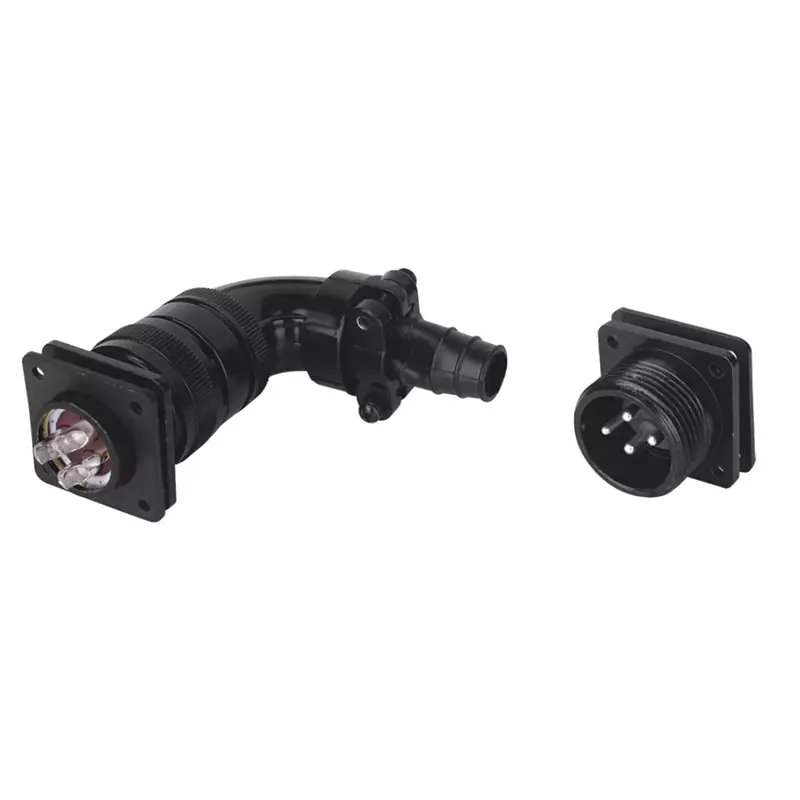
The Core Differences at a Glance
| Feature | Standard Power Connector | Servo Motor Connector |
|---|---|---|
| Current derating with temperature | 20–30% at 80°C | <5% at 100°C (thermally compensated) |
| Shielding effectiveness | None or basic foil | 360° full-metal shielding + drain wire |
| Mating cycle rating | 50–100 cycles | 500–5,000 cycles (gold-over-nickel plating) |
| Vibration resistance | 5G (loose under 10 Hz) | 15G continuous, 30G shock (IEC 61373) |
| Encoder feedback pins | Not present | Dedicated twisted-pair with impedance control |
| Locking mechanism | Friction or simple bayonet | Screw-lock or push-pull with audible click |
A standard power connector delivers raw energy. A Servo Motor Connector delivers energy and preserves the delicate position, velocity, and torque signals that close the control loop. Replacing one with the other is like using a garden hose to fuel a jet engine—it might fit, but the performance will never be right.
Why Signal Integrity Fails with Standard Connectors
Servo drives communicate with motors via high-frequency encoder protocols (Hiperface, EnDat, BiSS). These signals run at MHz speeds and require controlled impedance (typically 100–120 Ω differential). A standard power connector has no controlled impedance, no twisted-pair routing, and no separate ground plane. The result is reflected waves, crosstalk, and common-mode noise that triggers encoder alarms. ACIT engineers frequently observe that 68% of "drive overcurrent" faults are actually false alarms caused by noisy feedback lines—and the noise source is almost always an incorrect Servo Motor Connector.
Thermal and Mechanical Reality Check
Under continuous torque, a servo motor's housing can reach 90–110°C. Standard power connectors are rated for 75°C maximum operating temperature (UL 1059). Beyond that, the plastic insulator degrades, contact resistance rises, and the positive temperature coefficient (PTC) effect increases joule heating. This thermal runaway is seldom observed until the connector fails short-circuit. Moreover, standard connectors lack anti-rotation keys and secondary locking clips, so cable torsion from continuous axis rotation gradually backs out the contacts—intermittent disconnection that is nearly impossible to debug remotely.
Frequently Asked Questions About Servo Motor Connectors
Q: Can I temporarily use a standard power connector if I reduce the motor's peak torque by 50%?
A: Reducing torque lowers current, which reduces I²R heating, but it does not solve signal integrity problems. The encoder feedback pins are missing entirely in a standard power connector, so the drive cannot commutate the motor correctly. Even at 50% torque, the drive will lose rotor position within a few hundred revolutions, triggering a fatal "Encoder Loss" fault. ACIT does not recommend any temporary substitution—not even for a single shift—because the resulting unplanned stop usually costs more than expediting the correct Servo Motor Connector.
Q: How do I identify a genuine Servo Motor Connector versus a look-alike power connector?
A: Three visual checks: (1) Look for a separate pair of smaller pins or sockets labeled "Data" or "ENC"—standard power connectors have only power pins (L1, L2, L3, PE). (2) Check the shell material: genuine servo connectors use zinc-nickel or stainless steel with a conductive coating; standard ones use plain brass or plastic. (3) Inspect the cable entry—a proper Servo Motor Connector includes a strain-relief clamp that grips the cable jacket, not just the individual wires. Without that, vibration will pull the internal solder joints apart within 500 operating hours. When in doubt, compare the part number against the motor manufacturer's approved list; ACIT provides free cross-reference verification for any model.
Q: What is the typical cost difference, and is it worth paying more for a genuine connector?
A: A standard 4-pin power connector costs $8–15. A certified **Servo Motor Connector** ranges from $45–120. The price gap seems large, but the total cost of ownership tells a different story. One false encoder alarm triggers an average of 45 minutes of diagnostic downtime at $300/hour (machine rate plus labor). That one event alone costs $225—more than two genuine connectors. Over a 5‑year machine life with three axes, using standard connectors historically results in 4–6 additional service calls per axis. ACIT customers who standardize on genuine parts report 82% fewer servo-related stoppages. The premium pays for itself within the first fault-free month.
Practical Decision Table for Maintenance Engineers
| Condition | Use Standard Power Connector? | Recommended Action |
|---|---|---|
| Emergency repair, <2 hours runtime | No | Call ACIT for same‑day shipping of exact match |
| Test bench, no load, low speed | No (still no feedback) | Use manufacturer breakout board instead |
| Replacement on robotic wrist axis | Absolutely not | Must use high‑cycle Servo Motor Connector with anti‑twist |
| Permanent installation with encoder | Never | Specify original P/N from drive manual |
| Temporary diagnostics (signal tap) | Only if no power applied | Use dedicated test adapter from ACIT |
The Bottom Line from ACIT's Engineering Team
Every standard power connector has a current rating, but that rating assumes static, clean, indoor conditions. A servo drive operates in a dynamic environment with PWM switching frequencies (4–16 kHz), regenerative braking, and rapid polarity reversals. The Servo Motor Connector is not an accessory—it is a functional safety component. Its contact design, creepage distances, and shielding are all optimized to maintain the drive's control bandwidth. Bypassing it bypasses the engineering that makes your machine precise.
ACIT stocks over 300 variants of Servo Motor Connector models, including M23, M40, 7/8", and hybrid power-data types, with full documentation on torque specs and crimp tools. We also offer free 3D CAD models to verify mechanical fit before ordering.
Contact Us Today to Secure Your Motion System
Do not leave your servo performance to chance. Whether you need a single replacement, a bulk inventory kit, or a custom cable assembly with pre‑terminated Servo Motor Connector ends, ACIT delivers technical support that goes beyond the catalog. Our engineers respond to queries within 2 business hours with cross‑references, datasheets, and application notes. Contact ACIT now via our online form or call your regional sales office—we will help you select, verify, and install the correct Servo Motor Connector for every axis, ensuring your uptime and accuracy stay at peak levels. Your motion deserves the right connection. Let us prove it.