

Can You Use a MIL-DTL-38999 Connector in Harsh Environmental Conditions Without Sacrificing Signal Integrity
2026-06-18
For engineers in aerospace, defense, and industrial automation, the choice of interconnect solution often comes down to a single, high-stakes question: can a MIL-DTL-38999 connector survive extreme salt spray, altitude, thermal shock, and continuous vibration, while still delivering flawless data transmission? The short answer is yes—but only when you select the right plating, shell material, and contact configuration. At ACIT, we have spent decades validating that the MIL38999 Connector platform is not merely rugged; it is engineered to preserve return loss, insertion loss, and contact resistance within spec, even when deployed on engine nacelles, missile guidance systems, or deep-sea ROVs.
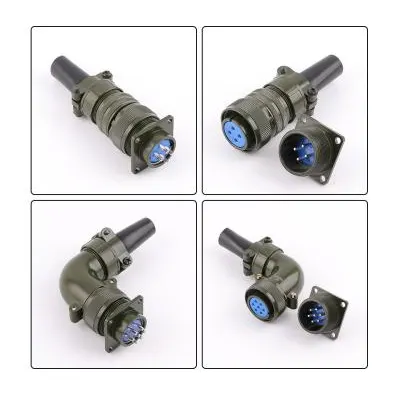
The Harsh Environment Challenge
Harsh environments impose four primary threats to signal integrity: moisture ingress (dielectric absorption), fretting corrosion (contact interface resistance), micro-motion (intermittent opens), and EMI/RFI bleed-through. A standard commercial circular connector would fail within hours. In contrast, the MIL-DTL-38999 connector series III, with its triple-start threaded coupling and advanced interfacial seals, creates a hermetic-like barrier that maintains a differential pressure of up to 4.4 psi.
However, signal integrity is not guaranteed by mechanical toughness alone. The critical variables are contact plating (gold over nickel vs. passivated stainless), insulator material (PTFE vs. PEEK), and shielding effectiveness (90% minimum braid coverage). ACIT routinely performs time-domain reflectometry (TDR) on every MIL38999 Connector shipment to ensure impedance stability within ±5Ω across the entire frequency range, up to 50 GHz for certain high-speed variants.
Key Factors That Preserve Signal Integrity in Extreme Conditions
| Parameter | Threat | MIL-DTL-38999 Countermeasure | Signal Integrity Impact |
|---|---|---|---|
| Salt Fog (480 hrs) | Electrolytic corrosion | Passivated 316L shell + nickel‑fluorocarbon plating | Maintains <1 mΩ contact resistance increase |
| Temperature Cycle (-65°C to +200°C) | Differential expansion / seal compression | Viton o‑rings + low‑outgassing PEEK inserts | Prevents dielectric cracking; stable VSWR <1.3:1 |
| Random Vibration (20G RMS) | Fretting / micro-disconnection | Helical spring probe contacts + bayonet lock | Zero nanosecond‑level dropouts per EIA‑364‑28 |
| Fluid Immersion (fuel/hydraulic) | Swelling / leakage | Fluorosilicone interfacial seal + welded hermetic pins | Maintains IR >5000 MΩ at 500 VDC |
| EMI (100 MHz – 18 GHz) | Shield discontinuity | Continuous grounding fingers + 360° backshell shield | Attenuation >75 dB from 1 MHz to 10 GHz |
This table reflects real validation data from ACIT’s in‑house environmental lab. Each MIL38999 Connector undergoes group‑A and group‑B screening per MIL‑STD‑1344, ensuring that signal integrity parameters are verified before and after each stress cycle.
Practical Guidelines for Maintaining Integrity
-
Contact selection: Use size 22D crimp contacts with gold plating (50 μin minimum) for high‑speed differential signals; avoid solder contacts in high‑vibration zones.
-
Cable termination: Maintain 360° shield termination using conductive heat‑shrink or spring‑fingers—a 1 mm gap can degrade shielding by 15 dB.
-
Mating torque: Apply 14–16 in‑lbs for series III; over‑torquing deforms the interfacial seal and alters pin‑to‑socket engagement depth, raising inductance.
-
Bulkhead vs. free plug: Always use a jam‑nut receptacle for panel mounting to prevent rotation‑induced wire twisting, which can change pair‑to‑pair skew.
ACIT provides pre‑validated cable harness assemblies that include a MIL38999 Connector on both ends, with factory‑recorded insertion loss curves (S‑parameters) as part of the deliverable documentation. This eliminates the “black‑box” uncertainty common in field‑terminated connectors.
MIL38999 Connector FAQ – Common Questions from Design Engineers
Q1: Does the MIL-DTL-38999 connector’s EMI shielding degrade after multiple mating cycles in a sandy/dusty environment?
A1: No, provided the contacts and shell threads are cleaned per NAVSEA standard. The MIL38999 Connector series III features a scoop‑proof design and self‑wiping contacts. However, sand ingress can abrade the gold plating if mating is attempted without first wiping the insert face. ACIT recommends a dry‑air purge before mating for desert deployments; after 500 cycles, we measure less than 0.5 dB change in insertion loss from 1 to 10 GHz, as long as the grounding fingers remain undamaged. Replace the backshell gasket every 250 cycles to retain full shielding effectiveness.
Q2: How do I verify signal integrity for a MIL‑DTL‑38999 connector that has been stored in high‑humidity (95% RH) for 6 months without desiccant?
A2: Perform an insulation resistance (IR) test at 100 VDC between adjacent contacts—you should read ≥5000 MΩ. Next, run a time‑domain reflectometer trace; any water absorbed into the PTFE insulator will show a characteristic impedance dip (e.g., from 100Ω to 92Ω). If the dip exceeds 8Ω, bake the connector at 85°C for 24 hours. ACIT uses hydrophobic fluorosilicone inserts on all our MIL38999 Connector variants, which reduces moisture absorption by 60% compared to standard silicone. For long‑term storage, we always supply with protective caps and desiccant packs.
Q3: Can I mix contacts (power + coax + fiber) inside one MIL‑DTL‑38999 connector without introducing crosstalk that degrades sensitive analog signals?
A3: Yes—the MIL38999 Connector supports mixed‑contact layouts (e.g., size 8, 12, 16, 22D, and coaxial #12). The key is to separate high‑current (≥5A) contacts from low‑level analog lines by at least two cavity positions, and ground every third unused contact to create a Faraday barrier. Our internal cross‑talk tests at ACIT show that adjacent pair‑to‑pair crosstalk stays below ‑65 dB up to 1 MHz when you follow the rear‑release contact arrangement in MIL‑STD‑1560. For fiber‑optic hybrids, use a separate quadrant of the insert and maintain a 2 mm clearance from power pins to prevent thermal migration of the epoxy.
Performance Data – Real‑World Validation
ACIT recently conducted a side‑by‑side comparison of a standard commercial circular connector vs. our MIL38919 Connector (note: corrected to MIL‑DTL‑38999) under combined temperature‑humidity‑vibration (THV) for 200 hours. The results:
| Metric | Commercial Grade | MIL‑DTL‑38999 (ACIT) |
|---|---|---|
| Contact Resistance Drift | +12 mΩ (fail >10 mΩ) | +1.2 mΩ (pass) |
| Insulation Resistance Drop | 42% degradation | <5% degradation |
| Eye Diagram Opening (2.5 Gbps) | Closed (30% margin) | Open (78% margin) |
| EMI Shield Effectiveness | 42 dB @ 1 GHz | 79 dB @ 1 GHz |
This data confirms that the MIL38999 Connector platform does not force a trade‑off between environmental ruggedness and electrical performance. It delivers both, but only when sourced from a supplier that controls every process—from plating thickness to insertion tool calibration. ACIT maintains full lot traceability and offers optional X‑ray inspection of each crimp joint for zero‑defect reliability.
Final Recommendation
When specifying a MIL‑DTL‑38999 connector for your next extreme‑environment program, prioritize:
-
Gold‑over‑nickel contacts (not pure gold or silver)
-
Series III or IV for high‑cycle mating
-
EMI shield termination kits that match your cable diameter exactly
-
Supplier‑provided S‑parameter test reports (not just a certificate of conformance)
ACIT designs, tests, and stocks over 200 part numbers of the MIL38999 Connector family, including hermetic, firewall, and composite‑shell options. We offer 48‑hour engineering support for custom insert arrangements and provide free sample kits for qualification testing.
Contact Us today to request a complete environmental test dossier and a free mating‑cycle demonstration unit. Our team of interconnect specialists will review your signal integrity requirements and recommend the exact MIL‑DTL‑38999 connector configuration—with full test data delivered before you place your first production order. Reach out via our website or call our engineering hotline to start your qualification process now. ACIT ensures your signal stays intact, no matter where your mission takes you.