

Can an LVDS to TTL Signal Conversion Board Support High-Resolution LCD Panels
2026-09-10
As display technology continues to advance, engineers and system integrators frequently ask whether an LVDS to TTL Signal Conversion Board can reliably drive high-resolution LCD panels. At SKY-TDM, we have spent years designing and testing conversion solutions for industrial, medical, and embedded display applications. The short answer is yes—but with important technical conditions. A properly designed LVDS to TTL Signal Conversion Board from SKY-TDM can support resolutions up to 1920×1200 and beyond, provided that bandwidth, clock speed, and signal integrity are carefully managed.
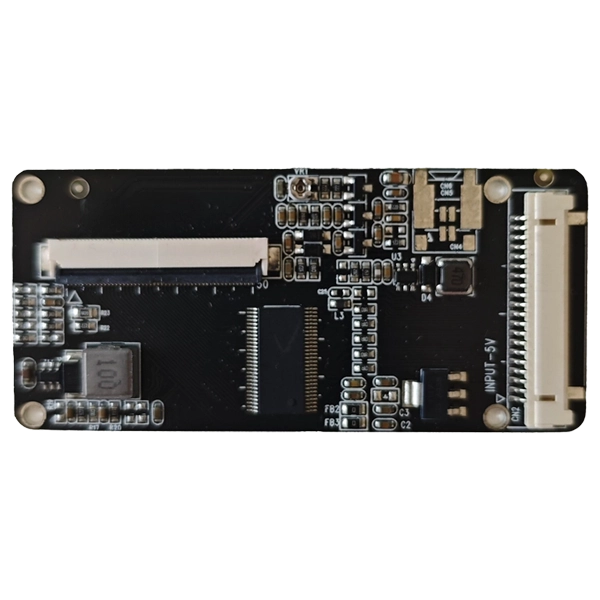
Understanding the Signal Difference
LVDS (Low-Voltage Differential Signaling) and TTL (Transistor-Transistor Logic) are fundamentally different interface technologies. LVDS uses differential pairs to transmit high-speed data with low noise, while TTL uses single-ended parallel signals. A LVDS to TTL Signal Conversion Board must therefore convert serialized differential data back into parallel RGB data without introducing timing errors or EMI.
Key Factors That Determine High-Resolution Support
| Factor | Impact on High-Resolution Support | SKY-TDM Design Approach |
|---|---|---|
| Maximum Pixel Clock | Determines max resolution and refresh rate | Supports up to 165 MHz and higher |
| Number of LVDS Channels | Single vs. dual channel affects bandwidth | Dual-channel architecture for 1080p+ |
| TTL Output Bits | 18-bit vs. 24-bit color depth | 24-bit true color output |
| Signal Integrity | Jitter and skew can corrupt data | Impedance-matched PCB layout |
| Power Supply Noise | Affects PLL stability | Low-noise LDO regulators |
| EMI Shielding | Critical for high-speed operation | Grounded shielding and filtering |
Resolution Capability Matrix
| Resolution | Refresh Rate | LVDS Channels Required | SKY-TDM Board Support |
|---|---|---|---|
| 1024×768 | 60 Hz | Single | Yes |
| 1280×1024 | 60 Hz | Single | Yes |
| 1366×768 | 60 Hz | Single | Yes |
| 1920×1080 | 60 Hz | Dual | Yes |
| 1920×1200 | 60 Hz | Dual | Yes |
| 2560×1600 | 60 Hz | Dual (higher clock) | Conditional |
Technical Requirements for Reliable Operation
To ensure a LVDS to TTL Signal Conversion Board supports high-resolution LCD panels, the following conditions must be met:
-
Pixel clock margin: The board must handle the panel’s required pixel clock with at least 10% headroom.
-
Dual-channel LVDS input: Resolutions above 1400×1050 typically require dual-channel LVDS.
-
24-bit TTL output: High-resolution panels demand full 24-bit color to avoid banding.
-
Stable power delivery: Ripple below 50 mV is recommended for PLL lock.
-
Short TTL trace length: Keep TTL output traces under 100 mm to reduce skew.
SKY-TDM addresses these requirements through optimized PCB stackups, matched-length routing, and rigorous factory testing across multiple panel models.
Common Challenges and Solutions
| Challenge | Symptom | Solution |
|---|---|---|
| Insufficient pixel clock | Flickering or no display | Use higher-speed SKY-TDM board |
| Single-channel limitation | Color loss or image tearing | Switch to dual-channel LVDS |
| TTL cable too long | Ghosting or noise | Shorten cable or add buffer |
| Incorrect mapping | Wrong colors or shifted image | Verify pinout and jumper settings |
LVDS to TTL Signal Conversion Board FAQ
Q: Can a single-channel LVDS to TTL Signal Conversion Board support 1920×1080 resolution?
A: Generally no. 1920×1080 at 60 Hz requires a pixel clock of approximately 148.5 MHz, which exceeds the practical bandwidth of most single-channel LVDS implementations. A dual-channel LVDS to TTL Signal Conversion Board is required. SKY-TDM recommends verifying the panel datasheet for the exact pixel clock and channel configuration before selecting a board.
Q: What is the maximum resolution that SKY-TDM LVDS to TTL Signal Conversion Boards can handle?
A: SKY-TDM boards are designed to support resolutions up to 1920×1200 at 60 Hz with dual-channel LVDS input and 24-bit TTL output. Higher resolutions such as 2560×1600 are possible only with reduced refresh rates or specialized timing controllers. Always confirm compatibility with the specific LCD panel model.
Q: How do I know if my high-resolution LCD panel is compatible with an LVDS to TTL Signal Conversion Board?
A: Check three specifications: the panel’s pixel clock, LVDS channel count, and TTL data mapping. If the panel requires a pixel clock above 100 MHz or uses dual-channel LVDS, choose a SKY-TDM dual-channel board. Matching the jumper settings and pinout to the panel datasheet ensures reliable operation.
Conclusion
A LVDS to TTL Signal Conversion Board can absolutely support high-resolution LCD panels when the design accounts for pixel clock, channel count, color depth, and signal integrity. SKY-TDM provides tested, industrial-grade conversion boards that meet these demands for 1080p and WUXGA applications. For engineers seeking dependable display interfacing, selecting the right board is the critical first step.
Contact us today at SKY-TDM to discuss your specific high-resolution LCD panel requirements and receive a tailored LVDS to TTL Signal Conversion Board recommendation from our engineering team.