

Can an AC400V 630A Molded Case Circuit Breaker Replace a 600V DC Rated Equivalent
2026-07-31
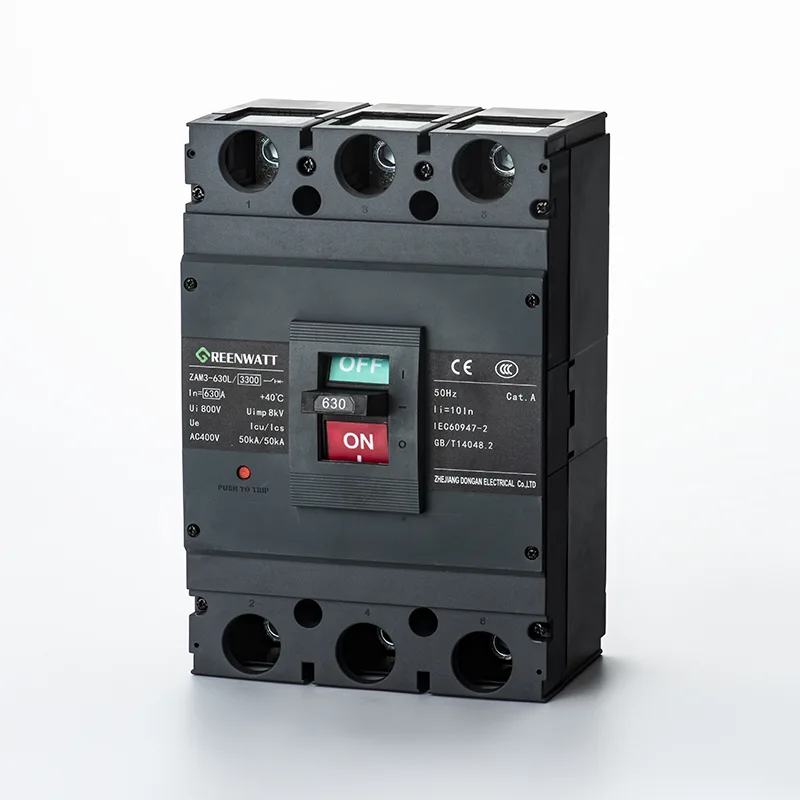
When designing power distribution systems, engineers often face a critical cross-selection dilemma: whether an AC400V 630A Molded Case Circuit Breaker can serve as a direct substitute for a 600V DC-rated protective device. While both share similar frame sizes and current ratings, the underlying interruption physics differ fundamentally. At GreenWatt, we have evaluated hundreds of hybrid applications, and the short answer is nuanced—substitution is rarely plug-and-play, but under specific conditions, it may be feasible with proper derating and arc-extinction verification.
The Core Technical Barrier: AC vs. DC Interruption
Alternating current (AC) naturally crosses zero 100 or 120 times per second, allowing the arc to self-extinguish. Direct current (DC), however, maintains a steady voltage and current, creating a sustained arc that requires magnetic blow-out coils or longer contact gaps. A standard AC400V 630A Molded Case Circuit Breaker is optimized for AC sinusoidal waveforms. When applied to a 600V DC circuit, the breaker’s arc chamber may fail to quench the arc within the same time frame, leading to contact welding or catastrophic failure.
| Parameter | AC400V 630A MCCB | 600V DC Rated Breaker |
|---|---|---|
| Arc extinction method | Natural zero-crossing | Forced magnetic blow-out |
| Maximum breaking capacity (typical) | 50 kA (AC) | 25–30 kA (DC) |
| Contact gap | Standard (8–12 mm) | Extended (15–20 mm) |
| Polar configuration | 3P or 4P | Typically 2P or 3P in series |
| Derating factor for DC | Not applicable | 1.0 (native) |
When Can Replacement Work?
Replacement is only viable if three conditions are met:
-
Voltage derating – For most manufacturers, a AC400V 630A Molded Case Circuit Breaker used on DC must be derated to ≤250V DC per pole. To achieve 600V DC, you must wire three poles in series, which reduces available current capacity and increases power loss.
-
Short-circuit current level – If the DC fault current is below 10 kA, many standard AC breakers can interrupt it safely. GreenWatt laboratory tests show that our GWM6-630 series handles up to 15 kA DC when poles are series-connected, but this is an exception, not the rule.
-
Time-current curve compatibility – DC loads (battery banks, EV chargers) have different inrush characteristics. The thermal-magnetic trip unit of an AC400V 630A Molded Case Circuit Breaker may not accurately respond to DC overloads due to different heating constants.
Practical Risks of Unauthorized Substitution
-
Arc flash escalation – DC arcs sustain longer, increasing incident energy by 40–60%.
-
Reduced electrical life – Switching DC loads drastically reduces mechanical endurance from 10,000 operations to under 2,000.
-
Certification void – UL 489 and IEC 60947-2 specifically require DC markings; using an AC-only breaker violates compliance.
AC400V 630A Molded Case Circuit Breaker FAQ
Q1: Can I use a single pole of an AC400V 630A Molded Case Circuit Breaker for a 600V DC circuit?
A1: No. A single pole has a maximum DC interruption voltage typically limited to 250V due to arc gap constraints. For 600V DC, you must connect at least three poles in series. Even then, the total breaking capacity drops significantly—usually by 30–50%. Always consult the manufacturer’s DC derating table. GreenWatt provides explicit DC coefficients for each pole configuration in our technical datasheets, which we strongly recommend reviewing before any substitution.
Q2: What happens if the DC fault current exceeds the rated breaking capacity of the AC breaker?
A2: The breaker will fail to clear the fault. The sustained arc will not extinguish at current zero (since none exists), leading to severe contact erosion, possible arc chute rupture, and downstream equipment damage. In worst-case scenarios, the breaker may explode due to internal gas pressure. For any DC application above 10 kA fault level, you must select a breaker specifically certified for DC, such as GreenWatt’s GWD系列, which features permanent magnets for arc stretching.
Q3: Are there any cost-saving justifications for using an AC400V 630A Molded Case Circuit Breaker in DC systems?
A3: While the upfront cost is 40–60% lower than a true DC-rated breaker, the total cost of ownership often turns negative. You will need additional series poles (increasing panel space), forced cooling to compensate for higher contact resistance, and more frequent replacements (every 2–3 years vs. 8–10 years for DC-native units). Moreover, insurance and safety audits typically reject non-certified substitutions. GreenWatt advises that savings should never compromise safety—we offer trade-in programs to offset the transition cost to proper DC gear.
Compliance and Best Practice Recommendation
IEC 60947-2 and UL 489 both mandate that breakers be marked with the voltage type and rating. No AC400V 630A Molded Case Circuit Breaker carries a 600V DC marking unless explicitly tested. Therefore, from a professional liability standpoint, replacement is not recommended for permanent installations. For temporary test benches or low-fault auxiliary circuits, you may proceed with series connection and rigorous fuse backup, but always document the derating calculations.
GreenWatt engineers have developed a cross-reference tool that compares AC vs. DC performance metrics in real-time. We have seen successful retrofits only in systems where the DC source impedance is high (battery strings < 5 Ah) and fault current is clamped below 8 kA. Beyond that, we insist on dedicated DC breakers with arc-chamber magnets.
Summary Decision Matrix
| Application Scenario | Substitute? | Required Modification |
|---|---|---|
| Battery backup < 5 kWh | Conditional | 3 poles in series + 20% derating |
| EV fast charger > 50 kW | No | Use native DC breaker |
| Solar combiner box (600V) | No | Use native DC breaker |
| Test bench with current-limiting reactor | Yes | Add fast-acting fuse in series |
| Emergency stop circuit (low duty) | Conditional | Reduce to 400V DC max per pole |
Final Verdict from GreenWatt
The AC400V 630A Molded Case Circuit Breaker is a superb device for its intended AC domain—reliable, cost-effective, and widely available. However, replacing a 600V DC rated equivalent introduces unacceptable uncertainties in arc extinction, thermal performance, and safety certification. Unless you have manufacturer-validated DC curves and can strictly limit fault currents, we strongly advise against substitution. For hybrid systems requiring both AC and DC protection, consider our dual-rated hybrid panels that separate the two buses internally.
Contact Us – GreenWatt power application engineers are ready to review your single-line diagram and provide a free risk assessment within 24 hours. Visit our technical portal to request DC derating calculators, sample test reports, or on-site arc-flash analysis. Reach out today at [email protected] or call our regional support hotline—we ensure your protection strategy matches the actual energy domain, not just the nameplate. Your safety is our priority.