

Can a Triplex 3-Wavelength White light Fiber Coupled Laser Source Really Simplify Precision Optical Work?
2026-01-15
When I first started evaluating multi-wavelength laser solutions for demanding optical systems, I was looking for something stable, practical, and genuinely engineered for real-world integration. That search is what led me, gradually and quite naturally, to Wavespectrum. Their approach to optical sources felt grounded in application logic rather than marketing noise, especially when I encountered the Triplex 3-Wavelength White light Fiber Coupled Laser Source and began testing how it performs across complex measurement and imaging scenarios.
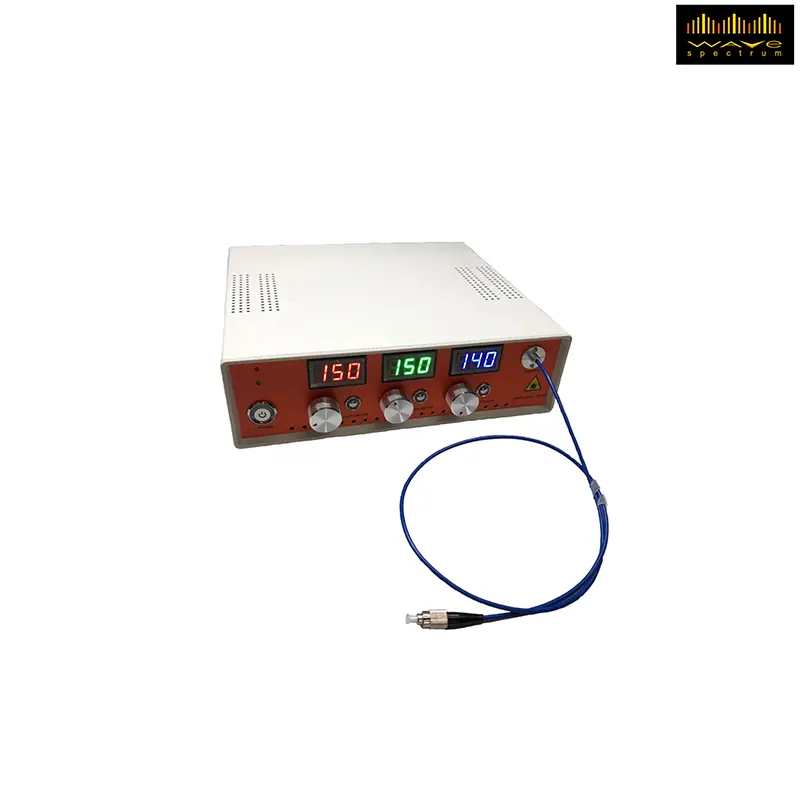
Why is managing multiple wavelengths such a persistent challenge in optical systems?
Anyone who has worked with precision optics knows that combining multiple wavelengths often introduces alignment headaches, signal instability, and unnecessary system complexity. Before using a Triplex 3-Wavelength White light Fiber Coupled Laser Source, I frequently had to rely on separate laser modules, additional optics, and repeated recalibration. These issues don’t just slow development; they directly affect measurement accuracy and long-term system reliability.
- Independent wavelength drift leading to inconsistent results
- Bulky optical paths increasing alignment time
- Higher maintenance costs due to multiple laser units
- Difficulty achieving uniform output across channels
How does a fiber coupled design change the way systems are built?
From my experience, fiber coupling is not just a convenience feature—it fundamentally reshapes system architecture. With a Triplex 3-Wavelength White light Fiber Coupled Laser Source, the light delivery becomes predictable, repeatable, and far easier to integrate into compact instruments. Fiber output eliminates many free-space alignment issues while maintaining clean beam quality.
This design choice becomes especially valuable in environments where vibration, temperature variation, or limited space would otherwise compromise performance.
What practical advantages do three wavelengths bring in real applications?
The real strength of a Triplex 3-Wavelength White light Fiber Coupled Laser Source lies in how seamlessly it supports multi-spectral tasks. Instead of switching sources or reconfiguring optics, I can work across multiple wavelengths within a single, unified platform.
| Application Area | Why Triplex Output Matters |
|---|---|
| Optical sensing | Simultaneous wavelength comparison improves signal reliability |
| Imaging systems | Enhanced contrast without mechanical filter switching |
| Metrology | Stable multi-band illumination reduces measurement uncertainty |
| Laboratory research | One source supports multiple experimental setups |
Can stability and consistency really be maintained across all channels?
This was one of my biggest concerns initially. In practice, a well-designed Triplex 3-Wavelength White light Fiber Coupled Laser Source demonstrates impressive output consistency. The wavelengths remain stable over extended operation, which directly translates into repeatable data and fewer interruptions for recalibration.
What stands out is how this stability supports long-duration experiments and continuous industrial processes where downtime is simply not an option.
Is this type of laser source suitable for long-term system integration?
Based on my experience, the answer is yes—provided the source is engineered with integration in mind. The Triplex 3-Wavelength White light Fiber Coupled Laser Source I worked with was clearly designed to fit into existing optical platforms without forcing redesigns. Compact housing, fiber output, and predictable performance make it a practical choice rather than a theoretical upgrade.
- Reduced system footprint
- Lower alignment and maintenance effort
- Improved reliability over extended use
- Scalable for both R&D and industrial deployment
Why am I seeing more engineers move toward triplex laser solutions?
The shift is driven by efficiency and performance. A single Triplex 3-Wavelength White light Fiber Coupled Laser Source replaces multiple components, simplifies optical paths, and improves overall system robustness. For engineers balancing precision, cost, and time-to-market, this combination is hard to ignore.
If you are evaluating ways to streamline your optical system while maintaining high performance standards, this technology is worth serious consideration. To explore specifications, integration options, or discuss your specific application needs, I encourage you to contact us directly. Reach out today and start a conversation about how the right laser source can elevate your next project.