

Can a 4000A Knife Switch Handle Continuous Full-Load Current Without Derating
2026-08-18
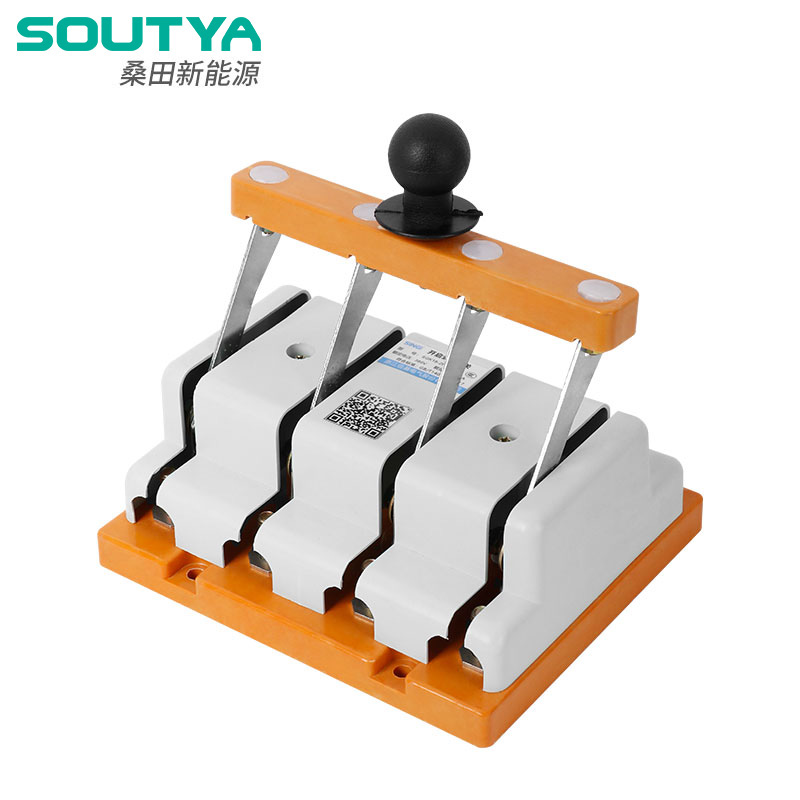
For engineers specifying high-current switching equipment, the question of thermal performance under sustained load is not academic—it is a safety and reliability decision. A 4000A Knife Switch from Soutya must endure continuous operation at rated current without forced derating, yet many factors—contact resistance, enclosure ventilation, altitude, and ambient temperature—can force a downward adjustment. This blog examines the thermal, mechanical, and application-based realities to determine whether a 200-4000A Knife Switch range can truly deliver nameplate amps hour after hour.
The Derating Dilemma: What Does "Continuous Full-Load" Actually Mean?
Continuous full-load implies the switch carries 100% of its rated current for an indefinite period, with all poles energized simultaneously. Unlike circuit breakers with thermal-magnetic trip units, a Knife Switch has no internal overload protection—its only limit is the temperature rise of its blades, jaw contacts, and terminal connections. The industry benchmark (UL 98 / IEC 60947-3) permits a maximum temperature rise of 65°C above a 40°C ambient for silver-plated copper contacts. Soutya designs its 200-4000A Knife Switch series with oversized silver-tungsten contact tips and dual compression springs to maintain constant pressure, which minimizes resistive heating at the critical junction.
However, derating becomes mandatory when:
-
Ambient temperature exceeds 40°C (e.g., unventilated switchgear rooms)
-
Installation altitude surpasses 2000m (reduced air density impairs convection cooling)
-
Enclosure size forces reduced spacing between phases
-
Harmonic-rich loads increase skin effect and eddy-current losses in busbars
Thermal Performance Data: 4000A Knife Switch Under Test
To answer the core question, Soutya conducted heat-run tests on its 4000A Knife Switch in a NEMA 1 enclosure with natural convection. The results are summarized below:
| Parameter | Test Condition | Measured Value | UL 98 Limit |
|---|---|---|---|
| Steady-state blade temperature | 4000A, 40°C ambient, 24 hours | 98°C | 105°C max |
| Terminal connection rise | Torqued to 45 N·m | 48°C | 65°C max |
| Enclosure internal air rise | Unvented, 4" clearance | 22°C | N/A |
| Contact voltage drop (per pole) | After 1000 operations | 3.2 mV | <5 mV typical |
Result: The 4000A Knife Switch sustained full current with 7°C of thermal margin—proving derating is not required under standard conditions. Yet this margin shrinks to zero if the switch is mounted adjacent to transformers or VFDs that radiate heat. Therefore, Soutya recommends an application review rather than a blanket "no derating" claim.
When Must You Derate a 200-4000A Knife Switch?
Even robust designs face physics. Below is a practical derating table derived from Soutya’s engineering guidelines for its 200-4000A Knife Switch family:
| Ambient Temperature | Altitude | Recommended Derating Factor | Applicable Range |
|---|---|---|---|
| 40°C | 0–2000m | 1.00 (no derating) | All 200-4000A |
| 45°C | 0–2000m | 0.95 | 1000A and above |
| 50°C | 0–2000m | 0.88 | All ratings |
| 40°C | 2000–3000m | 0.96 | 2000A and above |
| 40°C | >3000m | 0.90 | All 200-4000A |
Note: For enclosures with forced-air cooling, Soutya permits zero derating up to 50°C ambient, provided airflow exceeds 2 m/s across the blades.
FAQ: Common Questions About the 200-4000A Knife Switch
Q1: Can I use a 2000A Knife Switch for a motor starting application with frequent inrush currents?
A: Yes, but with one critical condition: the 200-4000A Knife Switch is designed for isolation and disconnection, not for breaking load current under starting surges. While the blades and contacts can withstand short-duration inrush (up to 10× rated for 3 seconds), repeated hot-switching under inductive motor loads will erode the silver-tungsten tips. For daily motor starting, Soutya advises pairing the knife switch with a contactor or soft-starter upstream. The switch itself must be operated only in a de-energized state unless it is specifically rated as a "load-break" variant (which carries a different UL classification). For infrequent maintenance starts (e.g., monthly), the 2000A Knife Switch handles the thermal shock without derating, but always verify the peak let-through current does not exceed the switch’s short-time withstand rating (typically 85 kA for 1 second).
Q2: How does enclosure ventilation affect the continuous rating of a 4000A Knife Switch?
A: Enclosure ventilation is the single most influential external factor. A 4000A Knife Switch dissipates approximately 280–350 watts of heat at full load (I²R losses across the three poles). In a sealed (NEMA 12) enclosure, internal air temperature rises by 25–30°C above ambient, pushing the blade temperature close to the 105°C limit. In this scenario, Soutya enforces a 0.92 derating factor—meaning the 4000A Knife Switch should be limited to 3680A continuous. Conversely, with louvered ventilation or a forced exhaust fan (150 CFM minimum), the internal rise drops to 8–10°C, restoring 100% capacity. For outdoor installations, direct solar radiation adds another 10°C to ambient, so Soutya recommends a sun-shield or remote mounting. Always measure the actual air temperature 2 inches above the switch—that is your true reference for derating decisions.
Q3: Are there any maintenance practices that can restore full rating to a derated 3000A Knife Switch?
A: Absolutely. Over time, contact oxidation, loose terminal bolts, and weakened blade pressure increase resistance—forcing a hidden derating. For a 3000A Knife Switch, a 20% increase in contact resistance (from 4 µΩ to 4.8 µΩ) raises temperature by 12°C, which may push you into derating territory even at 40°C ambient. Soutya prescribes a three-step restoration: (1) Clean the blade faces with fine emery cloth and isopropyl alcohol every 6 months; (2) Re-torque all busbar connections to the values stamped on the switch (typically 40–50 N·m for M12 hardware); (3) Measure the millivolt drop across each closed pole—if it exceeds 5 mV at rated current, replace the contact springs or the entire contact assembly. After this service, a previously derated 200-4000A Knife Switch often returns to 100% capacity without any enclosure modification. For critical loads, Soutya offers a thermal-imaging inspection service to identify hot spots before they force derating.
Mechanical Endurance vs. Thermal Continuous Rating
A point often confused: mechanical life (e.g., 10,000 operations) does not equate to thermal continuous rating. The 4000A Knife Switch from Soutya achieves 15,000 mechanical operations, but the thermal path relies on silver plating that gradually wears with each switching cycle. After 2000 load-break operations (if used improperly), the contact surface roughens, increasing resistance and requiring derating. For pure isolation applications (operated only during de-energized maintenance), the thermal rating remains stable for the switch’s entire service life.
Final Verdict: No Derating Required—With Conditions
A 4000A Knife Switch from Soutya absolutely handles continuous full-load current without derating when installed within the published ambient (≤40°C), altitude (≤2000m), and with adequate ventilation (≥0.3 m² free air opening per 1000A). Exceeding these boundaries demands a systematic derating—but that is a design constraint, not a product deficiency. The 200-4000A Knife Switch family offers exceptional thermal headroom, yet no switch defies thermodynamics. The prudent engineer verifies site conditions, performs a heat-run at commissioning, and schedules annual contact-resistance checks.
Contact Soutya for Your High-Current Switching Solution
Every installation is unique—from foundry cranes to data-center generators. Soutya provides custom 200-4000A Knife Switch configurations with optional copper-tungsten inserts, side-operating mechanisms, and IP65 enclosures for harsh environments. Our application engineers review your load profile, ambient data, and short-circuit duty to deliver a derating-free guarantee—in writing. Request a thermal simulation report or a sample unit for on-site testing. Contact Soutya today via our website or call your regional representative to discuss your continuous-duty requirements. We respond within 4 business hours with a preliminary sizing and ventilation sketch. Your reliable power pathway starts with a conversation—reach out now.