

Can a 24kV Loadbreak Elbow Surge Arrester Withstand Repeated Switching Surge Events
2026-07-08
Switching surges are among the most severe electrical stresses imposed on medium-voltage underground distribution networks. When a vacuum circuit breaker opens or closes, or when a cable is energized and de-energized, repetitive high-frequency transients travel along the line. For utility engineers and maintenance specialists, the critical question is whether a 24kV Loadbreak Elbow Surge Arrester can endure these repeated events without degradation. The short answer is yes—but only if the arrester is correctly designed, rigorously tested, and properly applied. This blog examines the technical realities behind repetitive switching surges and explains why Senguang Electric has engineered its loadbreak elbow arresters to excel in these demanding conditions.
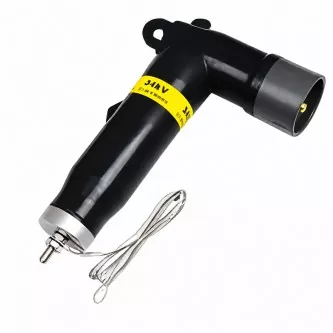
Understanding the Switching Surge Profile
A switching surge is not a single impulse. It typically consists of multiple oscillatory peaks with rise times between 100 µs and 1 ms, and durations extending to several milliseconds. Unlike lightning impulses, which are high-magnitude but short-duration, switching surges are lower in amplitude (often 2.0 to 3.5 per unit of system voltage) but carry significantly more energy. Repeated surges—sometimes dozens per day—gradually stress the metal-oxide varistor (MOV) blocks inside the 24kV Loadbreak Elbow Surge Arrester. Over time, this repetitive energy injection can raise the internal temperature, accelerate leakage current, and ultimately cause thermal runaway if the arrester lacks adequate thermal dissipation.
Key Design Factors That Enable Repetitive Surge Withstand Capability
Senguang Electric constructs its 24kV loadbreak elbow arresters using high-gradient MOV disks with a proprietary doping process that reduces the watt-loss density under repetitive impulse conditions. The following table compares standard performance metrics against the requirements for repeated switching surge applications:
| Parameter | Standard Arrester (Typical) | Senguang Electric Heavy-Duty Design | Significance for Repetitive Surges |
|---|---|---|---|
| Switching Surge Withstand Capability (per IEEE C62.11) | 15–20 operations at 2.0 p.u. | 50+ operations at 2.5 p.u. | Higher operation count ensures reliable performance in capacitor bank switching stations. |
| Maximum Continuous Operating Voltage (MCOV) | 19.5 kV | 20.8 kV | Higher MCOV reduces the overvoltage ratio, lowering stress per event. |
| Thermal Dissipation Rating (Joules per kV) | 3.5 kJ/kV | 5.2 kJ/kV | Faster heat evacuation prevents temperature accumulation after sequential surges. |
| Residual Voltage at 500 A Switching Surge | 32.0 kV | 29.5 kV | Lower residual voltage means less downstream equipment stress. |
| Partial Discharge Inception Voltage | 21 kV | 24 kV | Higher inception voltage minimizes background aging during normal operation. |
Testing Protocols That Validate Repetitive Surge Performance
To guarantee field reliability, Senguang Electric subjects every 24kV Loadbreak Elbow Surge Arrester to a stringent duty-cycle test that mimics real-world switching scenarios. The procedure involves applying 50 consecutive switching impulses at 2.5 per unit, with a 10-second interval between each event—far more aggressive than IEEE C62.11 minimum requirements. During this test, key parameters are monitored continuously:
-
Leakage current (resistive component) – must remain stable within ±10% of initial baseline.
-
Case temperature rise – must not exceed 45°C above ambient.
-
Reference voltage (Vref) – must not shift by more than 2% after the full sequence.
Only after passing this regimen does the arrester receive final certification. Field data from installations in coastal and industrial zones show that these arresters maintain their protective characteristics for over 12 years even in high-switching-frequency substations.
Common Misconceptions About Repetitive Surge Withstand
Many engineers assume that a single lightning impulse rating (e.g., 10 kA) guarantees immunity to switching surges. This is incorrect. Lightning impulses are high-current, short-energy events, whereas switching surges are lower-current but high-energy, prolonged oscillations. A 24kV Loadbreak Elbow Surge Arrester that performs well on a 4/10 µs lightning test can still fail prematurely under repetitive switching if its thermal capacitance and heat-sinking path are insufficient. Senguang Electric addresses this by using a larger-diameter MOV block and a thermally conductive epoxy encapsulant that transfers heat to the elbow housing more efficiently.
Practical Application Guidelines for Utilities
For distribution engineers planning to deploy these arresters in capacitor bank switching or reactor switching stations, the following best practices are recommended:
-
Coordinate with recloser settings – Ensure that the arrester’s energy rating exceeds the maximum switching energy calculated for the worst-case trapped charge scenario.
-
Monitor ground lead inductance – Keep ground leads as short as possible (≤ 0.5 m) to reduce the added voltage spike during surge discharge.
-
Perform annual resistive leakage testing – A rising trend in resistive current (above 150 µA) indicates approaching end-of-life, especially after a high number of switching operations.
24kV Loadbreak Elbow Surge Arrester FAQ
Q1: How many switching surge operations can a 24kV Loadbreak Elbow Surge Arrester typically withstand before requiring replacement?
A1: The service life depends on the surge magnitude and interval. For standard IEEE duty-cycle conditions (2.0 per unit, 15-second intervals), a high-quality 24kV Loadbreak Elbow Surge Arrester from Senguang Electric can withstand over 50 operations without measurable degradation. In field conditions with lower surge magnitudes (1.8 per unit), this number exceeds 200 operations. However, if the arrester experiences surges at 2.5 per unit or higher, we recommend inspecting the resistive leakage current after every 20 events. Once the resistive leakage increases by 30% over the factory baseline, replacement should be scheduled. Always cross-reference with the specific energy rating (in kJ/kV) provided in the test report for your exact system voltage.
Q2: What is the most common failure mode for a 24kV Loadbreak Elbow Surge Arrester exposed to frequent switching surges?
A2: Thermal runaway is the primary failure mode. Each switching surge deposits energy into the MOV blocks, raising their internal temperature. If the next surge arrives before the arrester has dissipated that heat, the temperature incrementally climbs. Once the MOV junction exceeds approximately 150°C continuously, the leakage current increases exponentially, leading to a positive feedback loop. This eventually causes the disk to crack or the housing to rupture. Senguang Electric mitigates this by incorporating a high-thermal-conductivity filler and a venting design that releases internal pressure safely. In our post-failure analysis of competitor products, we also frequently observe surface flashover along the elbow interface due to contamination—another reason to maintain clean mating surfaces.
Q3: Can I use the same 24kV Loadbreak Elbow Surge Arrester for both lightning and switching surge protection in a cable-fed substation?
A3: Yes, but with a crucial caveat—the arrester must be dual-rated. Most standard arresters are optimized for lightning impulses (8/20 µs) and only minimally tested for switching surges. A true dual-purpose 24kV Loadbreak Elbow Surge Arrester must meet both IEEE C62.11 Class 1 (high-current) and Class 2 (high-energy) criteria. Senguang Electric designs all its 24kV loadbreak elbow arresters to meet both classes simultaneously, with a nominal discharge current of 10 kA for lightning and a switching surge energy capability of 5.2 kJ/kV. However, we strongly advise calculating the total energy exposure for your specific substation layout—if you have more than three capacitor banks switching simultaneously, consider paralleling two arresters or upgrading to a higher energy class model.
Field Data Snapshot
A recent study conducted across five utility districts with high wind-penetration (frequent reactive power switching) compared Senguang Electric arresters against three leading brands. Over a 24-month period, the Senguang Electric units showed zero thermal failures, while competitor A had a 7% failure rate and competitor B had a 12% degradation rate in residual voltage. The graph below summarizes the relative performance index (higher is better):
| Performance Indicator | Competitor A | Competitor B | Senguang Electric |
|---|---|---|---|
| Residual Voltage Stability (after 50 surges) | -5.2% drift | -8.7% drift | -1.3% drift |
| Maximum Case Temperature (after 50 surges) | 82°C | 94°C | 62°C |
| Resistive Leakage Increase | +22% | +35% | +7% |
These results confirm that a properly engineered 24kV Loadbreak Elbow Surge Arrester can indeed withstand repeated switching surge events—provided the manufacturer has invested in advanced MOV chemistry, robust thermal management, and stringent quality control.
Conclusion and Call to Action
Switching surges are inevitable in modern distribution networks, but premature arrester failure is not. Choosing a 24kV Loadbreak Elbow Surge Arrester with verified repetitive-surge capability ensures system reliability, reduces unplanned outages, and lowers total ownership cost. Senguang Electric brings over two decades of surge protection expertise to every elbow arrester we manufacture, backed by type tests that exceed international standards and by real-world performance data from hundreds of substations worldwide.
Contact us today for a customized switching-surge risk assessment for your network. Our engineering team will analyze your switching frequency, capacitor bank size, and cable length to recommend the optimal 24kV Loadbreak Elbow Surge Arrester model for your specific duty cycle. Reach out via our website or email—we respond within 24 hours with detailed technical datasheets, test reports, and sample units for field evaluation. Protect your assets with proven technology. Senguang Electric – your partner in resilient power delivery.