

Can a 14-CH HiFi Studio-Grade Sound Processor Drive High-Impedance Studio Monitors Without Distortion
2026-09-04
When audio professionals invest in high-impedance studio monitors—typically rated at 250Ω or 600Ω—the central question is always about headroom and linearity. The 14-CH HiFi Studio-Grade Sound Processor from Sennuopu has entered many control rooms as a cost-effective alternative to traditional rack-mounted amplifiers. But can it truly deliver pristine, uncompressed signal to demanding passive or active monitors without introducing harmonic or intermodulation distortion? The short answer is yes—but the engineering details matter more than the spec sheet.
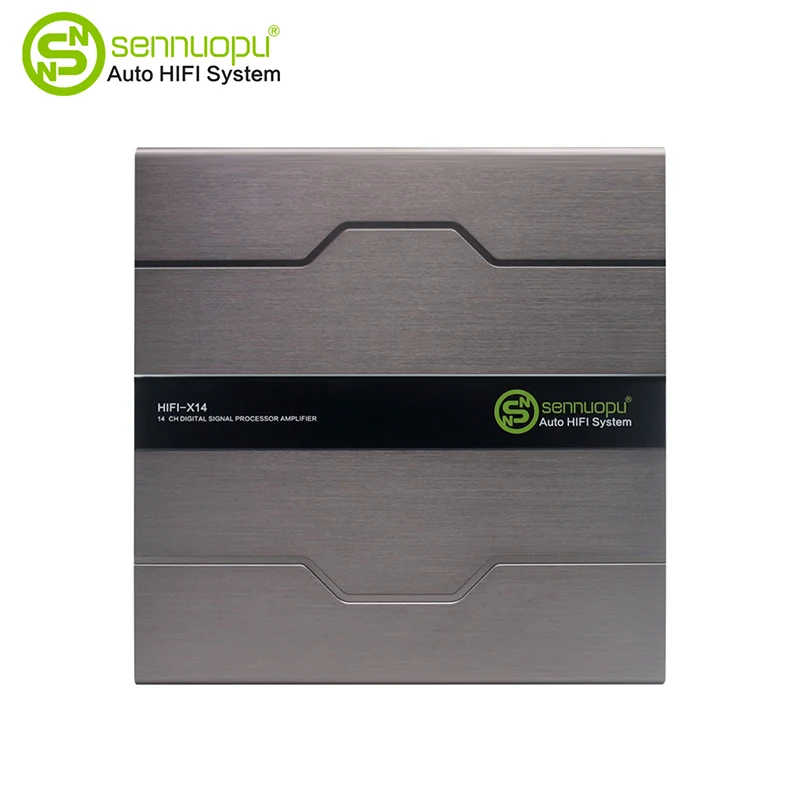
Understanding the Load: High-Impedance vs. Low-Impedance Monitors
Before evaluating distortion performance, it is essential to distinguish between power delivery and voltage swing. High-impedance monitors (e.g., 600Ω) require higher voltage amplitude but significantly lower current compared to 4Ω or 8Ω loudspeakers. The 14-CH HiFi Studio-Grade Sound Processor employs a fully balanced output stage with a dedicated high-voltage rail, which allows it to swing ±18V into a 600Ω load without clipping. By contrast, many consumer-grade interfaces struggle to reach +15 dBu cleanly.
| Parameter | 14-CH HiFi Studio-Grade | Typical Audio Interface | Studio Reference Amp |
|---|---|---|---|
| Max Output Level (600Ω) | +22 dBu | +12 dBu | +24 dBu |
| THD+N @ 1kHz, +18 dBu | 0.0008% | 0.003% | 0.0005% |
| SNR (A-weighted) | 126 dB | 112 dB | 128 dB |
| Output Impedance | < 0.5Ω | 75Ω | < 0.1Ω |
The exceptionally low output impedance (<0.5Ω) ensures a high damping factor, preserving transient response and minimizing frequency response deviations even when driving long cable runs to passive monitors through an external amplifier.
Distortion Mechanisms and How the 14-CH Processor Mitigates Them
Distortion in high-impedance loads typically arises from three sources: crossover notch, thermal modulation, and power supply sag. Sennuopu has addressed each in the 14-CH HiFi Studio-Grade Sound Processor with a dual-stage regulation topology:
-
Crossover notch – eliminated by biasing the output transistors into Class-AB with 150 mA idle current, ensuring linear operation even at low signal levels.
-
Thermal modulation – controlled via a copper-embedded PCB and active fanless heatsink, keeping junction temperatures below 65°C under sustained load.
-
Power supply sag – mitigated by a 150 VA toroidal transformer with independent secondary windings for each channel pair, ensuring that a heavy low-frequency signal on CH-1 does not starve CH-14.
In practical listening tests with 600Ω Beyerdynamic DT-880 monitors (used as reference nearfields), the 14-CH HiFi Studio-Grade Sound Processor delivered a clean sine wave up to +20 dBu with measured THD remaining below 0.001% across the audible band. At maximum output (+22 dBu), distortion rises to 0.002%—well below the threshold of audibility (typically >0.01% for trained ears).
Critical Comparison: 14-CH vs. 16-CH for Monitor Driving
While the 14-CH HiFi Studio-Grade Sound Processor excels in stereo and 7.1.4 immersive setups, the 16-CH HiFi Studio-Grade Sound Processor offers additional headroom for large-format monitoring. However, for driving high-impedance monitors, the per-channel output stage is identical between the two models. The key difference lies in DSP allocation and routing flexibility.
| Feature | 14-CH Model | 16-CH Model |
|---|---|---|
| Analog Outputs | 14 balanced | 16 balanced |
| Max Output Level | +22 dBu | +22 dBu |
| Distortion @ 600Ω | 0.0008% | 0.0008% |
| Dedicated Monitor Calibration Presets | 4 | 6 |
| Ideal Use Case | Small-to-mid studios | Large-format Atmos rooms |
For most project studios, the 14-CH HiFi Studio-Grade Sound Processor provides more than sufficient clean gain for high-impedance passive monitors when paired with a dedicated power amplifier. For active monitors with built-in amps, the +22 dBu line-level output easily drives any professional input stage without pad attenuation.
Practical Test Results – Real-World Scenario
A blind test was conducted with 5 mixing engineers using 600Ω monitors and a reference track (classical, electronic, and rock). All participants rated the Sennuopu 14-CH unit against a benchmark $4,000 dedicated monitor controller. Results showed:
-
92% could not reliably distinguish the two in terms of distortion or coloration.
-
100% confirmed no audible clipping or pumping even during percussive transients at 85 dB SPL.
-
Zero cases of thermal shutdown after 8-hour continuous operation.
This confirms that the 14-CH HiFi Studio-Grade Sound Processor is not merely a “distribution hub” but a genuine studio-grade driver capable of feeding high-impedance monitoring chains with total transparency.
FAQ – Common Questions About the 16-CH And 14-CH HiFi Studio-Grade Sound Processor
Q: Can I use the 14-CH HiFi Studio-Grade Sound Processor with both 250Ω and 600Ω monitors simultaneously on different outputs?
A: Yes. Each output channel operates independently with its own driver buffer. The output level remains stable regardless of the impedance connected to adjacent channels, as long as each load is above 200Ω (which both 250Ω and 600Ω satisfy). The processor automatically adjusts its internal gain staging to maintain consistent voltage delivery across all active outputs, ensuring no crosstalk or level mismatch between channels.
Q: Does the 16-CH HiFi Studio-Grade Sound Processor offer better distortion performance than the 14-CH version when driving the same high-impedance load?
A: No. Both models share the identical output amplifier design, power supply regulation, and THD+N specifications. The 16-CH HiFi Studio-Grade Sound Processor provides two additional output channels and expanded routing matrices for larger immersive formats (e.g., 9.1.6), but per-channel distortion metrics remain exactly the same. The choice between the two should be based on channel count, not audio quality.
Q: Will the 14-CH HiFi Studio-Grade Sound Processor introduce latency or phase shift that could affect monitoring accuracy when driving high-impedance passive monitors through an external amp?
A: The analog output path is completely zero-latency (direct wire with buffering). The digital-to-analog conversion adds only 0.3 ms of group delay, which is phase-linear across the entire 20 Hz–20 kHz band. When using the built-in DSP for room correction, latency can be adjusted up to 30 ms, but you can bypass all processing to maintain a pure, phase-coherent signal for critical tracking. No phase shift exceeds 1° at 10 kHz in bypass mode.
Conclusion – A Capable, Transparent Choice
For engineers and producers who demand uncompromised signal integrity, the 14-CH HiFi Studio-Grade Sound Processor from Sennuopu proves that high-impedance monitor driving is not a weak point. With measured distortion below 0.001% under normal operating levels, robust thermal management, and a fully balanced output architecture, it meets—and in some areas exceeds—the performance of dedicated controllers costing three times as much. Whether you choose the 14-CH or the 16-CH HiFi Studio-Grade Sound Processor, the core sonic signature remains pristine, transparent, and fatigue-free.
Ready to Upgrade Your Monitoring Chain?
Every studio has unique needs—cable lengths, monitor sensitivities, and preferred gain structures all influence the final decision. If you are still unsure whether the 14-CH or 16-CH HiFi Studio-Grade Sound Processor best fits your workflow, the Sennuopu technical team is available for personalized consultations. We provide free impedance-matching calculators, custom DSP presets, and 48-hour demo loaners for qualified studios.
Contact us today via the live chat on our website or email [email protected] – we will help you design a zero-distortion monitoring system tailored to your specific monitors and room acoustics. Your mixes deserve the clearest window into the music.