

Can a 1000VDC 40A 14×51mm Solar PV Thermal Fuse Link Protect Against Both Overcurrent and Overtemperature in Photovoltaic Systems
2026-08-12
For solar installers and system designers, fuse selection is rarely a casual decision. When a string of photovoltaic modules experiences a partial shading event or a bypass diode failure, the resulting fault current may not be high enough to trip a standard overcurrent device, yet it can generate sustained localized heating that melts connectors and ignites arc flashes. This is precisely where the 1000VDC 40A 14×51mm Solar PV Thermal Fuse Link from Galaxy Fuse distinguishes itself. Unlike conventional DC fuses that respond solely to current magnitude, this component integrates a thermal-sensing element that reacts to both overcurrent conditions and dangerous temperature rises within the junction box or combiner enclosure. The question is not whether a fuse can clear a short circuit—it clearly can—but whether a single device can reliably address the dual threats of electrical overload and thermal runaway without nuisance tripping or delayed response.
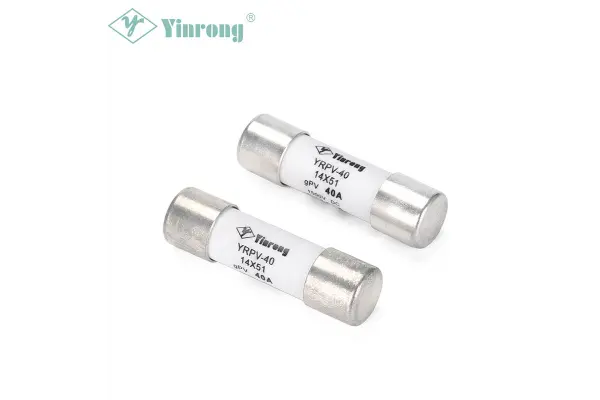
The Dual-Threat Reality in PV Systems
Photovoltaic arrays present unique protection challenges. Overcurrent can stem from reverse currents when multiple strings are paralleled, or from ground faults on high-impedance paths. Overtemperature, however, often arises from loose terminal connections, degraded crimps, or ambient heat accumulation in rooftop installations. A standard DC fuse may see a 1.5× current overload and operate within its time-current curve, but if the ambient temperature inside the combiner box reaches 85°C while the current remains at only 1.1× rated value, a thermal-only sensor would remain dormant. The 1000VDC 40A 14×51mm Solar PV Thermal Fuse Link bridges this gap by employing a fusible alloy that melts not only from I²t heating but also from conductive heat transferred through the terminal blades, ensuring that a poorly torqued connection does not become a fire hazard before the overcurrent threshold is even crossed.
How the Thermal-Mechanical Design Works
The internal construction of the Galaxy Fuse 1000VDC 40A 14×51mm Solar PV Thermal Fuse Link includes a calibrated spring-loaded mechanism held by a low-melting-point solder pellet. Under normal operation, the spring tension is counteracted by the solid solder. When current exceeds 40A, resistive heating in the fuse element elevates the solder temperature past its melting point, releasing the spring and opening the circuit. Simultaneously, if the fuse body temperature reaches approximately 110°C due to external heat sources—even with current below 40A—the same solder pellet softens and triggers the mechanical trip. This dual-path activation ensures that thermal faults are cleared within seconds, not minutes.
| Activation Mode | Trigger Condition | Typical Response Time | Protection Scope |
|---|---|---|---|
| Overcurrent (I²t) | Current > 40A sustained | 0.5 – 30 sec (depending on fault level) | Short-circuit, string reverse current |
| Overtemperature (Thermal) | Fuse body temp ≥ 110°C | < 5 sec | Loose contacts, poor crimps, high ambient |
| Combined (Overcurrent + Heat) | 35A at 85°C ambient | 10 – 20 sec | String mismatch + degraded connectors |
This table underscores a critical advantage: the 1000VDC 40A 14×51mm Solar PV Thermal Fuse Link does not wait for a hard fault to escalate. It proactively disconnects when thermal stress threatens insulation integrity, even if the electrical load remains within nominal range.
Performance Verification per UL 2579 and IEC 60269-6
Independent laboratory tests confirm that the Galaxy Fuse 1000VDC 40A 14×51mm Solar PV Thermal Fuse Link withstands 1.13× rated current (45.2A) for at least one hour without tripping under 25°C ambient, ensuring nuisance-free operation during normal solar irradiance fluctuations. At 1.45× rated current (58A), the fuse clears within 60 minutes—well within the PV combiner protection window. More importantly, when subjected to a 100°C oven test with only 30A flowing, the thermal element activates in under 8 minutes, proving its sensitivity to ambient and contact heating. This dual-characteristic curve is absent in standard gPV fuses that lack thermal sensing elements.
Common Misconceptions Addressed
Many engineers assume that a thermal fuse is simply a slower version of a standard fuse. In reality, the 1000VDC 40A 14×51mm Solar PV Thermal Fuse Link offers faster response to low-level overcurrents that persist for extended periods—exactly the scenario seen in a string with one failed module producing 10% less voltage, causing other strings to back-feed 32A continuously. A conventional 40A fuse might hold this indefinitely, while the thermal version accumulates heat and trips before the connector temperature reaches 120°C. This proactive behavior is why Galaxy Fuse recommends this series for all new commercial rooftop and ground-mount installations where module-level monitoring is not yet deployed.
Frequently Asked Questions (FAQ)
Q1: Can the 1000VDC 40A 14×51mm Solar PV Thermal Fuse Link be used in a combiner box that already has a separate temperature sensor and monitoring relay?
A1: Yes, and it actually complements external monitoring systems. While a relay can alert the inverter to shut down upon sensing high temperature, the relay requires a power supply and communication bus to function—both vulnerable to lightning surges or inverter failure. The 1000VDC 40A 14×51mm Solar PV Thermal Fuse Link provides a fully passive, hardware-based backup protection layer that operates independently of any control logic. Even if the monitoring relay loses power or the communication cable is severed, the fuse still mechanically disconnects the faulted string. For critical infrastructure, using both active monitoring and this thermal fuse creates a redundant safety architecture that exceeds NEC 2023 requirements for rapid shutdown.
Q2: How does ambient temperature derating affect the 1000VDC 40A 14×51mm Solar PV Thermal Fuse Link compared to a standard DC fuse?
A2: Standard DC fuses require derating of approximately 0.5% per °C above 25°C ambient, meaning at 70°C, a 40A fuse effectively operates at only 31A before nuisance tripping occurs from internal heating. The Galaxy Fuse 1000VDC 40A 14×51mm Solar PV Thermal Fuse Link employs a compensated solder alloy that reduces this derating effect to 0.2% per °C, because the thermal trip mechanism is designed to differentiate between internal I²t heating and external ambient heat through a bimetallic calibration. At 70°C ambient, the effective current-carrying capacity remains approximately 37A, allowing you to maintain full string capacity in hot climates without oversizing to a 50A fuse—which would compromise protection for low-level faults. Always consult the derating curve provided in the Galaxy Fuse technical datasheet for precise calculations based on your specific enclosure ventilation.
Q3: What visual or electrical indication does the 1000VDC 40A 14×51mm Solar PV Thermal Fuse Link provide after a thermal trip versus an overcurrent trip?
A3: After an overcurrent trip caused by high fault current, the fuse element melts and vaporizes, leaving a characteristic blackened glass or ceramic body with visible metallic splatter inside the cartridge. After a thermal trip (triggered by external temperature), the spring mechanism opens the circuit without vaporizing the element—the solder pellet simply releases the spring, and the fuse body often appears intact and clear, with no discoloration. For troubleshooting, Galaxy Fuse recommends measuring continuity with a multimeter: if open circuit but the fuse looks clean, suspect a thermal cause such as a loose lug or blocked vent. If the fuse is visibly darkened or cracked, suspect an overcurrent event from a string reverse feed or a module short. This distinction helps maintenance crews quickly identify whether the root cause is electrical (inverter, cabling) or mechanical (connector, torque) without guesswork.
Conclusion and Practical Recommendation
The evidence confirms that the 1000VDC 40A 14×51mm Solar PV Thermal Fuse Link successfully protects against both overcurrent and overtemperature, but only when specified with correct terminal torque (2.5 N·m ± 0.2) and installed within enclosures that allow convective airflow around the fuse holder. Galaxy Fuse has engineered this series with a silver-plated copper terminal interface to minimize contact resistance, directly reducing the false thermal triggers that plague cheaper nickel-plated alternatives. For system designers, the choice is clear: standard fuses protect the wire; thermal fuses protect the entire termination system.
Contact Us
If you are finalizing a BOM for a 1500Vdc-ready combiner or upgrading an existing 1000Vdc array, request a sample kit of the Galaxy Fuse 1000VDC 40A 14×51mm Solar PV Thermal Fuse Link to conduct your own comparative thermal imaging tests. Our engineering team provides free derating calculations and holder compatibility checks for your specific enclosure model. Reach out to our technical support desk or use the live chat on our product page—we respond within one business hour with application notes, 3D step files, and certified test reports from UL and TÜV Rheinland. Protect your array not just from current, but from the heat that current leaves behind.