

Are You Struggling to Integrate Multi-Wavelength Output in a Compact and Reliable Way?
2026-03-04
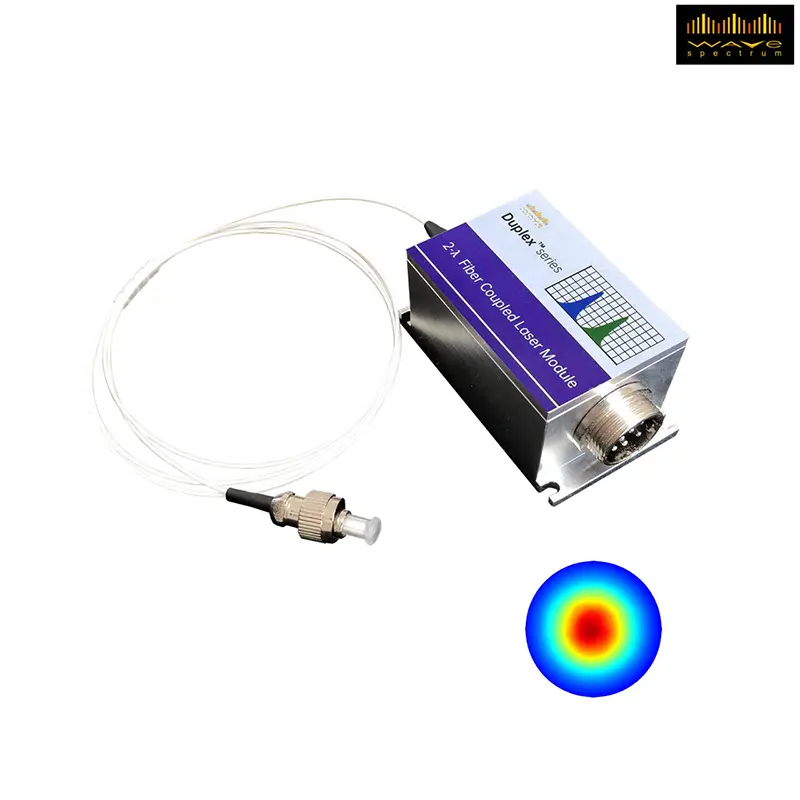
As photonics applications continue to demand higher precision and system flexibility, we have seen more engineers searching for efficient dual-wavelength integration rather than stacking separate laser sources. At Wavespectrum Laser Group, we gradually introduced the Duplex 2-Wavelength Fiber Coupled Laser Module to address exactly this challenge. Instead of forcing our customers to compromise between optical stability and system footprint, we developed a solution that combines two wavelengths into a single fiber-coupled platform with reliable beam delivery and long-term performance consistency.
In this article, I would like to share how our Duplex 2-Wavelength Fiber Coupled Laser Module helps solve real engineering pain points and why more OEM integrators are moving toward duplex fiber solutions.
Why Does Managing Two Laser Wavelengths Often Create System Complexity?
When I speak with system designers in biomedical imaging, spectroscopy, and industrial sensing, one issue comes up repeatedly. Managing two discrete laser sources often means:
- Increased optical alignment workload
- Higher risk of beam drift over time
- Bulky mechanical integration
- More complicated thermal management
- Additional failure points in connectors and mounts
Using separate modules may appear flexible at first, but in real-world applications it introduces hidden instability and maintenance costs. That is precisely where a Duplex 2-Wavelength Fiber Coupled Laser Module changes the equation.
By integrating two wavelengths into a single fiber output, we reduce optical path variation and simplify downstream system design. Instead of aligning two beams independently, our customers work with one fiber interface that delivers stable combined output.
How Does a Duplex 2-Wavelength Fiber Coupled Laser Module Improve Optical Stability?
Optical stability is not only about output power. It is also about beam quality, mode consistency, and thermal equilibrium. Our Duplex 2-Wavelength Fiber Coupled Laser Module integrates:
- Independent wavelength drivers with matched thermal control
- Precision wavelength combining optics inside a sealed structure
- Factory-aligned fiber coupling to minimize long-term drift
- Optimized heat dissipation structure for continuous operation
From my experience working with laboratory and industrial clients, pre-aligned internal combining reduces the need for repeated field recalibration. This translates into fewer service interruptions and more predictable performance over time.
What Technical Parameters Should You Compare Before Choosing a Duplex Module?
When evaluating a Duplex 2-Wavelength Fiber Coupled Laser Module, I always recommend reviewing not only nominal wavelength values but also practical integration metrics.
| Parameter | Why It Matters |
| Wavelength Accuracy | Ensures spectral precision for fluorescence, Raman, or sensing applications |
| Power Stability | Directly affects measurement repeatability and signal reliability |
| Fiber Core Diameter | Impacts beam coupling efficiency into downstream optics |
| Numerical Aperture | Determines compatibility with collimation and focusing systems |
| Modulation Capability | Supports synchronization with detection systems or scanning platforms |
| Thermal Management Design | Influences lifetime and long-duration stability |
Our Duplex 2-Wavelength Fiber Coupled Laser Module is designed with balanced driver architecture and matched thermal control, allowing both wavelengths to operate reliably without cross-interference.
Where Can a Duplex 2-Wavelength Fiber Coupled Laser Module Deliver the Most Value?
I have seen duplex fiber modules create measurable advantages in the following applications:
- Fluorescence microscopy requiring dual excitation bands
- Flow cytometry systems with multi-channel detection
- Raman spectroscopy with reference wavelength support
- Biomedical diagnostics equipment
- Industrial material inspection platforms
In these systems, space is often limited and optical alignment must remain stable over long cycles. A compact Duplex 2-Wavelength Fiber Coupled Laser Module allows engineers to reduce mechanical components and simplify optical routing, which ultimately shortens development cycles.
How Do We Balance Compact Design with Long-Term Reliability?
Miniaturization alone does not solve integration challenges. In fact, overly compact systems sometimes compromise thermal stability. That is why, at Wavespectrum Laser Group, we designed the Duplex 2-Wavelength Fiber Coupled Laser Module with:
- Optimized internal optical path layout
- High-efficiency heat sinking structure
- Stable current driving circuits
- Strict burn-in testing procedures
Each unit undergoes output stability validation before shipment. We understand that our customers rely on these modules for mission-critical equipment, so predictable performance is not optional.
Why Is Fiber Coupling the Key to Simplified System Integration?
Free-space optical alignment introduces complexity, especially when combining two wavelengths. Fiber coupling provides mechanical stability and repeatable beam delivery.
With our Duplex 2-Wavelength Fiber Coupled Laser Module, engineers can:
- Directly connect to collimators or fiber splitters
- Reduce vibration sensitivity
- Shorten assembly time
- Minimize long-term alignment drift
This approach reduces integration risk, particularly in portable or vibration-prone environments.
Are You Looking for a Reliable Dual-Wavelength Laser Partner for Your Next Project?
If you are developing advanced optical systems and need a stable, compact, and customizable Duplex 2-Wavelength Fiber Coupled Laser Module, we would be glad to discuss your technical requirements. Whether you require specific wavelength combinations, output power adjustments, or fiber specifications, our engineering team can tailor a solution to fit your system architecture.
Let us help you reduce integration complexity and improve optical performance. If you would like detailed specifications, pricing, or application consultation, please contact us today and share your project details. We look forward to supporting your next innovation.