

Are You Still Struggling to Achieve Stable Broadband Output in Compact Laser Systems?
2026-02-27
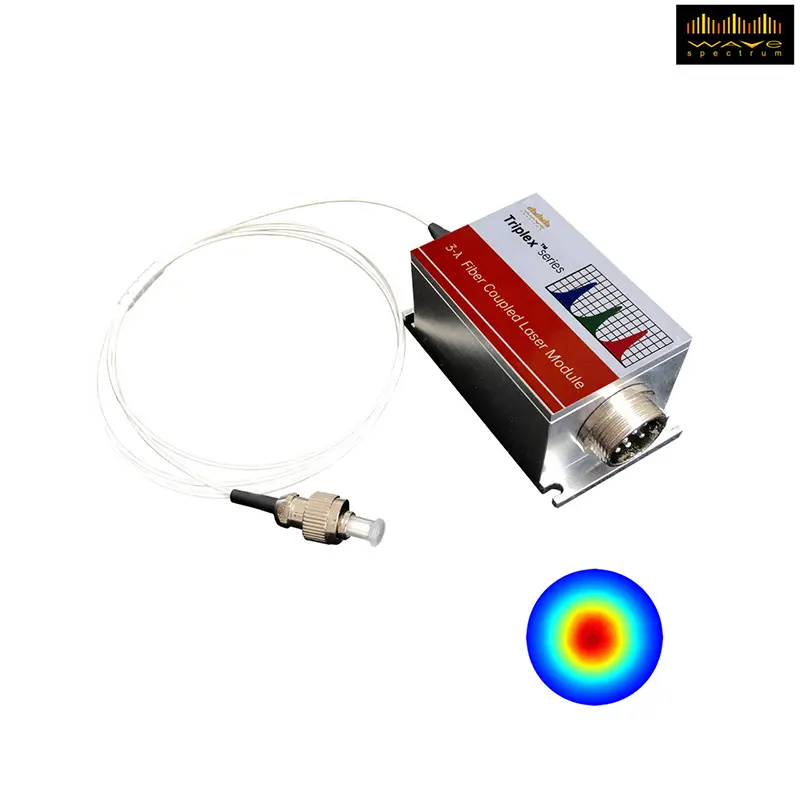
In recent years, I have seen more laboratories and OEM integrators searching for a compact, fiber-delivered broadband solution that can replace bulky multi-source assemblies. As application demands evolve, Wavespectrum Laser Group gradually introduced the Triplex 3-Wavelength White light Fiber Coupled Laser Module to address these integration challenges in a practical and scalable way. Instead of stacking separate laser heads, drivers, and optical combiners, I prefer working with a single engineered module that delivers stable multi-wavelength output through one fiber interface.
For engineers who value both performance and system simplicity, the Triplex 3-Wavelength White light Fiber Coupled Laser Module offers a more streamlined path toward broadband illumination without sacrificing beam quality or long-term reliability.
Why Do Multi-Wavelength Applications Often Become Integration Nightmares?
When I discuss system design with clients in fluorescence imaging, spectroscopy, and advanced inspection, the same issues repeatedly surface:
- Complex alignment when combining separate wavelengths
- Inconsistent power balance between channels
- Thermal drift affecting spectral stability
- Limited installation space in compact instruments
- High maintenance due to multiple drivers and connectors
Traditional solutions require separate red, green, and blue or other wavelength sources, followed by optical combination stages. That approach increases optical loss and mechanical sensitivity. In contrast, the Triplex 3-Wavelength White light Fiber Coupled Laser Module integrates three precisely controlled wavelengths within one engineered platform, significantly reducing external optical complexity.
How Does a Fiber-Coupled Triplex Design Simplify Optical Architecture?
I prefer fiber-coupled solutions because they decouple the light source from the mechanical constraints of the main instrument. With the Triplex 3-Wavelength White light Fiber Coupled Laser Module, the three internal laser channels are spectrally combined and optimized before entering the output fiber. This provides several structural advantages:
- Single fiber output reduces alignment steps
- Stable wavelength combination minimizes cross-channel fluctuation
- Compact housing improves thermal management
- Modular electrical interface simplifies system integration
Rather than redesigning the optical bench to accommodate multiple discrete lasers, I can integrate one compact module and route light precisely where it is needed.
What Technical Parameters Should Engineers Actually Compare?
In my experience, evaluating a broadband laser module requires looking beyond nominal wavelength labels. Below is a structured comparison framework I use when assessing a Triplex 3-Wavelength White light Fiber Coupled Laser Module for professional applications.
| Parameter | Why It Matters | Impact on Application |
| Wavelength Stability | Determines spectral consistency over time | Critical for fluorescence and spectroscopy accuracy |
| Power Balance Between Channels | Ensures uniform white-light synthesis | Prevents color shift and signal distortion |
| Fiber Core Diameter | Affects coupling efficiency and spot size | Influences illumination uniformity |
| Thermal Control Design | Maintains long-term output stability | Reduces drift in continuous operation |
| Modulation Capability | Supports dynamic intensity control | Essential for imaging synchronization |
The Triplex 3-Wavelength White light Fiber Coupled Laser Module is engineered with careful channel matching and controlled thermal design, which directly addresses the instability issues I often see in separated multi-laser assemblies.
Can One Compact Module Replace Three Independent Lasers?
This is a question I frequently hear from equipment manufacturers. The answer depends on output requirements, but in many imaging and analytical systems, the integrated architecture of the Triplex 3-Wavelength White light Fiber Coupled Laser Module provides sufficient combined output while dramatically reducing footprint.
Instead of managing three power supplies, three driver boards, and multiple beam combiners, I can operate a single synchronized system. This improves:
- Electrical efficiency
- Maintenance simplicity
- System reliability over extended cycles
- Consistency across production batches
From an OEM perspective, fewer components typically translate into lower long-term support costs.
Where Does This Type of Module Deliver the Most Value?
I have seen strong demand in the following application areas:
| Application Field | Why Broadband Output Is Required |
| Fluorescence Microscopy | Multiple excitation wavelengths for different markers |
| Spectroscopic Analysis | Broad spectral coverage for material characterization |
| Biomedical Instrumentation | Compact integration inside diagnostic platforms |
| Precision Inspection Systems | Multi-band illumination for defect detection |
In these environments, stability and repeatability matter more than raw peak output. The integrated design of the Triplex 3-Wavelength White light Fiber Coupled Laser Module supports consistent results across extended operating cycles.
What Should You Consider Before Selecting a Triplex White-Light Module?
Before finalizing a purchase decision, I recommend confirming the following:
- Compatibility with your fiber interface standard
- Driver communication protocol and modulation requirements
- Thermal management conditions inside your instrument
- Required spectral bandwidth and power ratios
Working directly with an experienced manufacturer allows you to tailor configuration details to your system architecture rather than forcing a generic light source into a specialized platform.
Are You Ready to Upgrade Your Multi-Wavelength Laser Architecture?
If you are currently balancing multiple discrete laser sources and facing alignment drift, integration complexity, or inconsistent broadband output, it may be time to reconsider your architecture. The Triplex 3-Wavelength White light Fiber Coupled Laser Module offers a practical and integration-focused alternative designed to reduce system burden while maintaining spectral performance.
I encourage you to evaluate how a unified, fiber-coupled multi-wavelength module could streamline your next design cycle. If you would like technical specifications, customization guidance, or application support, please contact us today. Our engineering team is ready to discuss your project requirements and provide a tailored solution. Submit your inquiry now and let us help you optimize your optical system with a reliable Triplex 3-Wavelength White light Fiber Coupled Laser Module.