

Are Miniature Intermediate Power Relays Suitable for PLC Output Interfacing Applications
2026-08-21
Programmable Logic Controllers (PLCs) form the backbone of modern industrial automation, but their output modules often cannot drive actuators, motors, or solenoid valves directly due to current and voltage limitations. This is where the Miniature Intermediate Power Relay steps in as a critical interface component. At Huaguan, we have engineered a range of these relays specifically to bridge the gap between low-power PLC signals and high-power field loads, ensuring reliable switching, electrical isolation, and long service life in harsh factory floors.
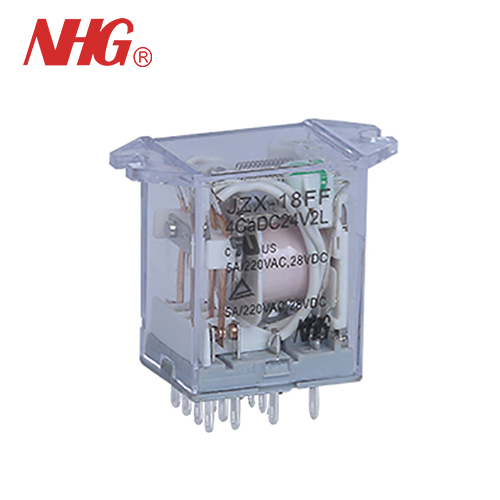
Understanding the PLC Output Interface Challenge
PLC output cards typically deliver 24V DC or 120V AC signals at currents below 0.5A per channel. Directly connecting these outputs to inductive or high-inrush loads—such as contactors, motors, or heating elements—risks damaging the expensive PLC module. A Miniature Intermediate Power Relay acts as a buffer, accepting the low-energy PLC command and switching a separate, higher-capacity load circuit. This arrangement protects the PLC, simplifies troubleshooting, and allows field replacement without system downtime.
Key Technical Parameters for Compatibility
| Parameter | PLC Output Typical Value | Miniature Intermediate Power Relay (Huaguan Series) |
|---|---|---|
| Coil Voltage | 24V DC, 120V AC, 230V AC | 5–240V AC/DC (wide-range available) |
| Pick-up Voltage | ≥75% of rated | ≤70% (ensures reliable pickup even with voltage dips) |
| Coil Power Consumption | N/A | 0.5–1.2W (low enough for direct PLC drive) |
| Contact Current Rating | PLC output: ≤0.5A | 10A–16A (resistive / inductive) |
| Max Switching Voltage | N/A | 250V AC / 30V DC |
| Mechanical Life | N/A | ≥10⁷ operations |
| Electrical Life (rated load) | N/A | ≥10⁵ operations |
This table demonstrates that a properly selected Miniature Intermediate Power Relay not only matches PLC signal levels but also provides a substantial power amplification margin—typically 20 to 30 times the PLC’s direct output capability.
Suitability Criteria: 5 Critical Factors
-
Coil Drive Compatibility – The relay’s coil must be energized by the PLC’s output current. Huaguan relays feature sensitive coils requiring as little as 5mA at 24V DC, well within the capability of most transistor or relay-output PLC cards.
-
Switching Speed – For high-speed counting or pulse-width modulation (PWM) applications, mechanical relays have inherent response delays (5–15ms). While not suitable for fast PWM, they excel for ON/OFF control, interlocking, and sequence logic.
-
Contact Material and Configuration – Silver-alloy contacts with gold-plating options prevent oxidation in low-signal applications. Huaguan offers 1-, 2-, and 4-pole configurations, enabling a single PLC output to control multiple load circuits simultaneously.
-
Dielectric Strength – Industrial environments experience voltage transients. A quality Miniature Intermediate Power Relay provides 4,000V AC isolation between coil and contacts, safeguarding the PLC from back-EMF generated by inductive loads.
-
Termination Style – Plug-in socket, PCB-mount, or screw-terminal versions allow flexible integration. For DIN-rail control panels, socket-mount relays from Huaguan simplify replacement without rewiring.
Practical Wiring Recommendation
For PLC output interfacing, we strongly recommend using a freewheeling diode (for DC coils) or an RC snubber (for AC coils) across the relay coil to suppress voltage spikes during de-energization. This practice doubles the relay’s electrical life and prevents erratic PLC resets. Huaguan provides built-in suppression modules on selected models, reducing external component count.
Miniature Intermediate Power Relay FAQ
Q1: Can a Miniature Intermediate Power Relay be directly driven by a PLC transistor output (sourcing or sinking)?
A1: Yes, provided the relay coil current does not exceed the transistor’s maximum sink/source rating (typically 0.5A). Huaguan low-power coils draw only 10–30mA at 24V DC, making them fully compatible. However, always verify the PLC manual for minimum load current requirements—some transistor outputs need a minimum current to maintain stable OFF-state leakage, and adding a small bleeder resistor in parallel with the coil solves this. For sinking outputs, connect the coil between the output terminal and the +24V supply; for sourcing, connect between the output and 0V. Polarity must be observed for DC coils with built-in LED indicators.
Q2: How do I select the correct contact configuration for my PLC output application?
A2: The choice depends on how many independent load circuits you need to control per PLC channel. For a single load (e.g., one motor contactor), a 1-pole (SPST or SPDT) Miniature Intermediate Power Relay is sufficient. For two circuits requiring simultaneous action (e.g., a contactor and a pilot light), use a 2-pole relay. Huaguan offers 4-pole models where one PLC output can switch up to four separate load lines—ideal for compact multi-function stations. Remember that each pole has its own current rating; summing multiple poles does not increase individual contact capacity. Also, consider whether you need normally-open (NO) for energize-to-run, normally-closed (NC) for fail-safe braking, or both in a changeover contact.
Q3: What is the expected service life when switching inductive loads like solenoids or small motors?
A3: Inductive loads generate arc energy during contact opening, which erodes the contact surface. Under rated inductive conditions (cosφ = 0.4), a standard Miniature Intermediate Power Relay delivers 50,000–100,000 operations. At Huaguan, we use silver-tin-oxide (AgSnO₂) contacts that resist welding and transfer, extending inductive life to over 150,000 cycles at 10A / 250V AC. To maximize lifespan, derate the current by 30–40% for inductive loads, add external arc-suppression (RC networks across the load, not the contacts), and keep switching frequency below 10 operations per minute. For very high cycle counts (≥500,000), consider our DC-switching optimized versions with magnetic blow-out features.
Common Pitfalls and How to Avoid Them
-
Using AC coils on DC PLC outputs – This causes humming, overheating, and rapid coil burn-out. Always match coil voltage and type (AC or DC) to the PLC output specification.
-
Ignoring ambient temperature – Relay coil heat dissipation drops above 55°C. Huaguan relays are rated for -40°C to +85°C operation, but derating curves apply—reduce continuous current by 20% when ambient exceeds 70°C.
-
Forgetting suppression diodes – Without a freewheeling diode, the inductive kickback from the relay coil itself can reach 200V, damaging the PLC transistor. Install a diode (1N4007 or faster) reverse-biased across the coil terminals, as close as possible to the coil.
Real-World Application Example
A packaging machine uses 16 PLC outputs to control pneumatic solenoid valves and conveyor motor contactors. By installing Huaguan Miniature Intermediate Power Relay modules on a common DIN-rail backplane, the integrator reduced panel wiring time by 40%, improved diagnostic visibility with LED status indicators, and eliminated PLC output card failures that occurred monthly. After 18 months of 24/7 operation, the relay contact resistance remained below 50mΩ, well within specification.
Why Huaguan Excels in PLC Interfacing
-
Wide coil voltage coverage – 5V to 240V AC/DC, compatible with all major PLC brands (Siemens, Allen-Bradley, Mitsubishi, Omron).
-
Cadmium-free contacts – RoHS compliant and environmentally sustainable.
-
Sealed or flux-tight versions – Protect against dust, humidity, and corrosive gases common in chemical or food-processing plants.
-
Quick-connect terminals and color-coded housings – Reduce installation errors and speed up maintenance.
Conclusion
The Miniature Intermediate Power Relay is not merely suitable for PLC output interfacing—it is the industry-standard solution for achieving robust, maintainable, and scalable automation systems. Its ability to provide galvanic isolation, current amplification, and multi-pole switching makes it indispensable in any control cabinet. When selecting relays, pay close attention to coil sensitivity, contact material, and suppression requirements. With Huaguan’s engineered portfolio, you gain a partner that understands both the electrical nuances and the operational demands of modern factories.
Ready to optimize your PLC output stage with reliable relay solutions?
Contact us today at Huaguan to request samples, get customized coil voltages, or consult our application engineers for a wiring diagram tailored to your specific load profile. We respond within 24 hours with technical data, 3D CAD models, and competitive pricing for volume orders. Your automation reliability starts with the right interface—let’s make it happen.