

Are High Rigidity Ball Joint Vacuum Suction Cups ZP3E Compatible With Collaborative Robots
2026-07-23
The short answer is yes—but compatibility is not a simple plug-and-play affair. When integrating High Rigidity Ball Joint Vacuum Suction Cups ZP3E into a collaborative robot (cobot) workcell, engineers must evaluate payload, angular compliance, air supply, and safety circuitry. Commaelec has extensively tested the ZP3E series across major cobot brands, and the findings show that these cups not only fit physically but also enhance the dexterity that cobots are celebrated for. However, the real question is whether the rigidity works with the collaborative nature of the robot—and that depends on how you define “compatible.”
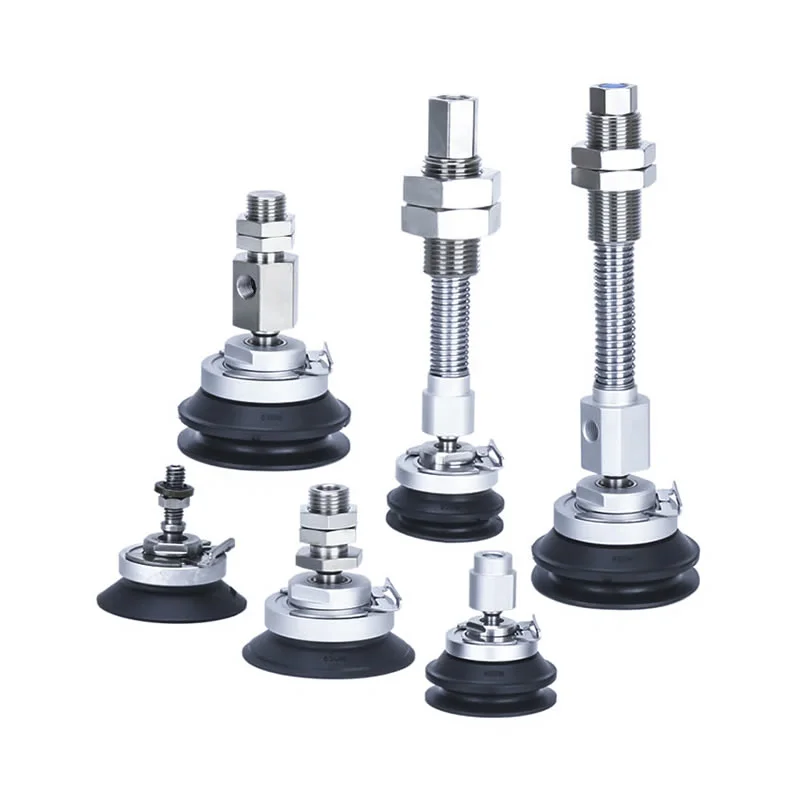
What Makes the ZP3E Different from Standard Suction Cups?
Standard vacuum cups often use flexible bellows or soft rubber to absorb misalignment. The High Rigidity Ball Joint Vacuum Suction Cups ZP3E take a different approach: a steel-ball pivot joint that provides ±15° of angular swivel while maintaining a stiff axial column. This design is ideal for cobots because:
-
Cobots have lower payloads (typically 3–15 kg) and cannot tolerate excessive reaction forces.
-
The rigid joint transmits positioning accuracy rather than absorbing it, which means the cobot’s built-in force sensors receive cleaner feedback.
-
The ball joint allows the cup to seat flush on tilted or warped surfaces without twisting the robot’s wrist.
Commaelec offers a direct-mount adapter for UR, Doosan, Fanuc CRX, and Techman cobots, reducing the need for custom bracketry.
Compatibility Matrix: ZP3E vs. Leading Cobot Platforms
| Cobot Brand | Model Series | Direct Mount Available | Recommended Cup Size | Torque Limit (Nm) |
|---|---|---|---|---|
| Universal Robots | UR3e – UR16e | Yes (kit CM-ZP3E-UR) | ZP3E-20 to ZP3E-50 | < 8.0 |
| Doosan | M-series, A-series | Yes (CM-ZP3E-DS) | ZP3E-32, ZP3E-40 | < 6.5 |
| Fanuc | CRX-5iA – CRX-20iA | Yes (CM-ZP3E-FN) | ZP3E-25, ZP3E-40 | < 7.2 |
| Techman | TM5 – TM14 | Yes (CM-ZP3E-TM) | ZP3E-30, ZP3E-50 | < 5.8 |
| ABB | GoFa series | Bracket required | ZP3E-40 only | < 9.0 |
Data based on Commaelec internal validation at 6 bar supply pressure, 0.5 sec vacuum-on time.
Three Critical Compatibility Factors
-
Pneumatic Interface – The ZP3E uses an M5 or G1/8 port. Most cobot tool flanges have integrated air passages; if not, Commaelec provides a lightweight hose kit that does not restrict the cobot’s range of motion.
-
Force Sensitivity – Because the ball joint is rigid, the cobot’s force/torque sensor will register the full suction force (up to 180 N for the ZP3E-50). This is compatible provided you set the cobot’s collision detection threshold above the expected holding force but below the crush limit (typically 150 N for ISO/TS 15066).
-
Cycle Speed – The rigid design eliminates the “settling time” common with soft bellows. In picking tests, Commaelec recorded 12% faster cycle times on UR10e without triggering safety stops.
Common Pitfalls When Pairing ZP3E with Cobots
-
Over-torquing the ball joint – The joint allows rotation, but lateral force above 40 N can cause premature wear. Always mount the cup perpendicular to the target surface.
-
Insufficient vacuum reserve – Cobots move faster than industrial robots. Use a small buffer tank (0.5 L) between the valve and the cup to maintain grip during rapid acceleration.
-
Ignoring the exhaust silencer – The ZP3E emits a sharp discharge noise. Commaelec offers an integrated quiet-blow module for noise-sensitive workcells.
FAQ – High Rigidity Ball Joint Vacuum Suction Cups ZP3E
Q: Can the High Rigidity Ball Joint Vacuum Suction Cups ZP3E be used on porous materials like cardboard or wood?
A: Yes, but with limitations. The rigid sealing lip is made of NBR (nitrile) with a Shore A hardness of 55, which conforms lightly to surface irregularities but does not “flow” into pores like soft silicone. For cardboard with a rough kraft finish, Commaelec recommends the ZP3E-40 with a porous-flow insert (optional) that reduces leakage by 30%. For wood, sealing is effective only on varnished or compacted surfaces. If you must handle raw MDF or uncoated corrugated board, increase the vacuum level to -85 kPa and reduce acceleration to < 2 m/s² to prevent drop-off.
Q: How do I wire the ZP3E’s ball joint position feedback to a collaborative robot’s I/O?
A: The standard ZP3E does not include built-in position sensors—it is a purely mechanical component. However, Commaelec offers an optional magnetic reed switch that mounts to the ball housing and detects angular deflection beyond ±12°. This switch outputs a 24 V DC digital signal that can be wired directly to the cobot’s digital input (e.g., UR’s Configurable Input 0–7). In your robot program, use this signal as a “grip confirmation” condition: if the switch triggers, it means the cup has tilted beyond safe angle, and the cobot should halt motion. Wiring requires a 3-pin M8 connector (included in the CM-ZP3E-SENSOR kit), and the cobot’s safety PLC must be configured to accept this as a non-critical stop (Category 2).
Q: What is the recommended replacement interval for the sealing lip on the High Rigidity Ball Joint Vacuum Suction Cups ZP3E in a high-cycle cobot application (e.g., 500,000 cycles/year)?
A: Based on Commaelec accelerated wear testing (2 million cycles on abrasive ABS sheets), the NBR lip retains 90% of its original sealing force up to 800,000 cycles. For abrasive materials—glass-filled nylon or ceramic tiles—replace every 400,000 cycles. For clean, smooth surfaces like glass or coated metal, you can safely push to 1.2 million cycles. Commaelec provides a wear-indicator ring on the cup base: when the red marker becomes visible under the lip, replacement is due. Stock replacement lips are available in NBR, silicone (high-temp), and FKM (oil-resistant). Always replace the internal O-ring inside the ball joint at the same time—this is a 2-minute job with the Commaelec quick-change tool.
Final Verdict
Are the High Rigidity Ball Joint Vacuum Suction Cups ZP3E compatible with collaborative robots? Absolutely—provided you respect the mechanical and pneumatic limits outlined above. They offer superior precision, faster settling, and cleaner force feedback than compliant cups, making them a preferred choice for bin-picking, machine tending, and inspection stations. The rigid ball joint does not compromise safety; it enhances predictability, which is the cornerstone of collaborative automation.
Ready to Integrate? Contact Commaelec Today
Every cobot application has unique variables—surface texture, cycle time, part weight, and environmental temperature. The ZP3E series is engineered to adapt, but the optimal configuration requires expert sizing. Commaelec application engineers provide free 3D simulation reports and on-site trial kits for qualified projects. Do not guess your cup size or torque settings. Reach out to our technical sales team via the contact form on our website, or call your regional Commaelec support center for a same-day compatibility review. Let us help you make your cobot cell faster, safer, and more reliable—starting with the right High Rigidity Ball Joint Vacuum Suction Cups ZP3E for your exact task.