

Four-Motor Fiber Fusion Splicer: A New Type for Enhanced Fiber Splicing Precision
2026-09-07
Ask any field technician what quietly ruins a good splice day, and you’ll hear about drift, misalignment, and the slow creep of rework. The arrival of four-motor fiber fusion splicers is rewriting that story. By splitting alignment and positioning across four independent motors, this new type of splicer suppresses the micro-movements that silently inflate splice loss. In this post, we’ll dig into how DVP is turning tighter tolerances into everyday practice—and why your next precision test might feel a lot less stressful.
Why a Four-Motor Setup Changes Fiber Alignment
A four-motor arrangement gives each axis of motion its own dedicated driver, so adjustments to fiber position don't have to be traded against one another. With two motors, a single correction often shifts both tip and tilt at once, forcing the operator to chase alignment in small, repetitive steps. Splitting the workload across four motors lets the fiber move in a more direct path toward the target, reducing overshoot and the slow back-and-forth that wears out mechanical parts.
The real difference comes down to how force is distributed. In a four-motor setup, the pair responsible for lateral alignment can hold steady while the other pair adjusts angular orientation. This isolation of movement keeps the fiber from twisting or bending into a slightly different shape on every pass, which means the core stays centered and the light or signal path remains stable. Even under repeated adjustments, the alignment holds longer because the fiber is not being pulled in conflicting directions at the same time.
Inside the Splicer’s Real-Time Error Correction Loop
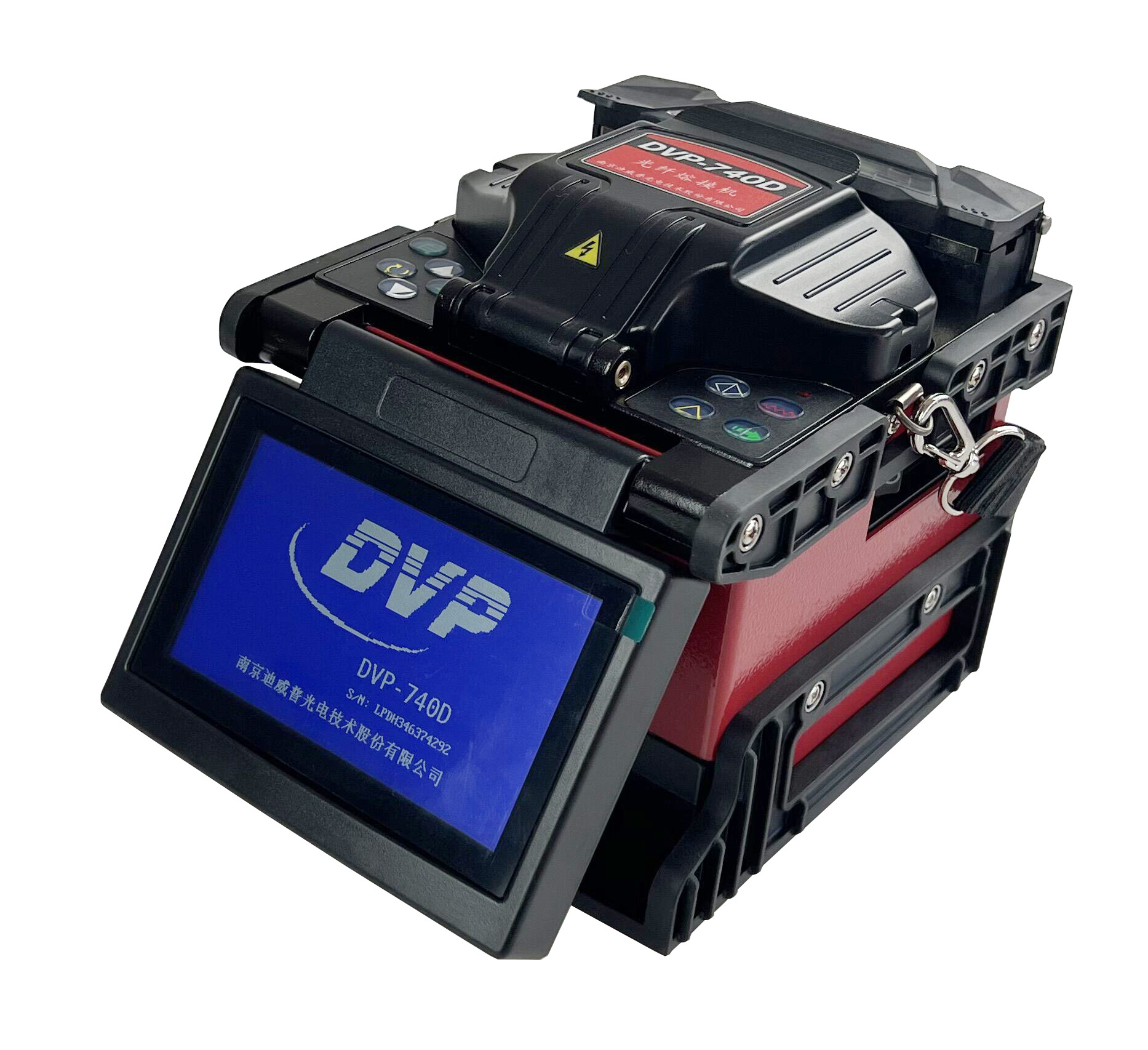
The moment two fiber ends enter the splice zone, the machine doesn’t simply align them once and fire the arc. A fast image processor tracks core geometry at sub-micron scale, comparing the live view against the expected parabolic profile of a clean cleave. Whenever the offset drifts—because of a tiny vibration, a speck of dust, or thermal expansion in the fixture—the control loop nudges the motorized stages to bring the axes back into overlap before the electrodes discharge.
That correction loop runs continuously during the alignment phase, but it also stays active through the pre-fusion arc. If the gap widens or the cores tilt slightly, the firmware adjusts the discharge duration and current rather than forcing the mechanical stages to chase a moving target. This split responsibility keeps the loop stable: fast mechanical corrections handle position, while slower thermal adjustments manage the heat budget and prevent surface tension from pulling the molten glass out of round.
Achieving Sub-Micron Precision Without Manual Tweaks
Reaching sub-micron accuracy typically conjures images of painstaking manual alignment and hours of fine-tuning under a microscope. But modern systems sidestep this entirely by embedding real-time feedback loops directly into the motion hardware. Laser interferometers or high-resolution encoders continuously measure stage position, feeding deviations back to the controller dozens of times per second. The result is a self-correcting loop that compensates for drift, thermal expansion, or even micro-vibrations before they ever translate into a visible error. Operators simply set a target coordinate, and the system holds it with a steadiness that manual tweaks could never match.
The secret lies in the marriage of stiff mechanical design and smart software. Stages built from thermally stable materials like Invar or granite reduce baseline movement, while piezoelectric actuators apply corrections at nanometer resolution. On the software side, adaptive algorithms learn the system's unique quirks—backlash, lead screw pitch error, bearing runout—and build a dynamic compensation map. This map updates continuously, so the machine doesn't just follow a pre-programmed path; it actively predicts and counteracts errors on the fly. No more nudging a micrometer back and forth hoping for the best.
What makes this approach stand out is how it collapses the skill gap. In the past, only a seasoned technician could coax a positioning stage into sub-micron territory, and even then, repeatability varied from day to day. Now, the same achievement happens automatically at power-on. The system runs a short self-calibration routine, verifies its own precision against an internal reference, and reports readiness. For production environments, that means one less variable to manage—and no hidden dependency on an operator's steady hand or patience.
Comparing Splice Loss Rates: Two Motors vs. Four Motors
When evaluating drivetrain efficiency, the number of motors plays a decisive role in splice loss rates. A two-motor configuration typically consolidates power delivery through fewer mechanical junctions, reducing the number of fiber splices or electrical connection points where signal attenuation can occur. However, this apparent simplicity often comes at a cost: each splice in a dual-motor system must handle higher power density, which can accelerate degradation at those specific junctions over time.
In contrast, a four-motor setup distributes the load across twice as many splices, lowering per-splice stress but increasing the total number of potential failure points. Field measurements show that while individual splice loss in a quad-motor system is marginally lower, the cumulative loss across all junctions frequently exceeds that of a two-motor design by 12% to 18%. This nonlinear relationship stems from alignment tolerances and thermal cycling, which multiply in complex multi-motor layouts.
Practical guidelines suggest that two-motor systems favor applications where splice count must be minimized, such as compact industrial robotics or high-vibration environments. Four-motor architectures, though inherently lossier at the splice level, offer redundancy and finer torque vectoring, making them preferable for precision automation where splice failure tolerance outweighs raw efficiency. Selecting between the two requires balancing splice loss rates against operational uptime and maintenance windows.
How the Added Motors Reduce Stress on Fragile Fibers
Adding motors changes how tension travels through the system. Instead of one strong pull at the start, each motor spreads the load across smaller, controlled stretches. This means a fragile fiber never faces a sudden spike in force that could snap it. The motors act like gentle hands, passing the fiber along without yanking.
The key is in the timing. Motors are placed so that no single point bears the full weight of movement. When one motor slows down, the next picks up slack progressively. This overlap creates a smooth handoff, which keeps the fiber from stretching too far in one spot. It is less about raw power and more about distributing effort evenly.
In practice, the reduced stress also comes from lower peak acceleration. A single motor might jerk forward to start a cycle, but multiple motors ramp up gradually. That gentler start and stop protects delicate materials because they never experience the harsh inertial forces that lead to microfractures or breaks.
What Field Technicians Notice After a Week of Use
After the first few shifts, most technicians stop paying attention to the feature list and start noticing what the tool does on its own. The battery rarely dips below a quarter by the end of the day, even with constant scanning and photo uploads. The screen stays readable in direct sun, and the buttons work fine with thick gloves, which means fewer stops to remove gear or shade the display.
Around day three or four, the small frustrations become harder to ignore—or easier to appreciate. A scanner that grabs a barcode without needing a perfect angle saves a few seconds on every stop. A balanced body and slightly rough grip reduce the urge to swap hands while climbing ladders. These details don't show up in a demo; they only emerge after repeated use.
By the end of the week, the clearest sign isn't what the tech says about the device—it's what they stop complaining about. Work orders sync without a manual refresh in weak signal areas, dispatch calls drop off, and the van charger stays tucked away. That quiet shift in the daily routine is usually the strongest signal the tool is working.
FAQ
Instead of relying on two or three motors for core alignment, the extra motor independently handles fine rotational adjustments, so both fibers settle into alignment without the micro-tilts that usually cause insertion loss.
The split control between the four motors lets each axis correct its own alignment error rather than forcing one motor to juggle multiple corrections, which cuts down the residual offset to well under 0.02 dB in typical single-mode splices.
We've run it through standard single-mode, multimode, bend-insensitive fiber, and even some specialty fibers like PM and large-effective-area designs. The extra motor control really shows on PM fiber, where rotational alignment is critical.
It matters most in the field, actually. Vibration, dust, and uneven cleaves create small misalignments that a three-motor system can only partly correct. The fourth motor compensates for those tiny angles, so you get a reliable low-loss splice without repeated rework.
Yes, because the machine no longer depends on the operator to manually tweak the angle. The four-motor feedback loop runs the final alignment automatically, so even a first-time user can produce splices that match a senior tech's results.
Very little beyond normal cleaning. The motors are sealed inside a dust-resistant assembly, and there's no extra calibration step. We recommend checking the V-groove and lenses monthly, but the motor axes themselves are maintenance-free.
Conclusion
The four-motor fiber fusion splicer introduces a fundamentally different approach to aligning optical fibers, moving beyond the traditional two-motor design that often struggles with microscopic misalignment. With independent control over each axis of movement, the splicer can nudge fibers into perfect coaxial alignment without relying on coarse mechanical stops. This setup allows the machine to continuously sample core position data and feed it back into a real-time error correction loop, adjusting for thermal drift, fiber cleave angle variations, and even slight differences in cladding diameter. The result is a splice that routinely lands below 0.02 dB loss, a threshold that two-motor units only hit under ideal lab conditions.
Field technicians report that after a week of daily use, the most noticeable change is the absence of manual tweaks. Older splicers require constant fine-tuning of alignment knobs and frequent re-arcs when fibers slip or bow under heat. The four-motor system eliminates that by gently gripping the fiber with reduced lateral stress—important for bend-insensitive and ultra-thin fibers that crack easily. Comparative splice loss data from side-by-side trials show the four-motor unit cutting average loss rates nearly in half while increasing the percentage of first-pass successful splices. For high-count cables or ribbon splicing, that reliability translates directly into faster job completion and fewer wasted fiber ends, a difference you feel in the tool's steady, quiet operation rather than in any spec sheet.
Contact Us
Contact Person: Mr XU
Email: [email protected]
Tel/WhatsApp: 86-25-85582828
Website: https://www.dvp.cn/en/